
When deciding between manual and automated bidding on Upwork, here’s the bottom line:
- Manual bidding offers personalized proposals but is time-consuming, limiting your daily output to about 10–15 proposals. It costs $10–$17.50 per proposal (including labor and Connects) and struggles with speed, especially for time-sensitive jobs.
- Automated bidding (e.g., using Convertix.io) is faster, sending tailored proposals in 3–7 minutes with 24/7 job monitoring. Plans start at $299/month for 300 proposals, significantly reducing costs and improving response times. However, it may lack the nuanced touch needed for complex projects.
- Hybrid approaches combine automation for speed and efficiency with human review for personalization, offering the best of both worlds.
Quick Comparison
| Metric | Manual Bidding | Automated Bidding | Hybrid Approach |
|---|---|---|---|
| Time per Proposal | 15–30 minutes | 3–7 minutes | 10–15 minutes |
| Daily Capacity | ~10 proposals | 300–600 proposals/month | 50–100 proposals/month |
| Cost per Proposal | ~$18 | ~$6.50 | ~$11 |
| Reply Rate | 15% | 30% | 35% |
| Win Rate | 4% | 6% | 10% |
For freelancers and agencies, automation is ideal for high-volume or time-sensitive jobs, while manual bidding works better for complex, high-value projects. A hybrid model often delivers the best return on investment by balancing speed and quality.
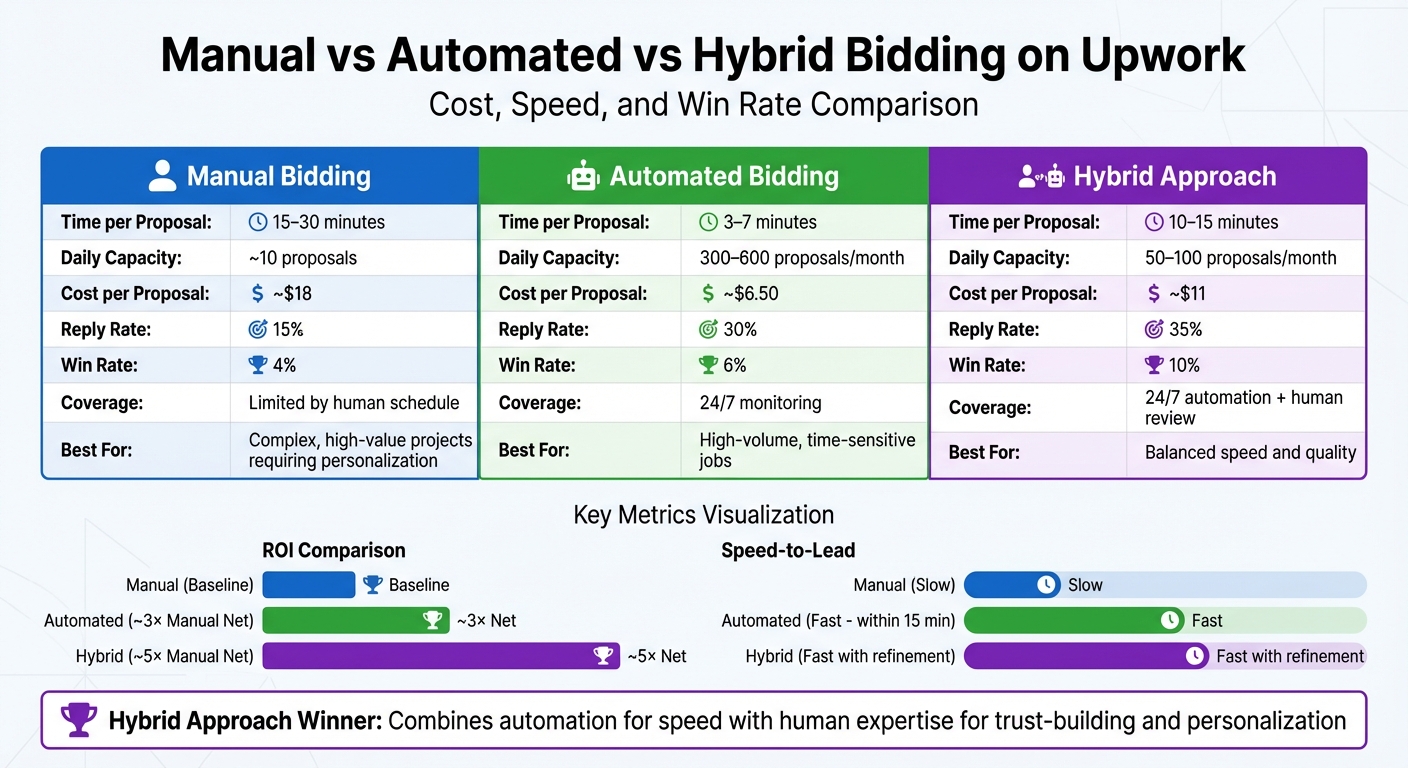
Manual vs Automated vs Hybrid Upwork Bidding: Cost, Speed and Win Rate Comparison
How I Made $500K On Upwork Using AI Automation (Step-By-Step)
sbb-itb-5c5517e
Cost Analysis: Manual vs Automated Bidding
Breaking down the true cost of manual and automated bidding goes beyond just subscription fees. You need to factor in labor hours, platform expenses, and the missed opportunities from delayed responses. Let’s dive into the direct costs and uncover where the real expenses lie.
Direct Costs: Manual Bidding
The biggest expense in manual bidding? Time. Crafting a single proposal takes about 20–35 minutes: 5–10 minutes to find and qualify the job, 10–20 minutes to write the proposal, and another 5 minutes for follow-up. At $10 per hour, that’s roughly $3.32 to $5.82 in labor costs per proposal.
Then there are Upwork’s platform fees. Each Connect costs $0.15, and standard jobs require 2–6 Connects. A freelancer sending 20 proposals weekly spends about $558 annually just on Connects. Add Upwork’s 12–13% service fee and withdrawal fees ($0.99 for international transfers, $2.00 for PayPal), and platform costs typically eat up 15–20% of gross earnings.
Manual bidding also hits a wall with throughput. Most people can’t sustain quality across more than 10 proposals a day. Fatigue sets in, leading to inconsistent results and lower win rates. You can track these metrics using a conversion rate analyzer to identify where your funnel is leaking. If you hire a lead-generation manager to handle this, expect to pay about $1,200 per month, not including tools and overhead.
Direct Costs: Automated Bidding with Convertix.io
Automated bidding shifts much of the workload to AI-powered lead automation technology. Convertix.io offers plans starting at $299 per month for 300 proposals (Starter plan), $599 per month for 600 proposals (Advanced plan), and custom pricing for unlimited proposals with the Bespoke plan. Automation reduces human involvement to just 3–7 minutes per proposal for a final review.
Let’s compare: If a virtual assistant (VA) earning $10/hour handles 300 proposals monthly at 25 minutes each, labor costs alone hit $1,250 – and that’s before adding Connects or platform fees. With Convertix.io’s Starter plan at $299, you cut direct labor costs by 76%, while also speeding up response times. For agencies managing 600+ proposals per month, the Advanced plan at $599 still saves significantly compared to the $2,500+ spent on manual labor for the same workload.
"If automation doesn’t cut human minutes per quality proposal by at least one-third or raise reply/shortlist materially, it’s overhead." – Vadym Ovcharenko, Founder, GigRadar
Hidden Costs: Manual vs Automated
One of the biggest losses with manual bidding comes from speed-to-lead. Many buyers choose a vendor within 30 minutes of posting a job. Manual bidders can’t monitor job feeds 24/7, which is crucial in time-sensitive categories like bug fixes, where responding within the first hour greatly improves reply rates.
Manual processes also lead to duplication and inefficiency. Think of team members reviewing the same job, inconsistent tracking in spreadsheets, and fatigue-driven mistakes that waste Connects on poorly targeted bids. These inefficiencies highlight the benefits of automation in capturing high-intent leads. For example, in 2025, DestiLabs replaced their manual Upwork bidding process with automated scanners and a Slack-to-CRM integration. This shift reduced their bidding time from 18 hours to just 18 minutes, saving 20 hours per week, cutting wasted Connects, and improving proposal relevance.
Automated systems can send tailored proposals within 15 minutes, increasing reply rates from 5–8% to 15–25%. The hidden cost of manual bidding isn’t just the time spent – it’s the revenue lost to competitors who respond faster and more effectively.
Speed Comparison: Manual vs Automated Bidding
Speed isn’t just a matter of convenience – it’s about seizing opportunities before they vanish. On Upwork, many clients shortlist candidates within the first hour of posting a job, especially for urgent tasks like bug fixes or migrations. If you’re not among the first few proposals, your chances of landing the job drop significantly.
Manual Bidding: A Slow and Tedious Process
Manual bidding takes time – lots of it. On average, you’ll spend 5–10 minutes finding and evaluating a job post, followed by another 10–20 minutes crafting a proposal. That’s 15–30 minutes per bid. Most freelancers hit a wall when trying to submit more than ten quality proposals a day.
And here’s the kicker: you can’t monitor job feeds 24/7. Opportunities that pop up late at night, during weekends, or outside your working hours often slip by unnoticed.
"Humans can’t watch feeds 24/7 or respond the instant a great post appears" – Vadym Ovcharenko, Founder, GigRadar
For time-sensitive jobs, even a short delay can drastically lower your odds of getting noticed. This is where automation steps in.
Automated Bidding: Lightning-Fast Job Matching with Convertix.io
Automated bidding changes the game entirely. Convertix.io continuously monitors Upwork around the clock, instantly alerting you when a high-priority job is posted. Its AI analyzes the job description, highlights the key points, and drafts a personalized opener (150–220 words) in seconds using an Upwork proposal generator. All you need is 3–7 minutes to review, tweak, and send the proposal.
This speed gives you a clear edge.
"For time-sensitive lanes (bug fixes, migrations, performance), being in the first hour with a precise plan noticeably lifts replies" – Vadym Ovcharenko
Convertix.io’s plans are built for efficiency. The Starter plan supports up to 300 proposals per month, while the Advanced plan scales to 600. With instant alerts for top-tier "P1" jobs and daily digests for secondary "P2" opportunities, you can respond quickly without compromising quality. Manual bidding just can’t compete with this level of speed and precision.
Win Rate Analysis: How Bidding Methods Affect Results
Win rate is the ultimate measure of success – after all, quick or low-cost bids mean little if they don’t lead to actual conversions. Data from Summer 2024 highlights a clear trend: AI-generated proposals outperformed manual ones in terms of close rates. But the story isn’t as simple as “automation always wins.” Let’s dive into how AI vs manual proposal writing stack up in this essential area.
Manual Bidding: Personal Touch, Limited Reach
Manual bidding shines when it comes to interpreting ambiguous requests and aligning with a client’s specific tone. Human bidders excel at identifying potential issues that AI might miss – like recognizing when a project with a $4,750 scope is paired with an unrealistic $2,500 budget. In these cases, a skilled bidder can propose phased solutions or suggest starting with a discovery phase to establish trust.
That said, manual bidding has its drawbacks. Its biggest limitation is scalability, making it less effective in high-volume areas like web development or bug fixes. While manual efforts can yield strong results for consultative projects – such as strategy, branding, or intricate data work – it often becomes a bottleneck when trying to handle a larger workload.
This is where automated bidding steps in to address scalability challenges with data-driven precision.
Automated Bidding: Speed Meets Smart Proposals
Automated bidding revolutionizes the process by delivering both speed and accuracy. Tools like Convertix.io create customized 150–220-word proposal openers, referencing your portfolio to highlight key project details. The numbers tell the story: AI-generated proposals required an average of 226.99 connects per reply, compared to 308.90 for manual bids – a roughly 27% improvement in efficiency. Similarly, AI proposals used just 99.20 connects per view, while manual bids needed 191.75.
Quick, accurate responses are a game-changer for conversion rates. With 24/7 monitoring, platforms like Convertix.io ensure you’re always ready to respond during critical moments.
The real magic lies in a hybrid approach. Automation can handle the heavy lifting of discovery and drafting, while you focus on refining the fit, pricing, and milestones. As Vadym Ovcharenko puts it:
"The winner across most lanes is human-in-the-loop. Think of tools as power steering, not autopilot."
In short, while manual bidding emphasizes personalization, automation combines speed and efficiency to drive better win rates overall.
Side-by-Side Comparison: Cost, Speed, and Win Rate
Let’s break down the differences between manual and automated bidding. Manual bidding can be time-consuming, requiring significantly more effort per proposal. This puts you at a disadvantage when competing with automated systems that can respond almost instantly while remaining compliant with AI proposal tools vs. Upwork policies.
With Convertix.io, automated bidding slashes the time spent on each proposal. The platform uses real-time alerts to identify jobs and creates tailored drafts based on your portfolio. This level of AI personalization boosts ROI by ensuring every pitch resonates with the client’s specific needs. Your team only needs 3–7 minutes to review and adjust the proposal before sending it off. This dramatically reduces the workload compared to manual methods.
The costs also vary greatly. Manual bidding typically involves paying a virtual assistant $5–$12 per hour, along with the cost of Upwork Connects. If you’re submitting 10 or more proposals daily, those expenses can add up fast. Convertix.io, on the other hand, offers a subscription-based model: the Starter plan costs $299/month for 300 proposals, and the Advanced plan is $599/month for 600 proposals.
Win rates are another area where automation shines. For time-sensitive projects like bug fixes or migrations, being among the first five proposals significantly increases your chances of being shortlisted. Manual bidders often miss this critical window due to human limitations like sleep and time zones. Convertix.io operates 24/7, ensuring your proposals are submitted during the prime engagement period – typically within the first hour.
Here’s a quick summary of the differences:
Comparison Table
| Metric | Manual Bidding | Automated Bidding (Convertix.io) |
|---|---|---|
| Time to Find/Qualify | 5–10 minutes | Near-instant (real-time alerts) |
| Time to Draft/Send | 10–20 minutes | 3–7 minutes (human review) |
| Total Time per Proposal | 15–30 minutes | 3–7 minutes |
| Cost Structure | $5–$12/hour (VA) + Connects | $299–$599/month (subscription) |
| Daily Volume Capacity | ~10 proposals (before fatigue) | 300–600 proposals/month (scalable) |
| Coverage Window | Limited by human schedule | 24/7 operation |
| Consistency | Variable (fatigue-dependent) | High (AI-driven templates) |
| Speed-to-Lead | Slow (manual monitoring) | Fast (instant alerts) |
This comparison highlights the advantages of automated bidding in terms of speed, cost-efficiency, and reliability, setting the stage for hybrid strategies that combine the best of both approaches.
Hybrid Bidding: Combining Manual and Automated Methods
Many successful agencies now use a mix of manual and automated bidding. This hybrid approach taps into the speed and efficiency of automation while keeping the human insight necessary for building trust and making nuanced decisions. The trick is knowing when to use each method.
By weighing factors like cost, speed, and win rates, the hybrid model stands out as a strategy that draws on the best of both worlds. For example, tools like Convertix.io handle tasks like round-the-clock job screening and draft creation. Meanwhile, your team focuses on refining proposals, setting pricing, and managing negotiations. This division of labor significantly reduces the time spent on manual reviews.
In 2025, five accounting agencies using a hybrid bidding model secured $2.5 million in contracts and saw a 150% increase in their Lead Response Rate. Another agency specializing in AI automation achieved an impressive 8.6× ROI on Upwork by automating discovery tasks while relying on human judgment for critical decisions.
By combining the strengths of manual and automated bidding, this strategy optimizes performance across the board.
When to Use Manual Bidding
Manual bidding is best for projects that demand trust and precise attention to detail. For instance, enterprise-level RFPs often require coordination with multiple stakeholders and custom-tailored proposals – tasks that automation simply can’t handle effectively. The same goes for sensitive industries like healthcare, finance, or projects involving regulated data, where human oversight ensures compliance and builds client confidence.
Creative projects that are brand-critical also benefit from manual bidding. When tone, messaging, or specific cultural nuances are at play, often requiring AI tone matching to ensure consistency, a human touch is invaluable. Similarly, high-value strategy audits require a depth of understanding that goes beyond what templates can provide.
When to Use Automated Bidding
Automation excels in situations where speed is the priority. For example, in time-sensitive projects like bug fixes or system migrations, being one of the first 5–10 bidders can significantly boost your chances of landing an interview. With tools like Convertix.io, proposals can be submitted in ~10 minutes, compared to the 1–2 hours it typically takes for manual submissions.
This approach is also ideal for maintenance retainers and repetitive, small-scale projects. These types of jobs often follow predictable patterns, making them perfect for maximizing revenue with AI-powered proposals that your team can quickly review and send out. Plus, with 24/7 automation, you won’t miss opportunities due to time zone differences. To streamline the process, prioritize urgent "P1" jobs for immediate automated responses and save "P2" jobs for manual review.
ROI Calculation for Different Bidding Strategies
ROI is a key metric that helps balance cost, speed, and efficiency in bidding processes. It provides a clear way to evaluate investment decisions. The formula is simple:
(Revenue per proposal – Cost per proposal) ÷ Cost per proposal × 100.
However, the real value emerges when you account for hidden expenses, like missed leads caused by slow responses or the costs of training new virtual assistants (VAs) for bidding tasks.
To predict returns, you can use the Expected Value (EV) formula:
Reply Rate × Shortlist Rate × Win Rate × Average Deal Value.
Subtracting the Cost per Proposal from this figure gives you the net profit. This method helps identify which bidding strategy yields the best measurable outcomes. You can further refine these results by A/B testing proposals to see which messaging converts best. It also lays the groundwork for comparing different approaches.
"Measuring ROI drives improvements. Once you know your real proposal cost and ROI by bidder type, your scaling decisions stop being guesswork and start being strategic." – Vadym Ovcharenko
When calculating input costs, consider factors like Connects (costing $0.15 each), labor, software subscriptions, and managerial oversight. For manual bidding, keep in mind that preparing a single proposal takes 20–35 minutes, including job discovery, drafting, and follow-up. At a labor rate of $30 per hour, this translates to a cost of $10 to $17.50 per proposal.
A hybrid approach, which combines the strengths of manual and automated methods, can significantly improve ROI. Agencies using hybrid systems report ROI gains of up to 8.6×, primarily by cutting review times from 25–35 minutes to just 3–7 minutes. It’s essential to track both direct spending and lost opportunities to fully understand the impact.
The table below compares ROI metrics across Manual, Automated, and Hybrid bidding strategies:
ROI Worksheet Table
| Strategy | Cost per Proposal (CPP) | Reply Rate (RR) | Win Rate (WR) | Expected Profit (per 100 bids) |
|---|---|---|---|---|
| Manual | ~$18.00 (30m @ $30/hr + Connects) | 15% | 4% | Baseline |
| Automated (Convertix.io) | ~$6.50 (5m @ $30/hr + Tool + Connects) | 30% | 6% | ~3× Manual Net |
| Hybrid | ~$11.00 (15m @ $30/hr + Tool + Connects) | 35% | 10% | ~5× Manual Net |
Note: These estimates are based on a labor rate of $30/hr and an average deal value of $1,000.
This comparison highlights how streamlining processes with automated or hybrid strategies can lead to better returns while reducing time and effort.
How to Set Up Automated Bidding with Convertix.io
Account Configuration
You can get started in as little as 1–3 days – no need to wait weeks. First, integrate a Convertix.io business manager into your Upwork agency account. Unlike traditional API calls, Convertix.io uses authentic browser sessions and verified accounts, which helps minimize the risk of account suspension. Set up job filters based on keywords, job categories, and budget ranges that align with your agency’s expertise. For even more precision, create separate title and description inputs using AND/OR conditions. Additionally, provide an AI prompt that outlines the technologies and skills you want to prioritize – or avoid. This setup ensures that Convertix.io delivers accurate, real-time job matches right from the start.
Customizing Proposal Templates
Once your account is ready, focus on crafting proposal templates that stand out. Many agencies struggle with Upwork proposals because they rely on generic templates rather than personalized pitches. Upload your portfolio to allow the AI to select the most relevant projects for each bid. Customize your cover letter prompts to emphasize critical details, such as project titles, URLs, and tech stacks. For screening questions, you can either set default answers or configure instant Slack/Telegram alerts to provide manual responses when needed.
Tracking Performance Metrics
The Convertix.io dashboard gives you real-time insights into view, reply, and hire rates across job streams, templates, and business managers. On average, you can expect a 25–30% view rate and a 5–15% reply rate, offering plenty of data to A/B test your templates and improve your results. These performance metrics are key to refining your bidding strategy and boosting your ROI.
"Convertix reduced our proposal workflow from 15 hours to about 3–5 hours per week and made scaling our Upwork outreach much easier." – Zoha, Co-Founder, Skip The Noise Media
With real-time metrics, you can make quick adjustments to your strategy, ensuring ongoing improvements. The platform also offers a 14-day free trial, so you can test it before committing. Pricing starts at $299/month for the Starter plan (300 proposals), $599/month for the Advanced plan (600 proposals), and $799/month for the Pro plan (800 proposals).
Conclusion: Choosing the Right Bidding Strategy
Success in bidding isn’t about choosing between manual and automated approaches – it’s about creating a system where automation and human expertise work together seamlessly. Automation can handle repetitive tasks like discovery and drafting, while humans focus on the nuanced elements: building trust, pricing strategically, and qualifying leads effectively.
"The debate around manual vs automated Upwork bidding misses the point. Winning agencies don’t pick a side – they design a human-in-the-loop system where automation scouts and drafts, a VA enforces process, and a closer shapes value and tone." – Vadym Ovcharenko, GigRadar
The best approach depends on your specific challenges. If you’re overwhelmed by irrelevant leads or missing out on time-sensitive jobs, automation provides 24/7 monitoring and instant alerts for high-priority opportunities. On the other hand, if your proposals lack a personal touch and you’re losing deals, human expertise becomes critical for crafting tailored solutions, setting clear milestones, and refining pricing strategies. For most agencies, a hybrid model works best – letting AI handle initial scans and drafts while experienced team members fine-tune the details and build client trust.
Different industries require different balances. For example:
- Web development and mobile projects: A hybrid approach shines, with automation identifying issues quickly while humans assess scope and risks.
- Data and AI projects: These lanes demand more human oversight due to the complexity of framing and calibration.
- SEO and content creation: Automation helps reduce noise, but human input is critical for strategic adjustments.
To evaluate the impact of your strategy, use this formula: Reply Rate × Shortlist Rate × Win Rate × Average Deal Value. For instance, if automation costs $299 per month and doubles your shortlist rate on $2,500 projects, the return on investment becomes evident. In one case from 2025, an agency achieved an 8.6× ROI on Upwork by combining automated discovery with human-led final proposal reviews.
If you’re ready to test this hybrid approach, start small with a 10-day pilot. Here’s how:
- Map out your service lanes.
- Create a library of reusable snippets.
- Set up automated alerts, including negative keyword filters.
- Assign AI to draft responses, then have a senior team member refine them.
- Once the process feels smooth, bring in a virtual assistant (VA) to handle triage.
"Let AI earn you time; let humans earn you trust." – Vadym Ovcharenko
FAQs
When should I choose manual bidding instead of automation?
When using Upwork, manual bidding is your go-to strategy for situations that demand a personal touch. For instance, if you’re working with vague project briefs or tackling high-stakes opportunities, crafting tailored proposals can make all the difference. This approach shines when you need to build rapport with clients, negotiate terms, or assess risks with care. While automated bidding is faster, manual bidding allows you to focus on customization and connection – perfect for pursuing complex or high-value projects.
How many proposals do I need per month for automation to pay off?
When deciding if automation is worth the investment, two key factors come into play: your costs and your win rate. Typically, automation starts making sense when you’re dealing with a large volume of proposals. For instance, tools like Convertix.io are designed to handle hundreds of proposals each month, helping agencies manage heavy workloads more efficiently and boosting their return on investment (ROI).
How do I prevent automated proposals from sounding generic?
To make your proposals stand out, blend automation with a human touch. Leverage tools to scan job posts and draft initial proposals, but always take the time to personalize them. Add specific details from the job description to show genuine interest and understanding. Prioritize relevance, maintain a professional yet approachable tone, and ensure your message feels authentic. Keep proposals short and to the point – clients appreciate clarity and efficiency. Avoid sending out generic, mass submissions, and instead, focus on quality over quantity. Finally, track metrics like response rates to refine your approach and improve results over time. Personal effort goes a long way in making your proposals resonate with clients.
