
Want to win more proposals on Upwork? Start using client data.
Freelancers often miss opportunities by sending generic pitches that fail to resonate with clients. But analyzing client data – like hire rates, feedback history, and job post details – can help you write winning proposals that stand out.
Here’s what works:
- Personalization: Address the client by name and restate their problem in your opening lines.
- Timely Submissions: Proposals sent within 60–90 minutes of a job posting perform better.
- Data Insights: Use tools like Upwork’s Proposal Insights to track metrics like response rates and average bid amounts.
- Tailored Solutions: Focus on the client’s pain points and offer specific, actionable solutions.
Collecting and Analyzing Client Engagement Data
Key Data Points to Collect
To create a truly data-driven proposal strategy, start by gathering essential details from every job post and client interaction. Focus on logging specifics like job keywords, budget type, proposed rates, timelines, and client location. These elements help you tailor your proposals to match what the client is looking for.
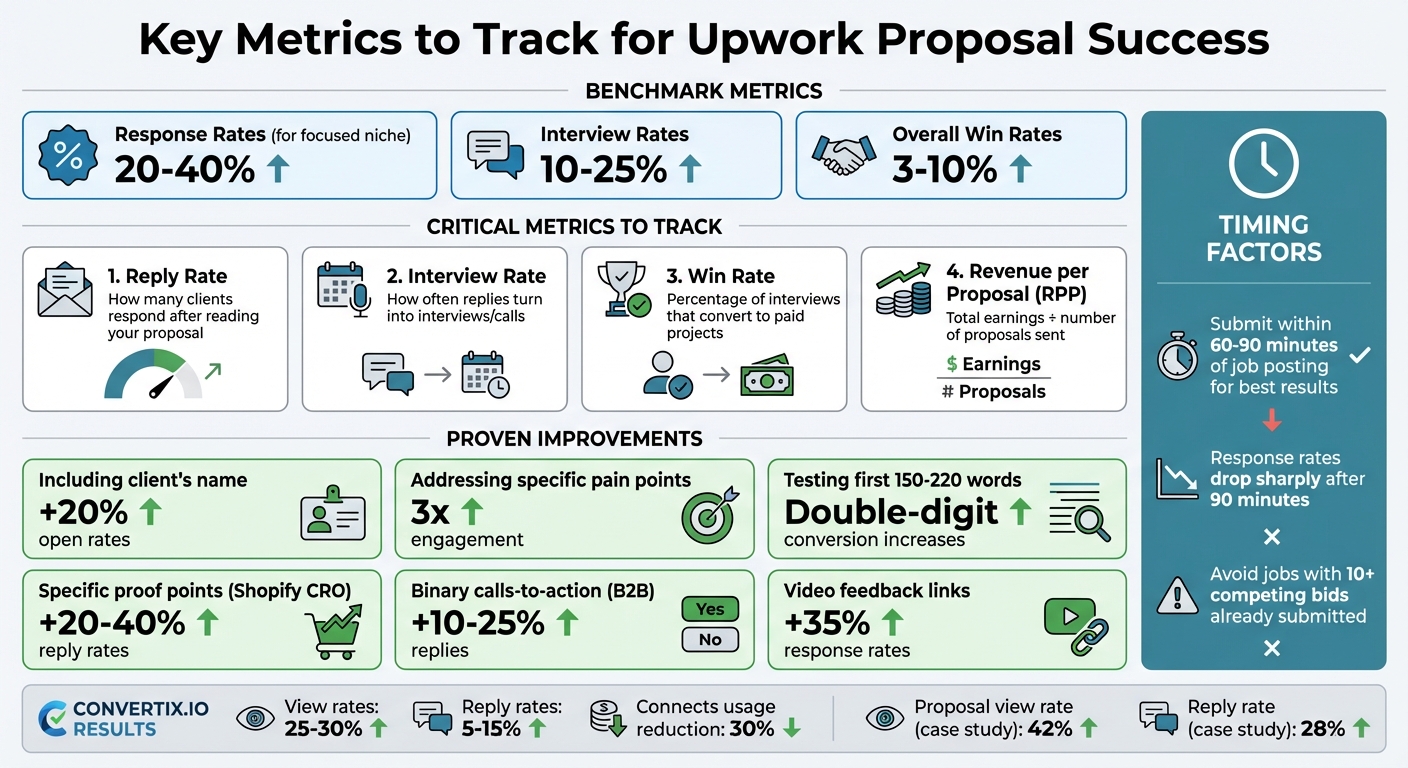
But don’t stop with job post details – dive into proposal funnel metrics to pinpoint where potential clients lose interest. Track how proposals progress from being sent to being viewed, responded to, leading to interviews, and finally resulting in hires. Key metrics like "Time to First Response" (how quickly a client replies after submission) and the number of competing proposals already submitted when you place your bid are invaluable. Research indicates that response rates drop sharply if a proposal is submitted more than 60–90 minutes after the job is posted or if there are already over 10 competing bids.
For a broader perspective, calculate Revenue per Proposal (RPP) by dividing your total earnings by the number of proposals sent or measure proposal conversion rates. This metric helps identify which client types and projects are most profitable. Generally, a focused niche will yield response rates between 20% and 40%, interview rates between 10% and 25%, and overall win rates averaging 3% to 10%. These insights allow you to refine your proposals to better meet client needs and expectations.
Using Upwork‘s Project Insights and Historical Metrics
Once you’ve gathered the data, leverage Upwork’s built-in tools to sharpen your analysis. If you subscribe to Freelancer Plus, the Proposal Insights feature offers hourly updates that show how your bid stacks up against others. It reveals the total number of submissions and tracks client actions like opening, shortlisting, or messaging your proposal. One particularly helpful insight is the average bid amount that prompted a client response, which can uncover budget flexibility beyond the posted job description.
The "Stats and Trends" dashboard is another essential tool. It tracks profile views, client invitations, and whether your proposals were opened. Updates occur within 24 hours, giving you timely feedback on your strategy. Additionally, the Job Success Score (JSS) insights provide a breakdown of how short-term versus long-term contracts affect your score over 6-, 12-, and 24-month periods. This historical data helps you spot trends in client satisfaction and address performance gaps before they hurt your reputation. Together, these tools and metrics allow you to craft proposals that align more closely with client expectations and improve your overall success rate.
"A high JSS can help you stand out in the Upwork marketplace, helping you spend less time finding clients and more time working with them." – Upwork Help
sbb-itb-5c5517e
Identifying Client Needs and Writing Tailored Proposals
Finding Patterns in Client Behavior
Once you’ve collected data, the next step is spotting patterns that reveal what clients truly need. Start by analyzing job descriptions for recurring issues. For example, if a client frequently mentions "slow load times" or "missed deadlines", those are likely their main challenges. Similarly, reviewing their spending history can help you understand their budget preferences and calculate your bid accordingly. A client accustomed to paying $75/hour might not take a $25/hour bid seriously.
Another key indicator is their hire rate. Clients with a high hire rate tend to know exactly what they want and move quickly, while those with a low hire rate may still be exploring their options. Feedback they’ve left for other freelancers is also a goldmine of information. If their reviews highlight things like "fast communication" or "attention to detail", you know what to emphasize in your proposal. Identifying these patterns helps you build a proposal that feels tailored and relevant.
Personalizing Your Proposals with Data
Use these insights to craft a proposal that speaks directly to the client. The first two sentences are critical – they’re what clients see in Upwork’s search results before opening your full proposal. Start by restating their main issue in your own words to show you’ve carefully read their job post. For instance: "Hi [Name], I noticed your e-commerce site’s checkout process is leading to cart abandonment issues" is far more engaging than a generic "I’m interested in your project."
Including the client’s name can increase open rates by 20%, and addressing their specific pain points can triple engagement. To find their name, check feedback from freelancers they’ve hired before – names are often mentioned there. Once you have their attention, use bullet points to outline a clear, actionable solution. Focus on how your work aligns with their business goals. For example, instead of saying, "I’ll redesign your website", explain, "I’ll redesign your homepage to reduce bounce rates and boost lead conversions by 25%." This approach demonstrates your commitment to their success, making your proposal stand out.
Using Portfolio-Based Insights with Convertix.io
How Convertix.io Automates Proposal Generation
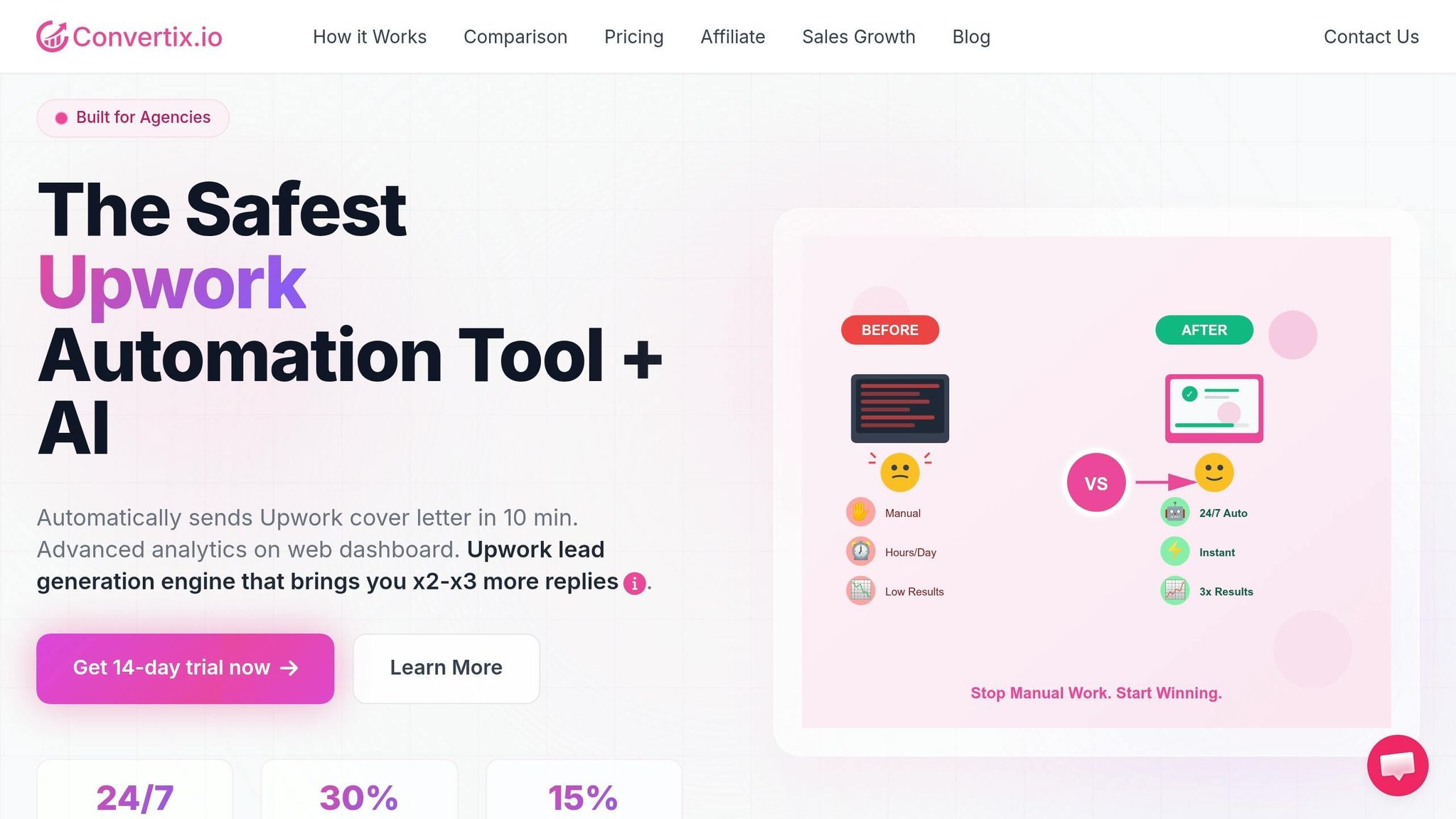
Convertix.io simplifies the process of creating proposals by using your portfolio to craft tailored bids for Upwork jobs. Instead of starting from scratch, its AI reviews your past projects and selects the most relevant examples to match the job requirements. For instance, if a client is looking for an e-commerce redesign, the tool will identify and showcase a case study that demonstrates your expertise in that area.
The AI doesn’t just pick a project – it explains why it fits the client’s needs. Say a job mentions "mobile-first design"; Convertix.io might highlight a previous project where you delivered a responsive site that boosted mobile traffic by 35%. It even includes details like the project title, URL, and tech stack to provide a complete picture. This approach mimics the personalized strategies top freelancers use, but it works on a much larger scale. One software development agency in India saw a 42% proposal view rate and a 28% reply rate within just two days of using the tool on a new profile. Plus, Convertix.io can apply to jobs within about 10 minutes of posting, giving your proposals an edge in timing.
You can also control which portfolio details the AI emphasizes. Whether it’s ROI for marketing projects or specific technologies for development work, you can ensure every proposal feels uniquely suited to the client’s needs.
Beyond just automating proposals, Convertix.io also helps you refine your strategy with detailed performance tracking.
Tracking Proposal Performance with Analytics
The Convertix.io dashboard offers insights into crucial metrics like view rates, reply rates, and hire rates across job types, cover letter templates, and even individual team members. These analytics allow you to fine-tune your approach. For example, including video feedback links has been shown to increase response rates by 35%, giving you a clear direction for improving future proposals.
Typical results include view rates of 25–30% and reply rates between 5–15%. By tracking which portfolio elements resonate most with clients, you can adjust your messaging to improve engagement over time. Zoha, Co-Founder of Skip The Noise Media, shared her experience:
"Convertix reduced our proposal workflow from 15 hours to about 3–5 hours per week and made scaling our Upwork outreach much easier".
Additionally, Convertix.io helps optimize your resources by cutting Upwork connects usage by 30%, ensuring you focus on the most promising opportunities.
I sent 3,255 Upwork Proposals (Here’s how to get clients)
Measuring and Improving Proposal Success
Upwork Proposal Success Metrics and Benchmarks for Freelancers
Key Metrics to Track
Tracking the right metrics is essential to understanding how well your proposals are performing. Start with three main ones:
- Reply Rate: This measures how many clients respond after reading your proposal.
- Interview Rate: This tracks how often replies turn into interviews or calls.
- Win Rate: This shows the percentage of interviews that convert into paid projects.
Another useful metric is Revenue per Proposal (RPP) – your total earnings divided by the number of proposals sent. While not as critical as the others, it gives you a solid financial perspective.
To dig deeper, segment your data by categories like niche, budget tier, and the age of the job post. Each of these factors can affect performance. Also, pay attention to time-to-reply – a shorter median response time often signals that your proposals are hitting the mark.
Use these metrics to spot patterns and pinpoint areas where your proposals could be improved.
Improving Proposals Based on Data Insights
Once you’ve gathered data, use it to fine-tune your proposals. Testing is key here. For example, changing the first 150–220 words of your proposal can lead to significant improvements – sometimes even double-digit increases in conversion rates. To get reliable results, test with 30–50 proposals per variant or over a two-week period. If you see a difference of 10 percentage points or more in reply rates (with at least 20 sends per variant), you’ve likely found a winner.
A four-week testing cycle can help you systematically improve different elements of your proposals. For example:
- Week 1: Focus on your opening lines and proposal tones.
- Week 2: Experiment with calls-to-action.
- Week 3: Test different proof formats.
- Week 4: Refine how you phrase milestones.
In Shopify CRO niches, including specific proof points – like a "before and after" of a mobile LCP – can increase reply rates by 20–40%. Similarly, binary calls-to-action (offering two clear options) can boost replies by 10–25% in B2B categories. Keep track of what works by saving successful elements in a "Best Practices" document to avoid repeating ineffective strategies. You can also use an Upwork proposal generator to quickly apply these proven elements to new bids.
When testing, run variants A and B simultaneously to account for changing market conditions. Assign variants fairly – using something like odd/even job IDs – to ensure unbiased results. The goal isn’t perfection but finding repeatable wins that consistently improve your outcomes.
Conclusion
Turning client data into actionable insights transforms proposal writing into a more deliberate and effective process. By analyzing engagement metrics, reviewing client history, and understanding behavioral patterns, you can craft proposals that align with specific client needs. In fact, proposals that address targeted pain points see three times the engagement compared to generic ones – a testament to the power of a data-driven approach.
Pay attention to key metrics like reply rates, interview rates, and win rates. These provide valuable feedback on what’s working and what isn’t. Small adjustments, such as personalizing your opening line or experimenting with presentation styles, can make a noticeable difference. For instance, including a client’s name in your proposal can increase open rates by 20%. These small but meaningful changes often lead to more interviews and, ultimately, more paid projects.
Platforms like Convertix.io simplify this process for Upwork agencies. By automating job matching and generating tailored proposals based on portfolio insights, this tool removes the need for manual submissions. Its performance tracking feature helps identify which strategies deliver the best results, allowing you to refine your approach without relying solely on trial and error. This kind of automation embodies the systematic, data-driven methodology discussed in this guide.
To put these strategies into action, start with your next five proposals. Track their performance – note which ones generate responses and analyze the reasons behind their success. Experiment with personalized openings that directly address the client’s primary challenge. Review your metrics weekly and adjust your approach based on the patterns you observe. This iterative process allows you to develop a reliable and repeatable strategy for winning projects on Upwork.
FAQs
What client data should I check before sending a proposal?
Before submitting a proposal, take a moment to examine the client’s communication style, tone, and profile details. By doing this, you can craft a proposal that feels personalized, aligns with their preferences, and boosts your chances of making a strong impression.
How can I improve my reply rate without lowering my price?
If you’re looking to get more responses without lowering your rates, the key lies in creating personalized and relevant proposals. Tailor your responses to each client by using their engagement data and addressing their specific needs or challenges. This approach makes your proposal feel more thoughtful and aligned with their goals.
AI tools can be a game-changer here. These tools can quickly analyze job descriptions and help you create customized proposals that are both efficient and high-quality. By blending personalization with speed, you can grab the client’s attention and make your pitch more compelling.
The result? You stand out from the competition and boost your response rate – all while keeping your pricing intact.
Which metrics matter most to track proposal performance over time?
The key metrics to keep an eye on for tracking the performance of your proposals are response rate, interview rate, and win rate. These numbers reveal how effectively your proposals capture client interest and lead to opportunities. By working to improve these areas, you can boost your overall success.
