
Scaling outreach with automation helps businesses save time, improve efficiency, and increase client engagement. Here’s what you need to know:
- Comparing manual vs. automated outreach shows that automation boosts productivity: Sales teams using AI tools report up to 83% revenue growth, compared to 66% for those who don’t.
- Personalization matters: 71% of customers prefer tailored experiences, and AI can craft messages using data like job titles and company growth.
- Set clear goals: Define measurable targets, such as increasing qualified leads by 40% or reducing manual tasks by 60%.
- Track performance: Use KPIs like response rates, conversion rates, and cost per acquisition to measure success.
- Choose the right tools: Look for features like AI-driven personalization, real-time analytics, and CRM integration.
- Refine strategies: Regularly analyze data, test templates, and gather feedback to improve outreach quality.
Set Clear Outreach Goals
To make the most of automation in your outreach efforts, it’s crucial to set clear, measurable goals. Without defined objectives, even the most advanced automation tools can feel like guesswork. Goals act as a compass, steering your outreach strategy and giving you a way to measure progress effectively.
Successful agencies don’t just automate for the sake of it – they automate with purpose. Whether your aim is to double your client base, boost revenue by a specific percentage with AI-powered proposals, or cut down the time spent on manual tasks like proposal writing, your outreach goals should guide every decision about automation. Once you have these broad objectives, the next step is to break them down into measurable, actionable targets.
Create Measurable Targets
For outreach goals to be effective, they need to be specific and trackable. Replace vague aspirations with concrete targets. For example, instead of saying “get more leads”, aim to increase qualified leads by 40% within the next quarter. Or, rather than just wanting to save time, set a goal to reduce the time spent on proposals from two hours to 30 minutes.
Start by looking at your current performance. If you’re sending 20 proposals a week with a 15% response rate, a realistic goal might be to scale up to 50 proposals per week while maintaining – or better yet, improving – that response rate. This ensures you’re not sacrificing quality for volume.
Tie your revenue goals directly to outreach. For instance, determine how many new clients you need to meet your financial targets and backtrack to figure out the outreach volume required. Efficiency goals are just as important – targets like automating 80% of follow-ups or cutting manual tasks by 60% can free up your team for more strategic work, like nurturing client relationships.
Another key target might be to achieve a 25% proposal acceptance rate while keeping personalization scores above 85%. This ensures that automation doesn’t dilute the quality of your outreach, keeping it as engaging and effective as possible.
Choose Key Performance Indicators (KPIs)
Once you’ve set your goals and targets, the next step is to pick the right KPIs to track your progress. KPIs turn your goals into tangible metrics, providing a clear picture of how well your automation strategy is working.
- Response rates are a top priority. They show how well your messages resonate with prospects. A healthy response rate for targeted campaigns typically falls between 15% and 25%.
- Proposal volume is another critical metric. Track how many proposals you’re sending and whether you’re hitting your weekly targets consistently. Any major dips or spikes could point to underlying process issues.
- Conversion rates – from initial contact to signed contracts – are the ultimate measure of success. The goal is to ensure that increased outreach volume translates into actual business growth, not just more activity.
- Time-to-response is especially important when automation handles follow-ups. Faster responses often lead to higher engagement and conversion rates, so track how quickly your system replies to inquiries.
- Cost per acquisition (CPA) helps you gauge the financial efficiency of your efforts. Calculate the total cost of your automation tools, team time, and other resources, then divide that by the number of new clients acquired. This ensures your scaling efforts are profitable.
- Pipeline velocity measures how quickly prospects move through your sales process. A solid automation system should speed this up with timely follow-ups and consistent communication.
- Engagement quality scores track how well your messages are connecting. Metrics like email open rates, click-through rates, and the depth of interactions with your content provide insight into whether your outreach feels personal and meaningful.
Review these KPIs weekly and adjust your strategy monthly. Regular tracking helps you catch trends early, so you can fine-tune your approach before small issues turn into big problems. By keeping an eye on these metrics, you ensure that your automation efforts stay aligned with your business goals and deliver measurable results.
Choose and Set Up Automation Tools
Once you’ve established clear outreach goals, the next step is selecting the right automation tool. Picking the wrong one can lead to wasted time, poor results, and frustrated teams. On the flip side, the right tool becomes the backbone of your growth strategy, taking care of repetitive tasks while maintaining the personal touch that wins over clients.
Start by identifying bottlenecks in your current workflow. Many agencies struggle with finding relevant opportunities, creating personalized proposals, and tracking performance across multiple campaigns. Look for a tool that addresses these challenges and integrates smoothly with the systems you already use.
Security should also be a top priority, especially when working on platforms like Upwork. Choose tools that comply with platform rules and protect your agency’s reputation by avoiding risky practices like sharing sensitive login information.
Next, focus on the features your automation tool should have to meet your needs.
Review Automation Features
A good automation tool should check several key boxes: AI-driven personalization, real-time analytics, and seamless integration. For example, tools with advanced job-matching algorithms can analyze context – not just keywords – to identify opportunities that align with your expertise. Instead of relying on generic templates, these tools can highlight relevant examples from your portfolio, showing clients exactly why you’re the right fit.
Proposal generation should go beyond basic templates. The tool should adapt proposals to each client’s specific needs by incorporating elements from your most successful pitches.
Performance tracking is another must-have. Real-time insights into how your outreach is performing – like which proposals get the best responses, when engagement peaks, and which portfolio pieces resonate most – can help you fine-tune your strategy.
Integration capabilities are also critical. The tool should work seamlessly with your project management, CRM, and communication platforms to avoid disrupting your workflow.
Build Workflows for Target Clients
Tailor workflows based on client segments such as project size, industry, or complexity. For example, workflows for enterprise clients might emphasize your agency’s stability and ability to build long-term partnerships. Meanwhile, workflows for startups could focus on agility, cost-efficiency, and fast delivery.
Portfolio-based workflows are especially effective. Set up rules to automatically match specific project types with relevant portfolio examples. This ensures that prospects see examples that align with their needs, making your proposals far more compelling.
Timing is also crucial. Automate proposal submissions to align with peak client activity. Research shows that proposals sent shortly after a job posting are more likely to succeed, so balancing speed with quality is key.
Finally, integrate personalization triggers throughout your workflow. Customize greetings, pricing, and technical details based on client data to make each interaction feel tailored.
Now, let’s look at how Convertix.io can help you implement these workflows effortlessly.
Use Convertix.io for Streamlined Automation
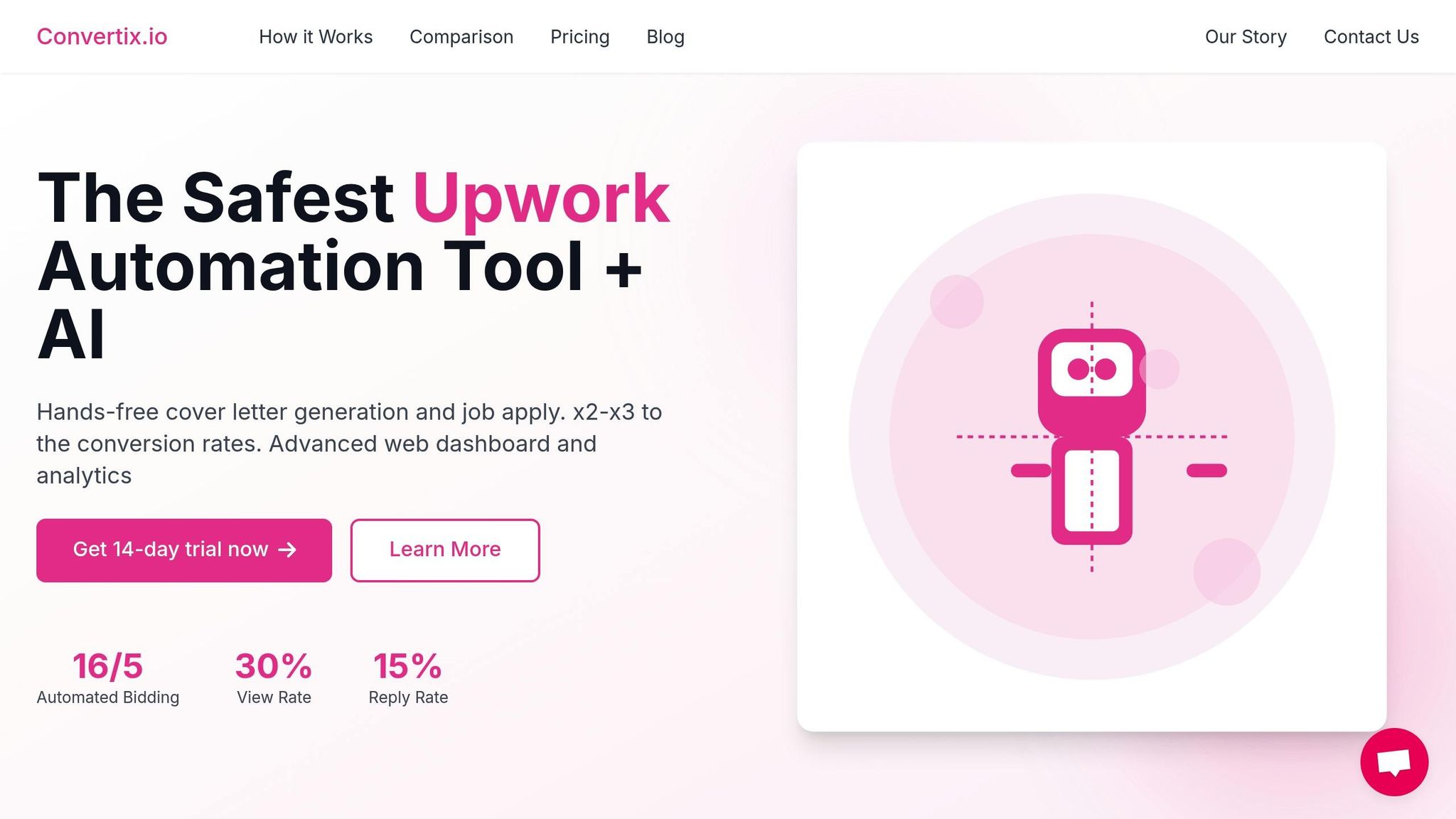
Convertix.io simplifies automation for Upwork agencies by using AI-driven job matching to find opportunities that align with your agency’s strengths. Instead of wasting time on irrelevant prospects, you can focus your outreach on clients who are a perfect fit.
Its portfolio-centric approach goes beyond generic proposals. By analyzing your most successful projects, Convertix.io crafts proposals that showcase your expertise in a way that directly appeals to potential clients. This personalized approach can significantly increase your chances of success.
The platform also offers robust performance tracking, giving you detailed analytics to refine your outreach strategy over time. Convertix.io provides three pricing tiers designed to meet the needs of agencies at different stages:
- Starter plan: $299 per month for 300 proposals, including advanced portfolio matching. Ideal for smaller agencies just starting to scale.
- Advanced plan: $599 per month for 600 proposals, with custom portfolio optimization for growing agencies.
- Bespoke plan: Custom pricing for unlimited proposals and dedicated account management, perfect for larger agencies.
Convertix.io is built for seamless integration, working with your existing tools while adhering to Upwork’s guidelines. With 24/7 operation and customizable job preferences, you can fine-tune the types of opportunities you pursue, ensuring your outreach aligns with your agency’s strengths and goals.
Improve Proposal Generation and Personalization
Creating better proposals through tailored content is essential for scaling outreach while maintaining a personal touch. Winning clients often hinges on personalization – generic templates might save time but rarely close deals. The key is to develop a system that combines automation with a personal feel, ensuring your proposals adapt to each opportunity and highlight the most relevant examples from your portfolio.
When done right, this approach shifts outreach from impersonal mass messaging to targeted, meaningful conversations that resonate with potential clients.
Build Portfolio-Based Templates
Your portfolio isn’t just a showcase of past projects – it’s a powerful sales tool. In fact, freelancers with a portfolio are hired nine times more often than those without one. This statistic underscores why portfolio-based templates are crucial for scaling outreach effectively.
Start by curating a robust portfolio that tells your professional story. Include projects that demonstrate your range and expertise. Whenever possible, add measurable results, like, “My landing page redesign increased webinar signups by 438%”. These specific achievements provide concrete proof of your capabilities.
Each portfolio entry should clearly outline your role, the problem you addressed, the skills you applied, and the results you achieved. This not only highlights your expertise but also gives your automation tools the data needed to match the right examples to specific client needs.
Design templates that automatically pull relevant portfolio examples based on job requirements. Incorporate placeholders for dynamic content, such as the client’s name, project details, tailored portfolio links, and customized pricing. At the same time, ensure the core messaging aligns with your agency’s voice and value proposition. Directly link specific portfolio items in your proposals rather than sending clients to browse your entire portfolio. This targeted approach builds trust by showing exactly why you’re the right fit for the project.
Once your templates are set to showcase your best work, use analytics to refine and improve them over time.
Use Analytics for Improvement
Analytics can take your tailored templates to the next level by providing data-driven insights. By analyzing past successes, proposal performance, and client responses, you can boost your win rates. For example, track key metrics for proposal success, such as which portfolio examples generate the highest engagement for different types of projects. If mobile app case studies consistently outperform web development examples, adjust your templates to feature mobile work when relevant.
Monitor client engagement to identify patterns, such as the best times to send proposals. While proposals sent shortly after job postings often perform well, timing can vary depending on the industry and project complexity. Use this data to optimize your scheduling for maximum impact.
Analyze client engagement and sentiment toward AI-generated proposals to identify what works and what doesn’t. Pay close attention to which personalization elements resonate most – whether it’s technical details, business outcomes, or creative solutions. These insights can help you refine your templates to better meet client expectations.
Review your win rates by examining factors like proposal length, pricing strategies, and portfolio examples used. Some clients may prefer concise proposals, while others might value a more detailed breakdown. Understanding these preferences allows you to tailor your templates to different industries and client types.
Finally, use client feedback from both successful and unsuccessful proposals to identify common questions or concerns. Address these proactively in your templates. Regularly update your portfolio to replace underperforming examples with newer, more relevant work. Keeping your portfolio aligned with your agency’s evolving strengths ensures you stay competitive in a changing market.
sbb-itb-5c5517e
Track and Scale Outreach Performance
To grow your outreach efforts effectively, tracking performance through specific metrics is essential. Metrics help you identify what’s driving results and what needs improvement. Without this kind of monitoring, you’re left guessing about what’s working and what isn’t.
Scaling successfully requires a mix of real-time tracking and long-term strategy adjustments. This combination allows you to address immediate issues while also planning for sustained improvement. With a clear strategy in place, it’s time to focus on real-time metrics to spot and fix performance gaps as they happen.
Monitor Real-Time Metrics
Real-time tracking helps you identify trends and make quick adjustments before problems escalate. It’s important to focus on metrics that directly impact your business goals, rather than getting distracted by numbers that might look good but don’t actually drive revenue.
For example, keep an eye on response quality and your proposal-to-hire ratio to gauge how effective your messaging is. Consider how these rates vary depending on factors like industry, project type, or even the time of day. If you’re getting responses but not many follow-ups, it might be time to tweak your initial outreach.
A drop in your proposal-to-hire ratio could signal issues with the quality of your proposals and interviews, your pricing, or even how your services are positioned in the market. Real-time data on how quickly clients respond can also offer valuable insights. Faster responses often indicate stronger interest, helping you decide when to prioritize follow-ups or adjust your outreach timing.
It’s also important to balance outreach volume with quality. While it’s tempting to ramp up the number of messages sent, keeping an eye on qualitative indicators ensures your approach remains effective. Tools like Convertix.io can simplify this process by offering automated tracking and real-time dashboards, so you can consolidate key metrics without the hassle of manual data entry.
Finally, understanding your cost per acquisition is crucial. This metric accounts for outreach time, tool expenses, and any opportunity costs, giving you a clear picture of what it really takes to land new clients.
These real-time insights set the stage for more in-depth strategy adjustments, which we’ll explore next.
Review and Adjust Strategies
Regular reviews are where raw data turns into actionable insights. Short-term reviews help you make tactical fixes, while deeper analyses can uncover larger trends that might require a shift in your overall strategy.
Weekly reviews are great for quick adjustments. If you notice a sudden drop in response rates or changes in client feedback, dig into potential causes. It could be due to shifting market conditions, inconsistencies in your messaging, or other factors.
Take a systematic approach to identifying bottlenecks in your outreach funnel. For instance, if you’re generating interest but not seeing follow-ups, the problem might lie in your follow-up process or how you’re positioning your services.
A/B testing can be a powerful tool here. Test different subject lines, message lengths, or calls to action to see what resonates best. Make sure to run these tests over a reasonable period to account for natural fluctuations in client behavior.
Don’t overlook seasonal or industry-specific trends. Many industries have cycles that can impact outreach success. Adjusting your outreach calendar to align with these patterns can make a big difference.
If you’re working with a team, pay attention to individual performance. Success rates can vary based on factors like writing style or engagement techniques. Learning from your top performers can help improve the overall standard.
Client feedback is another valuable source of insights. Numbers can tell you a lot, but qualitative feedback often highlights issues or opportunities that metrics alone can’t capture. Pay attention to recurring suggestions or concerns and adjust your messaging or offerings accordingly.
Make sure your automation tools are up to date. Even small issues, like a decrease in email deliverability, can have a significant impact when you’re scaling outreach efforts. Regular updates ensure your tools are running smoothly.
Set clear thresholds for when immediate action is needed. If a key metric suddenly deviates from its usual range, investigate the issue right away to prevent larger problems.
Finally, document every strategy adjustment and its results. Building a knowledge base of what works – and what doesn’t – will guide future decisions and help you avoid repeating mistakes.
Make Changes Based on Data
Metrics are only helpful if they lead to actual improvements. The key is turning the data you’ve gathered into specific, actionable updates for your automation workflows and outreach strategies. Instead of making random changes, focus on a methodical approach – test one variable at a time and use both numbers and feedback to fine-tune your process.
As you learn more about what works for your target clients, your automation tools should adapt too. This ongoing process keeps your strategies aligned with market shifts and helps you maintain an edge as you expand your outreach efforts.
With a data-focused mindset in place, the next step is to dive into testing specific elements of your outreach.
Test and Experiment
Testing is all about pinpointing what works. By focusing on one variable at a time, you can identify what’s driving changes in performance.
- Proposal formats: Experiment with different layouts. Try varying the length of your pitch, where you include portfolio samples, or how you present pricing. Some clients prefer detailed breakdowns, while others like concise summaries with links for more details.
- Subject lines and opening messages: These can significantly influence response rates. Test approaches like starting with a question, emphasizing a key benefit, or referencing something specific to the client’s project. Monitor which styles lead to meaningful conversations.
- Follow-up cadences: Timing matters. Some prospects need several follow-ups before they engage, while others may find frequent messages off-putting. Experiment with intervals between follow-ups and vary the content of each message.
- Client types and project sizes: Test different combinations of client histories, industries, and project scopes. You might find that certain profiles respond better to your services, allowing you to focus your energy where it counts.
- Timing experiments: The time and day you send proposals can influence responses. Try sending them at different times to discover patterns – some industries have clear preferences for when decision-makers review proposals.
For those using tools like Convertix.io, analytics can simplify controlled testing by automatically tracking performance across variables. This eliminates the need for manual comparisons and helps you identify strategies that work faster.
Document your test results carefully. What works in one segment may not work in another, and seasonal trends can play a role. Keeping a history of your tests allows you to make smarter decisions for future outreach.
Once you identify successful strategies, incorporate the findings into your process for continuous improvement.
Use Team and Client Feedback
While metrics guide your adjustments, qualitative feedback adds another layer of insight. Your team and clients often notice things that numbers alone can’t reveal.
- Team feedback: Your team interacts with prospects at various stages, giving them a unique perspective. They might pick up on recurring client questions, objections, or areas of confusion that aren’t obvious from data alone. For example, if certain projects involve more back-and-forth communication, it could mean your proposals need to address key concerns upfront. Similarly, if team members find certain messaging awkward, it might be time to tweak your templates.
- Client feedback: Clients offer direct insight into how your outreach is perceived. Pay attention to what they say caught their attention or why they chose to respond. During project discussions, ask about their decision-making process. Knowing what they value – whether it’s your experience, communication style, or project approach – helps you emphasize the right elements in future proposals.
Negative feedback is often more useful than positive comments. If a client declines your proposal or doesn’t respond, try to understand why. Was the pricing unclear? Did the proposal miss important details? Was the timeline unrealistic?
Make feedback collection a regular habit. Weekly team check-ins can highlight issues early, and client surveys after project completion can uncover insights for future outreach.
Use this feedback to update your automation rules and templates. For example, if your team notices consistent issues with a certain type of proposal, adjust your workflows to address those concerns. This way, your improvements benefit all future efforts, not just isolated cases.
Platforms like Convertix.io make it easier to act on feedback by allowing you to update templates and workflows directly. This ensures that feedback from your team and clients leads to immediate, system-wide improvements.
The quality of the feedback you gather depends on the questions you ask. Instead of general queries like, “How was our proposal?” try asking more specific ones, such as, “What information would have been most helpful in your decision-making process?” or “Which part of our proposal stood out the most?” This approach yields insights you can actually use to improve.
Conclusion: Key Points for Scaling Outreach with Automation
Using automation to scale your outreach offers a structured way to grow your agency while maintaining high standards. By following a thoughtful approach, you can expand your efforts without overwhelming your team or straining client relationships.
It all starts with having clear goals and measurable targets. Without defined KPIs, it’s like navigating without a map. These metrics serve as your guide, ensuring your automation efforts stay on track and deliver real results.
Choosing the right tools is equally important. For example, platforms like Convertix.io leverage AI to handle tasks like job matching and proposal generation, all while keeping the personal touch clients value. The trick is finding tools that fit smoothly into your current workflows, rather than forcing you to rebuild your processes from scratch.
Once you’ve set up the right tools, the challenge becomes maintaining a personal connection in your outreach. Using portfolio-based templates and data-driven customization allows you to craft tailored proposals efficiently. This balance between AI speed and manual personalization is what sets thriving agencies apart from those that struggle to scale.
Another crucial aspect is the commitment to continuous improvement. Regularly analyzing data and refining your strategies ensures your automation remains effective as markets shift and competitors adapt. Testing and feedback loops shouldn’t be one-off tasks – they’re ongoing efforts that keep your outreach sharp and relevant.
It’s important to remember that automation is here to enhance your team’s capabilities, not replace them. The most successful agencies use these tools to streamline operations while prioritizing relationship building, creative problem-solving, and strategic thinking.
Start small – implement automation in one manual process, measure the results, and then expand gradually. This step-by-step approach ensures growth that’s both scalable and sustainable.
Ultimately, scaling your outreach comes down to reaching the right prospects while maintaining quality. By aligning clear objectives, smart tools, personalized proposals, and continuous analysis, you can create a system that supports manageable growth and drives your agency’s success.
FAQs
How can businesses keep their automated outreach personalized and engaging for potential clients?
To make automated outreach feel personal and engaging, businesses can use templates that allow for customization. Including specific details like the recipient’s name, their company, or recent accomplishments adds a personal touch and makes the message more relevant.
On top of that, AI-powered tools can analyze behavioral data to adapt messages in real time. This ensures that the communication feels tailored to the recipient. Combining this approach with a thoughtfully designed sequence of follow-ups helps keep the interaction meaningful and maintains a personal connection, even when operating at scale.
What metrics should I track to measure the success of my outreach automation strategy?
To gauge how well your outreach automation strategy is working, keep an eye on the metrics that reveal both engagement and efficiency.
Engagement metrics – like open rates, click-through rates, response rates, and conversion rates – show how well your outreach content connects with your audience. These numbers can give you a clear picture of whether your message is hitting the mark.
On the other hand, efficiency metrics focus on the practical side of things. Look at cost savings, the time it takes to complete processes, and your return on investment (ROI). These figures help you understand the financial and operational value of your efforts.
By combining these two perspectives, you can ensure your strategy not only aligns with your goals but also delivers results that matter.
What’s the best way to integrate automation tools with existing CRM and project management systems to improve outreach?
To make automation tools work effectively with your CRM and project management systems, start by selecting platforms that offer easy API integrations and real-time data updates. This way, your systems can communicate effortlessly, keeping information consistent and current across all tools.
Automate repetitive tasks like lead tracking, follow-ups, and assigning tasks. Doing so not only frees up valuable time but also allows you to tailor your outreach more effectively. Using AI-powered automation tools can take this a step further by refining your messaging and timing, helping to boost engagement and improve conversion rates. Simplifying these workflows makes your outreach smoother and more impactful.
