
AI competitor insights are changing the game for agencies. Here’s what you need to know:
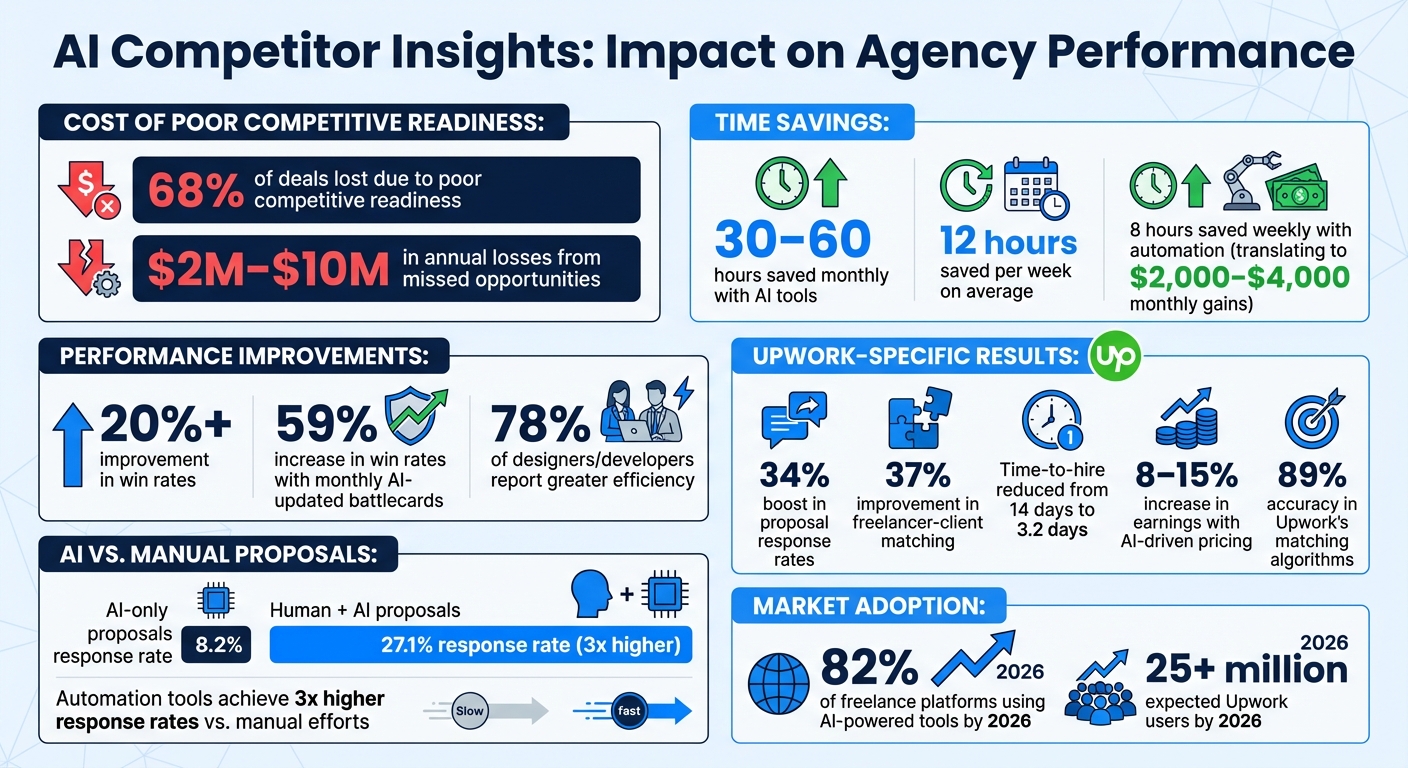
- Manual competitor research is outdated: Agencies lose 68% of deals due to poor competitive readiness, costing $2M–$10M annually.
- AI saves time and drives results: Teams using AI save 30–60 hours monthly and see 20%+ improvements in win rates.
- Real-time tracking matters: AI tools monitor competitors 24/7, analyzing pricing, messaging, and hiring trends to uncover actionable data.
- Upwork-specific benefits: AI tools boost proposal response rates by 34%, improve client matching, and optimize pricing strategies.
- Privacy concerns: Upwork’s default AI training settings require double opt-outs to protect sensitive data and maintain account safety.
Agencies leveraging AI are gaining a competitive edge by automating research, refining proposals, and targeting opportunities more effectively. Staying ahead means combining AI tools with human judgment for accurate, impactful strategies.
AI Competitor Insights Impact on Agency Performance: Key Statistics
What AI Competitor Insights Are
Definition and Core Concepts
AI competitor insights rely on machine learning and automation to continuously track, analyze, and report on competitors’ strategies and market trends. Unlike traditional manual research or periodic reviews, these systems work 24/7, processing thousands of data points at once.
These tools pull data from various sources like websites, job boards, social media, and review platforms. Using natural language processing (NLP), they identify patterns such as shifts in sentiment or frequently mentioned sales objections. On platforms like Upwork, AI monitors saved searches and alerts, scanning new job postings to understand project scopes, technology stacks, budgets, and potential challenges.
“Traditional competitive analysis used to mean spending weeks manually collecting data… AI changes everything. Instead of drowning in data, you can now process hundreds of data points in minutes.” – Miro Team
AI doesn’t just provide historical overviews – it delivers real-time insights. It evaluates external signals like pricing updates, messaging changes, and hiring trends, alongside internal data such as CRM entries and sales call notes. On Upwork, AI dives into transaction histories and response rates to identify winning proposal strategies and effective bidding behaviors. For example, Upwork’s Pricing Advisor uses over 50 market factors and billions of data points to recommend competitive hourly rates.
These capabilities directly translate into actionable benefits for agencies.
Main Benefits for Agencies
By replacing slow, manual research processes, AI allows agencies to move faster and seize opportunities they might otherwise miss. On average, professionals save 12 hours per week by using AI for competitive insights, freeing up time to fine-tune their bidding strategies without hiring more managers. In fact, 78% of designers and developers report greater efficiency in competitive research thanks to AI tools.
AI also helps agencies identify market gaps by spotting recurring customer pain points. This enables them to position their services more effectively. For instance, if competitors are hiring for “Enterprise Sales” roles, it could signal a shift away from small and medium-sized businesses (SMBs), creating an opening for your agency to capture that segment.
Real-time insights also improve performance benchmarking. AI-powered algorithms have enhanced freelancer-client matching by 37%, while the average time-to-hire has dropped from 14 days to just 3.2 days. Agencies can use these insights to compare their proposal response rates, interview rates, and hire rates against competitors in the same niche.
“Knowing what your competitors are doing is not optional anymore. It’s survival.” – Milan Patel, AI Tools That Make Money
The financial impact of these insights is hard to ignore. Companies can lose anywhere from $2 million to $10 million annually in missed opportunities due to poor competitive readiness. Teams that update their sales battlecards monthly using AI insights have seen up to a 59% increase in win rates. For Upwork agencies, specifically, AI-optimized proposals have boosted response rates by 34%, leading to more interviews and higher close rates – all without additional manual effort.
sbb-itb-5c5517e
How AI Tools Analyze Competitor Activity on Upwork
Data Collection and Pattern Analysis
AI tools rely on publicly accessible information – like freelancer profiles, job postings, and client reviews – ensuring compliance with platform policies and privacy regulations. These tools also respect Upwork’s robots.txt file and manage request rates to avoid overwhelming servers.
With recent advancements, AI-powered data extraction has become 30–40% faster than older methods, achieving accuracy rates as high as 99.5%. These tools can handle intricate website structures and organize data automatically, allowing agencies to scale on Upwork by monitoring multiple competitors simultaneously without exhausting resources on manual research.
By clustering data points, AI can uncover strategic trends. For instance, if a competitor starts posting numerous job openings for “Enterprise Sales” roles, the system might flag a shift toward targeting larger clients. This could present an opportunity for your agency to focus more on small-to-medium businesses (SMBs). Similarly, sentiment analysis can highlight recurring issues, such as 90% of a competitor’s negative reviews mentioning slow customer support – offering a clear area where your agency could stand out.
Ethical guidelines are firm: only public data is analyzed. Accessing private or restricted data, or violating regulations like GDPR or CCPA, is strictly off-limits. Any data collected is used solely for internal strategy and business intelligence purposes, ensuring that the process remains above board.
Metrics Tracked by AI Tools
Once data is processed and organized, AI tools help agencies benchmark competitors by tracking essential metrics. For example, metrics like response rates and bidding frequency can reveal how aggressively competitors pursue new contracts. Tracking the Job Success Score (JSS) – which reflects client feedback, contract history, and relationship retention – provides insights into the quality of service competitors deliver. A JSS above 90% is particularly important for visibility under Upwork’s 2026 algorithm updates.
Proposal personalization is another key area. Agencies using automation tools have reported achieving three times higher response rates compared to manual methods. Automated systems also provide an edge by submitting proposals at any time, ensuring “early applicant” status even outside standard business hours.
Pricing trends and client retention are also monitored to identify shifts in market dynamics. In 2025, 68% of clients preferred agencies with proven expertise in niche areas, making specialization tracking crucial. Additionally, professionals with AI-related skills on Upwork are earning 40% more than peers in non-AI roles, highlighting the growing demand for these abilities.
Common Challenges When Using AI for Competitor Insights
Data Privacy and Platform Restrictions
On January 5, 2026, Upwork introduced a significant policy update that agencies need to be aware of, particularly regarding AI proposal tools vs. Upwork policies. By default, all accounts are now “opted in” for AI training across three data categories: work product, communications, and platform data. This means that your proposals, client conversations, and project deliverables could be used for AI training unless you actively opt out.
The most critical aspect of this policy is the “double opt-in” rule. For sensitive contract data, such as work products and messages, to be excluded from AI training, both your agency and the freelancer must manually opt out. If only one party updates their settings, the data remains eligible for training.
“You can’t ‘unring the bell.’ Data that’s already gone into AI training stays there.” – Attorney Sergei Tokmakov
| Data Type | Current Default Setting | Opt-Out Available? | Requirement for Exclusion |
|---|---|---|---|
| Work Product | Opted In | Yes | Double Opt-In (Both parties must opt out) |
| Communications | Opted In | Yes | Double Opt-In (Both parties must opt out) |
| Platform Data | Opted In | Yes | Single-party control |
To secure sensitive data, both parties need to adjust their settings under Account Settings → AI Preferences. This becomes especially critical for industries like healthcare or legal services, where using platform AI features could violate regulations like HIPAA or even waive attorney-client privilege. Notably, Upwork does not sign Business Associate Agreements (BAAs). For these cases, consider moving confidential discussions to encrypted email or secure external portals.
Taking these steps not only protects your data but also ensures the confidentiality of your competitive strategies. However, even beyond privacy, there are challenges with the accuracy of AI-driven insights.
Accuracy and Reliability Issues
Data privacy is only one part of the equation – agencies also grapple with the reliability of AI-generated insights. While AI tools are great at detecting patterns, they often lack the nuance needed to separate meaningful insights from irrelevant noise. For example, Upwork’s AI matching algorithms perform well for standardized projects, achieving 85–95% accuracy, but their effectiveness drops significantly – down to 50–69% – for creative or highly customized work. Similarly, the platform’s Pricing Advisor has a margin of error of ±12% compared to actual hired rates, which can lead to incorrect pricing strategies that either undercut your value or lose you potential work.
The numbers tell a compelling story. When comparing AI vs manual proposal writing, AI-generated proposals have an 8.2% response rate, but when human-written proposals are enhanced with AI, the response rate jumps to 27.1% – more than triple the success rate. UX Designer Elena Rodriguez learned this firsthand in 2026. By shifting from purely AI-driven pricing to a more human-centered approach, she increased her net income from $33,600 to $75,000 by her third year.
Biases in AI rankings also create challenges. Western freelancers, for example, gain 34% more visibility, while newcomers see 67% less exposure compared to established profiles. Content Strategist Sophia Williams tackled this issue by adopting a hybrid strategy in 2026. She used AI tools for discovery but relied on human-led efforts for 70% of her client interactions. This approach helped her raise her hourly rate from $97 to $167.
To address these reliability concerns, it’s essential to cross-check AI-generated insights against multiple data sources. Focus on identifying broader trends in pricing, language, and service offerings rather than reacting to isolated data points. Always verify AI-generated predictions manually, as these tools can sometimes produce misleading results that only human judgment can catch.
Blending AI capabilities with human expertise is key to achieving accurate and actionable competitor insights.
How to Implement AI Competitor Insights
Implementation Steps
To get started, you’ll need to decide between established AI providers like Google and Microsoft, or AI-native orchestration platforms such as SuperAGI. These options help reduce integration challenges and simplify the process.
Next, determine how deeply you want to integrate AI into your workflow. Pre-built APIs, such as Microsoft Cognitive Services, are straightforward and budget-friendly, while custom integrations can offer more flexibility but come with higher costs and added complexity. For most agencies on Upwork, pre-built solutions are the easiest way to kick things off without overcomplicating the process.
When it comes to pricing, choose a model that aligns with your usage. Per-interaction pricing (ranging from $0.10 to $1.50 per interaction) is ideal for scalability, while subscription models offer more predictable costs. For most use cases, you’ll need around 50,000–55,000 interactions annually to break even, with a payback period of 4–12 months. This kind of integration ensures you’re constantly refining your competitive strategies on Upwork.
Set up a monitoring schedule to stay on top of competitor insights. A tiered approach works best:
- Weekly: Gather competitor news alerts.
- Monthly: Analyze keyword gap data.
- Quarterly: Conduct a comprehensive positioning audit using AI.
Lastly, always validate AI-generated insights by cross-checking them with primary sources like competitor websites and pricing pages. AI tools can sometimes produce inaccurate or outdated information, so verifying data ensures you’re working with reliable insights.
Using Convertix.io for Portfolio-Based Automation
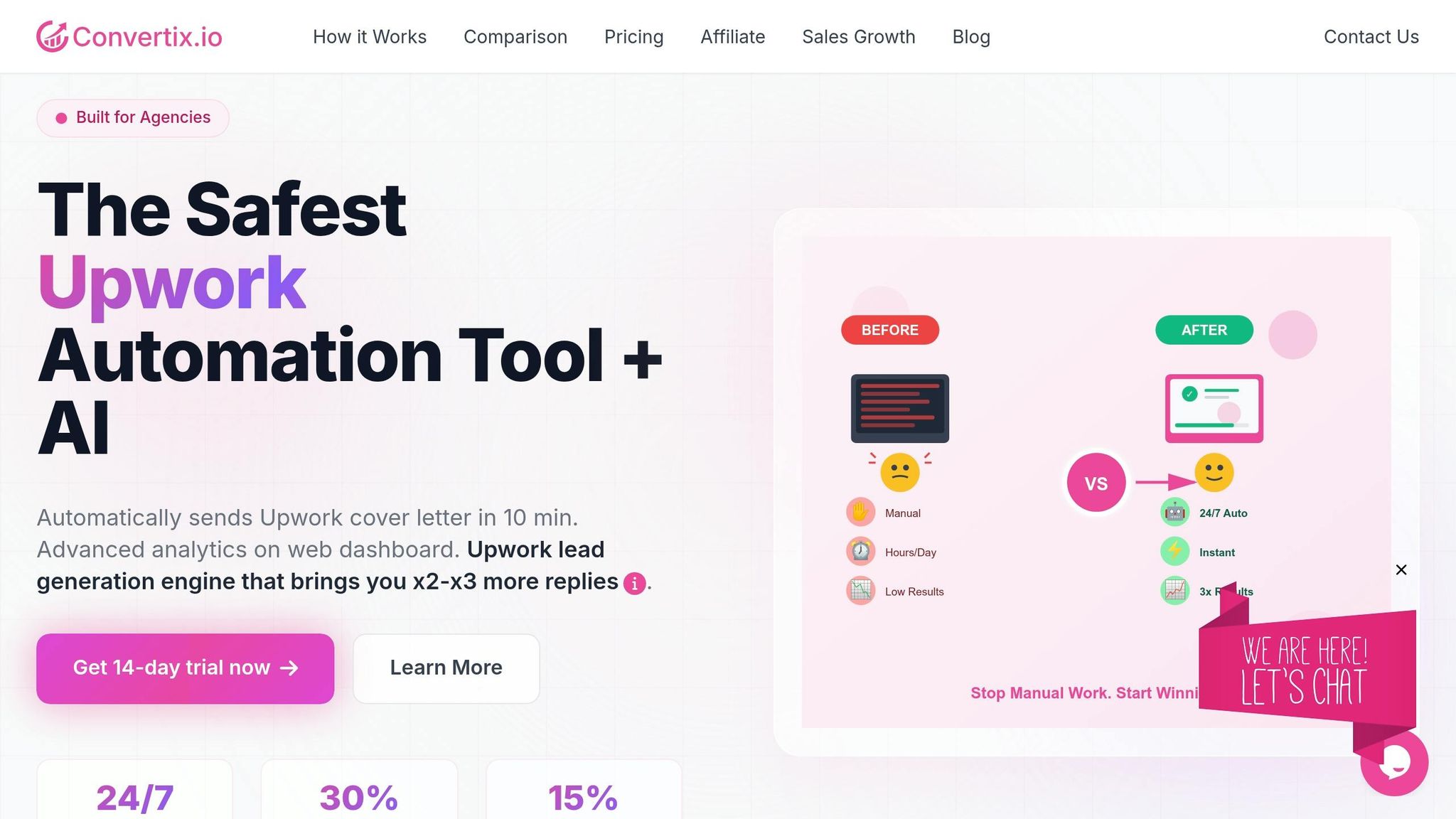
Once your AI integration is in place, tools like Convertix.io can take your Upwork strategy to the next level. Convertix.io uses competitor insights to automate and refine your proposal process, creating tailored submissions that stand out from generic, copy-paste templates.
Here’s how it works: Convertix.io scans full Upwork job postings and matches them with your agency’s profile and portfolio before you spend any connects. This approach ensures you’re only targeting jobs where you have a clear competitive edge. The platform then generates personalized cover letters in under two minutes. These proposals reportedly achieve a 50% higher reply rate compared to generic templates.
The system operates around the clock, so you never miss potential opportunities – even when you’re offline. The Starter plan ($299/month) includes 300 proposals per month, advanced portfolio matching, and priority support. The Advanced plan ($599/month) doubles that capacity to 600 proposals and adds custom portfolio optimization with 24/7 dedicated support.
What makes Convertix.io stand out is its ability to apply competitor insights automatically. Instead of manually analyzing which proposals succeed, the platform’s performance analytics track what works and refine your strategy over time. This means your proposals continuously improve, using the language, structure, and positioning that resonate most with your target clients. By turning competitive intelligence into actionable strategies, Convertix.io helps boost both your proposal win rates and overall close rates.
How to use AI to do quick competitive analysis
Many agencies are already scaling with AI tools for Upwork to automate these workflows and gain a competitive edge.
Applying Competitor Insights to Grow Your Agency on Upwork
Using AI-driven competitor insights can fine-tune your proposals and improve how you target jobs and clients on Upwork.
Improving Proposal Strategies
Competitor insights provide a treasure trove of data to help you craft proposals that stand out. By analyzing winning bid prices, you can set rates that are both competitive and grounded in real market trends.
AI tools can also play a big role in refining your content. They identify key technical terms and value propositions commonly used in successful proposals. Incorporating this language into your submissions ensures you’re speaking the client’s language and aligning with Upwork’s AI-driven screening.
Another powerful strategy? Review competitor feedback to spot recurring complaints, like slow communication or lack of technical expertise. Then, turn these gaps into your strengths. For example, highlight your quick response times or deep technical skills right in your proposal’s opening paragraph.
Once your proposals are tailored, the next step is aligning these insights with client preferences to land the right jobs.
Better Job Matching and Client Preference Prediction
Beyond proposals, competitor insights can help you zero in on jobs you’re most likely to win before you even spend a single connect. How? By analyzing historical hiring patterns. AI tools can identify trends, such as whether a client prefers small agencies, specific geographic locations, or particular project management approaches. Crafting your pitch to match their “ideal hire” profile can give you a serious edge.
When it comes to your portfolio, focus on quality over quantity. Use competitor insights to identify which case studies resonate most with clients. Instead of showcasing everything, highlight a few key projects that align with the client’s past hiring preferences.
Here’s the proof: agencies that use Upwork automation tools see three times higher response rates compared to those relying on manual efforts. Analytics-driven tools can also boost win rates by 20%. With Upwork’s user base expected to exceed 25 million by 2026, sharpening your targeting with competitor insights is more important than ever.
Conclusion
By 2026, manual tracking will no longer cut it. With 82% of freelance platforms already using AI-powered tools, agencies sticking to outdated methods risk being left behind. AI tools now play a crucial role in monitoring constant shifts like pricing updates, messaging changes, and feature launches – things manual tracking simply can’t keep up with. These trends highlight why real-time competitive intelligence is no longer optional.
Agencies using AI automation are saving eight hours a week, translating to $2,000–$4,000 in monthly gains and a 34% boost in response rates. On platforms like Upwork, AI-driven pricing recommendations are helping freelancers and agencies increase earnings by 8–15%. This isn’t just about keeping up – it’s about transforming stagnant workflows into scalable growth opportunities.
The winning strategy here is a hybrid approach. Tools like Convertix.io automate critical tasks, such as job matching and proposal generation, using a portfolio-focused model. This frees up agencies to concentrate on what truly matters: building strong client relationships and creating standout value propositions.
But insights alone aren’t enough – they need swift action. Agencies that thrive are the ones setting up hourly monitoring of competitor pricing, using AI to distill actionable insights, and turning those insights into tailored proposals. The smartest agencies aren’t just working harder – they’re working smarter by letting AI handle the repetitive, time-consuming tasks. This shift not only saves time but also positions them for greater market share growth.
With Upwork’s matching algorithms now boasting 89% accuracy, competition on the platform has never been fiercer. Agencies that embrace AI-driven strategies and tools like Convertix.io aren’t just surviving – they’re thriving and capturing a bigger slice of the market.
FAQs
What data sources can AI use for competitor insights on Upwork?
AI collects competitor insights on Upwork by examining publicly available data, including platform activity, client reviews, job postings, and pricing patterns. It can also monitor updates to competitor profiles, portfolios, and feedback. By pairing this data with an analysis of market trends and customer perceptions, AI tools offer a detailed understanding of competitors’ strategies, helping agencies pinpoint areas where they can enhance their performance.
How do I protect my Upwork proposals and messages from AI training?
To keep your Upwork proposals and messages safe from being used for AI training, you can adjust your AI preferences in your account settings. By opting out, you ensure your content won’t be included in AI training datasets. If you haven’t updated these settings since the policy changes in 2026, your content might already be included. It’s important to review and disable this option to maintain your privacy.
How can I verify AI competitor insights before changing pricing or bids?
To ensure your AI-generated competitor insights are reliable, blend automated analysis with human oversight. Start by using AI tools to collect and analyze data from competitors. Then, take the extra step of manually reviewing this information to confirm its accuracy and relevance. This combination lets you benefit from AI’s efficiency while keeping control over key strategic decisions.
It’s also a good idea to periodically revisit automated insights. By doing so, you can validate their reliability before making critical adjustments, like tweaking pricing strategies or modifying bids. This balanced approach helps you stay both agile and informed.
