
Want to save time on Upwork proposals? Virtual assistants (VAs) combined with AI tools like Convertix.io can help agencies send more proposals in less time, boosting response rates and efficiency. Here’s the big picture:
- Manual Proposal Writing: Takes ~23 minutes per proposal. Writing 15 proposals daily = ~5 hours/day.
- With VAs: They handle job research, draft tailored proposals, and attach relevant samples. Time per proposal drops significantly.
- With Convertix.io: Automates job matching and proposal drafting, cutting manual work by up to 70%. Agencies can send 50+ proposals daily, improving response rates from 12% (average) to 20-25%.
Why it works: VAs focus on refining AI-generated drafts, adding personalization, and managing client responses. This combination of human oversight and automation ensures faster, high-quality submissions without sacrificing the personal touch.
Key benefits:
- Faster proposals: From 23 minutes to under 3 minutes.
- Higher output: Scale from 25 to 100+ proposals per week.
- Improved response rates: Up to 2x or 3x higher than average.
Whether you’re a freelancer or agency, delegating proposal tasks to VAs and leveraging tools like Convertix.io can save time, reduce effort, and increase your chances of winning jobs on Upwork.
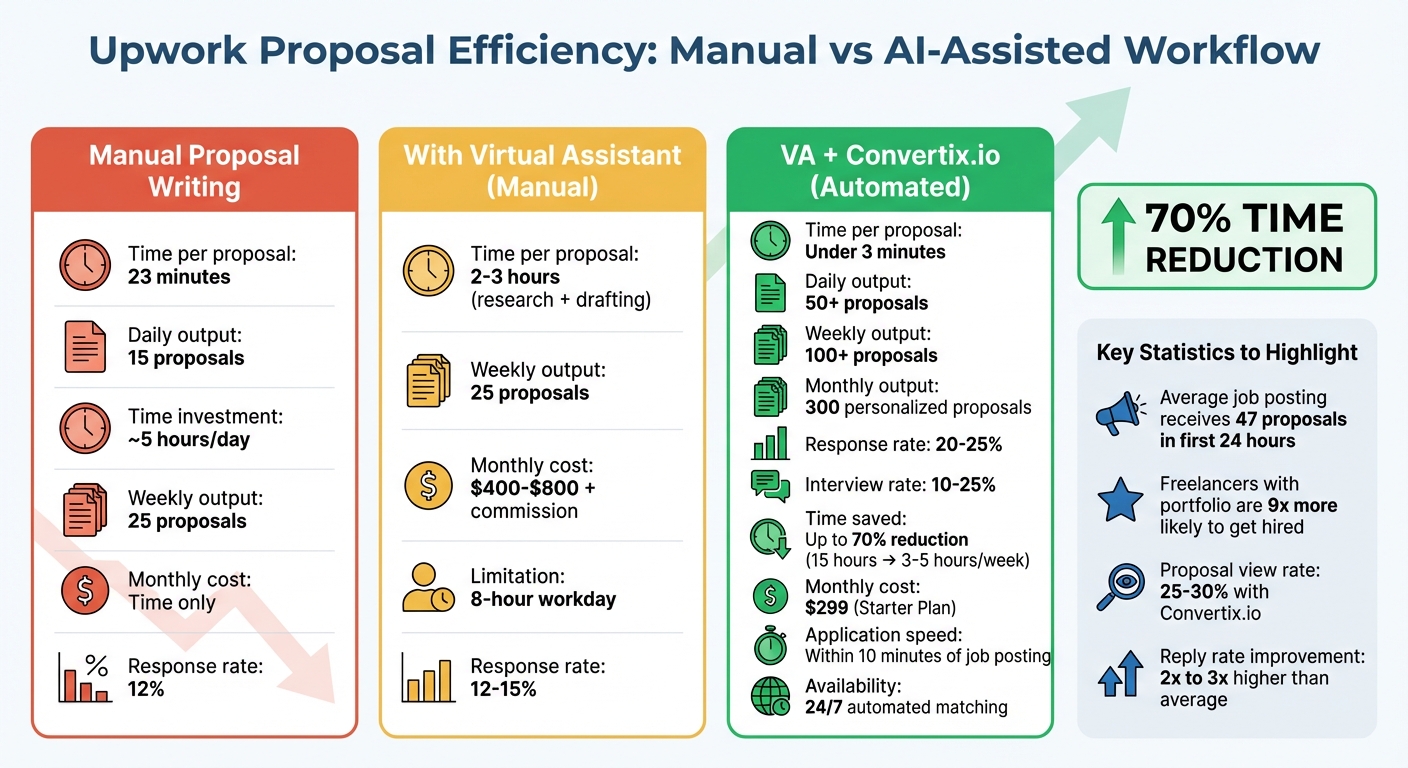
Manual vs AI-Assisted Upwork Proposal Workflow Comparison
How I Write Virtual Assistant Proposal (with FREE Sample)
sbb-itb-5c5517e
What Virtual Assistants Do for Upwork Proposals
Virtual assistants (VAs) tackle the repetitive and time-consuming tasks that often bog down the proposal process. By managing activities like identifying promising job postings and customizing submissions with targeted work samples, they allow agency leads to focus on engaging with clients and closing deals. Here’s a closer look at how VAs streamline proposal creation through detailed job research, tailored templates, and strategic use of testimonials.
Finding and Analyzing Job Postings
One of the key roles of a VA is spotting high-quality job opportunities. They achieve this by saving searches for terms like “virtual assistant”, “admin support”, and “executive assistant”, checking these listings at least once or twice daily. This approach minimizes wasted Connects on low-potential leads.
A skilled VA evaluates each job posting by reviewing factors like verified payment methods, client project history, and freelancer feedback. They carefully analyze job descriptions to uncover critical details such as project objectives, required tools or technologies, timeline expectations, and any red flags. Additionally, they identify relevant “Skills and Expertise” keywords to align their proposals with the client’s needs.
Finding the client’s name can also add a personal touch. As Andreea-Lucia Lavorenciuc, an Upwork Top Rated Plus freelance writer, advises:
“One trick is to look at the feedback on the client’s Upwork profile when applying; other freelancers will call them by their first name in the feedback. This lets me start my application with their name.”
Considering that the average job posting gets 47 proposals within the first 24 hours, a personalized greeting can help a proposal stand out right from the start.
Personalizing Proposal Templates
A major reason proposals fail is their lack of specificity – 67% are rejected for being too generic. VAs address this by customizing pre-written templates to reflect the client’s project goals in their own words, showing they’ve paid close attention. They also use AI tone matching to align with the client’s style, whether formal, casual, or technical, and clearly link their skills and experiences to the client’s objectives.
Proposals should be concise, ideally just three short paragraphs: a hook, a solution, and a call to action. Keep the total word count between 150–300 words, focusing on crafting an engaging opening sentence. This is especially important since only the first few lines of a proposal are visible in search results before the client expands the full text.
Adding Testimonials and Portfolio Items
To strengthen proposals, VAs include relevant work samples, case studies, and testimonials that resonate with the client’s needs. Freelancers with a published portfolio are nine times more likely to get hired than those without one. Instead of linking to a general portfolio, VAs direct clients to specific examples that align with the project’s nature, building credibility through personalization.
Additionally, VAs often include a brief credibility statement, such as “Top Rated status” or “100% Job Success Score”, and incorporate one or two tailored sentences from past client testimonials. Using concrete data – like metrics or results from previous projects – further reinforces their experience and value.
| Task Category | Specific VA Action | Benefit |
|---|---|---|
| Research | Analyze client feedback and hiring rate | Helps avoid wasting Connects on poor leads |
| Drafting | Restate client goals | Shows understanding and active listening |
| Customization | Match technical keywords to job requirements | Improves visibility in client searches |
| Social Proof | Attach case studies relevant to the niche | Builds trust and establishes credibility |
Using Convertix.io with Virtual Assistants
Agencies can cut down on manual proposal work by up to 70% – reducing the time spent from 15 hours to just 3–5 hours per week – by combining the efforts of virtual assistants (VAs) with Convertix.io’s automation capabilities. Convertix.io takes care of repetitive tasks like job searching and drafting proposals, while VAs refine these outputs and manage client interactions. This partnership ensures faster responses and higher reply rates without compromising on the personal touch. It’s a blend of efficiency and customization that perfectly complements a VA’s role.
Automated Job Matching for Faster Research
With Convertix.io, VAs no longer need to repeatedly check saved searches throughout the day. By setting up AI job validation prompts – which specify preferred technologies, acceptable domains, and stacks to avoid – the system continuously filters Upwork postings. Jobs are then applied to within 10 minutes of posting, a massive improvement over the 1–2 hours it typically takes a human VA to research and submit proposals.
For example, in early 2024, a Software Development agency in India tested Convertix.io on a new Upwork profile. In just two days of automated job matching and bidding, they achieved a 42% proposal view rate and a 28% reply rate, securing responses from clients in the US and Israel within 48 hours. This speed advantage can make all the difference in staying ahead of competitors.
While automated job matching speeds up the process, the platform’s portfolio-based proposal generation ensures that each submission feels tailored and relevant.
Portfolio-Based Proposal Generation
Instead of manually selecting case studies or crafting custom explanations, Convertix.io analyzes the agency’s portfolio to pick the most relevant project for each job posting. The AI then generates personalized proposals, complete with project titles, URLs, and tech stacks, demonstrating how the agency’s expertise aligns with the client’s needs. This automation allows VAs to focus on adding final touches – like addressing the client by name or asking specific questions about deliverables and timelines.
“Convertix.io cut our proposal workflow to 3–5 hours weekly and scaled our Upwork outreach efficiently.” – Zoha, Co-Founder, Skip The Noise Media
The platform’s Starter Plan, priced at $299/month, delivers a 25–30% proposal view rate and a 5–15% reply rate. These results are on par with or even better than manual VA work, which can cost $400–$800 per month (plus commission) and is limited to an 8-hour workday. By automating the initial outreach, Convertix.io frees up VAs to focus on lead management – handling client responses, scheduling interviews, and closing deals.
How to Delegate Proposals to Virtual Assistants
Managing proposals effectively is crucial when working with virtual assistants (VAs). Without clear instructions, VAs might waste time on irrelevant jobs or send out pitches that miss the mark. The key is to establish a clear, repeatable process so your VA knows which jobs to focus on, how to write winning proposals, and when to get your input for final approval.
Set Clear Guidelines and Job Criteria
Start by defining 2–4 specific focus areas that align with your services, tools, and target clients. For example, you might focus on “Shopify Speed Optimization for DTC Brands” or “React Development for SaaS Startups.” This helps your VA avoid chasing every job posting and ensures they stick to opportunities that align with your agency’s expertise.
Next, provide your VA with a quick qualification script to evaluate potential jobs. They should assess four main factors before drafting any proposals:
- Fit & Skills: Is there a relevant portfolio piece to showcase?
- Scope Clarity: Are the deliverables clearly outlined?
- Budget/Timing: Does the budget make sense for the work required?
- Client Signal: Is the client verified, and have they been active recently?
Jobs that don’t meet these standards should be skipped. To further streamline this, use a scoring system (0–5) for fit, clarity, value alignment, and client credibility. Jobs scoring between 17 and 20 should be prioritized for proposals.
Once these criteria are in place, equip your VA with the right tools to handle the workload efficiently.
Use Tools Like Convertix.io for Proposal Drafting
Provide your VA access to the Convertix.io Starter Plan ($299/month). This tool automates job matching and generates AI-drafted proposals based on your portfolio, saving time and effort. With Convertix.io, a single VA can increase their weekly output from 25 to 100 proposals. Plus, the platform operates 24/7, meaning proposals can be prepared even outside standard working hours.
Review and Refine AI-Generated Proposals
While tools like Convertix.io can handle the heavy lifting, human oversight is still essential. Set up a review process where you – or a senior team member – check every draft before submission. The reviewer should focus on:
- Ensuring the tone matches your brand voice.
- Including at least two specific details from the job description.
- Outlining a clear micro-milestone with acceptance criteria.
As GigRadar puts it:
“Human in the loop: No proposal goes out without reviewer sign-off. The reviewer’s sign-off is your brand safety net and raises the win rate.”
Submit Proposals and Track Performance
Once the proposal is approved, your VA should submit it and log important details like the job title, client location, budget, and submission time. Keep track of weekly metrics such as response rates, interview rates, and revenue generated per proposal. If you notice strong interview rates but low conversions, consider adjusting your pricing or clarifying timelines rather than overhauling the entire proposal.
To stay top-of-mind with clients, schedule follow-ups: one at 24 hours to check in and another at 72 hours, including a mini-plan or screen capture. These follow-ups add value and increase the chances of client engagement, even if they’re not ready to hire right away.
How Virtual Assistants Should Structure Proposals
Crafting a well-structured proposal not only highlights your skills but also ensures your pitch is concise and impactful. A solid structure – comprising a hook, solution, and credibility – can significantly improve client engagement and make your proposals stand out.
Writing the Opening Summary and Problem Statement
The opening lines of your proposal are crucial since they’re the first thing clients see in their results list before clicking to expand. Start with a personalized greeting, addressing the client by name if possible. Andreea-Lucia Lavorenciuc, an Upwork Top Rated Plus freelancer, offers this simple yet effective tip:
“One trick is to look at the feedback on the client’s Upwork profile when applying; other freelancers will call them by their first name in the feedback. This lets me start my application with their name”.
After the greeting, show that you understand their needs by restating their main challenge in your own words. Avoid vague statements, use effective proposal tones, and instead reference specific details from the job description. Keep this section between 25 and 35 words to maintain clarity and impact.
To further demonstrate you’ve read the job post, include two specific details about the project. With an average of 47 proposals submitted within the first 24 hours of a job posting – and only 12% receiving any response – it’s critical to make a strong first impression. You can also use an Upwork Proposal Generator to quickly draft these initial sections.
Outlining Solutions, Timeline, and Pricing
Once you’ve captured the client’s attention, outline your plan of action. Use bullet points to list 3–4 specific deliverables. For virtual assistant roles, this could include tasks like developing Standard Operating Procedures (SOPs), managing Service Level Agreements (SLAs), or using specific tools like CRMs or automation software.
When detailing the timeline, break the project into phases with clear deadlines. Instead of relying on Upwork’s generic duration options, specify dates for discovery, execution, and delivery milestones. Mention your timezone and the hours you can overlap with the client’s schedule.
For pricing, clearly state your rate and explain its value. Be transparent by factoring in Upwork’s 10% service fee, ensuring clients understand how your rate is calculated.
| Component | What to Include | Purpose |
|---|---|---|
| Solution Plan | 3–4 bullets with milestones and tools (e.g., SOPs, CRMs) | Show expertise and process |
| Timeline | Specific dates for each phase; mention timezone overlap | Manage expectations |
| Pricing | Rate with explanation; account for Upwork’s 10% fee | Build transparency |
Showcasing Experience and Asking Questions
To build credibility, include one portfolio item that demonstrates measurable success. Avoid generic claims like “I have experience with email management.” Instead, use specific data: “I reduced inbox response time by 40% for a DTC brand managing over 200 daily inquiries”. This approach helps clients visualize the value you bring.
Wrap up your proposal by including one or two project-specific questions and a clear call to action, such as suggesting a quick call to discuss further. High-performing freelancers who maintain response rates between 18% and 25% consistently use this approach.
Attach no more than two highly relevant samples to avoid overwhelming the client. Keep in mind that freelancers with a published portfolio on their profile are hired nine times more often than those without one.
Tips for Better VA Performance and Results
To get the most out of your virtual assistant (VA), it’s essential to combine AI automation with thoughtful customization. By shifting your VA’s focus from drafting proposals to refining AI-generated drafts, you can save time and improve results.
Use AI Tools for Better Customization
Giving your VA access to tools like Convertix.io’s Starter Plan ($299/month) can streamline the proposal process. Instead of spending hours manually searching for jobs, the platform matches opportunities to your agency’s portfolio and skills automatically. This allows your VA to focus on fine-tuning the proposals to make them more engaging.
Train your VA to enhance AI-generated drafts with client-specific details. A solid workflow might look like this: start with the automated job match, verify that the AI-generated summary addresses the client’s needs, and then adjust any parts that require a personal touch. Vadym Ovcharenko, Founder of GigRadar, emphasizes the importance of precision:
“Clients spend an average of 15 seconds per proposal. Make every word count.”
To ensure consistent quality, monitor your VA’s work using a PQS rubric. This rubric evaluates proposals based on five key elements: hook, plan, proof, fit, and call to action. It’s a quick way to identify areas for improvement, whether in templates or AI prompts.
These strategies create a foundation for comparing the efficiency of manual VA work versus AI-assisted solutions.
Manual vs Automated Performance
The contrast between manual work and AI-powered automation becomes clear when you break down the time and cost for each task. A VA drafting proposals manually might spend 2–3 hours per proposal, while Convertix.io can generate portfolio-based drafts in seconds. Considering your VA’s hourly rate and the cost of Connects ($0.15 per connect), the monthly investment in Convertix.io ($299 or $599) delivers higher output with consistent quality.
| Task | Manual VA Effort | Convertix.io Starter Plan ($299/mo) | Convertix.io Advanced Plan ($599/mo) |
|---|---|---|---|
| Job Matching | 4–5 hours/week | 300 automated matches/month | 600 automated matches/month |
| Proposal Drafting | 2–3 hours/proposal | Instant AI generation | Instant AI generation |
| Performance Tracking | Manual spreadsheets | Built-in analytics | Advanced reporting |
To measure success, track metrics like response rate (client responses divided by proposals sent) and interview rate (interviews divided by proposals sent). Submitting proposals within 45–90 minutes of a job posting is also critical. Aim for benchmarks like a 20–40% response rate and a 10–25% interview rate to ensure your VA is meeting performance goals.
Conclusion
Using virtual assistants (VAs) alongside Convertix.io creates a streamlined system for Upwork agencies, boosting proposal output without sacrificing quality. VAs take on the critical task of human oversight – evaluating job postings, polishing AI-generated drafts, and ensuring every proposal aligns with your agency’s unique voice. At the same time, Convertix.io handles the heavy lifting, automating job matching and initial proposal creation. This allows VAs to focus on refining content instead of starting from scratch.
This setup shifts the VA’s role from simply creating content to acting as a “quality curator.” With the Starter Plan at $299/month, proposal creation time drops from 23 minutes to under 3 minutes per submission. This translates to 300 personalized proposals monthly, each tailored to include the most relevant past work for every potential client.
Comparing manual vs. automated lead generation, traditional manual proposal writing limits agencies to 5–8 applications per day with a 12% response rate. In contrast, Convertix.io enables agencies to send over 50 proposals daily while boosting response rates to over 20%. Considering the average Upwork job posting receives 47 proposals within the first 24 hours, speed and precision become critical. These numbers highlight the need for an optimized workflow.
To maximize results, establish a clear process where your VA reviews every AI-generated proposal before submission. Use strict criteria to filter out low-quality leads and monitor key metrics like response and interview rates to refine your strategy over time. You can track these metrics accurately using an Upwork Conversion Rate Analyzer. By combining human expertise with AI-driven automation – just as outlined in this article – you can maintain high-quality proposals while focusing your energy on client interviews and closing deals.
FAQs
How do I hire a VA for Upwork proposals?
If you’re looking to hire a virtual assistant (VA) to handle your Upwork proposals, start by outlining the specific tasks you’d like them to manage. For example, this could include researching job postings or tailoring proposals to match client requirements.
Next, create a job post detailing your needs, or search through Upwork’s pool of experienced VAs. Take the time to review profiles carefully, paying attention to their skills, previous experience, and client feedback. Once you’ve identified potential candidates, conduct interviews to gauge their expertise and communication skills.
After hiring, make sure to set them up for success. Provide clear instructions, templates, and any tools they’ll need to streamline your proposal process. This ensures they can work efficiently and meet your expectations.
What should my VA never send without approval?
Your virtual assistant (VA) should never send proposals or communicate with clients without getting your approval first. This guarantees that all messages meet your standards and maintain a professional tone.
How do I measure if proposals are working?
You can gauge how well your proposals are performing by keeping an eye on metrics such as response rates (the percentage of clients who reply) and success rates (the percentage of jobs you secure). By comparing your win rate to the total number of proposals you’ve sent, you can spot trends and pinpoint areas where adjustments might help you improve.
