
Automation is transforming how agencies work on Upwork in 2026. AI-powered tools like Convertix.io streamline job discovery, proposal generation, and outreach, saving freelancers 7+ hours per week and boosting efficiency. While automation excels at scale and speed, manual work offers unmatched customization for high-value projects.
Key Takeaways:
- Automation Strengths: Operates 24/7, saves time, handles 100+ proposals weekly, costs $299/month, and ensures compliance with Upwork’s rules.
- Manual Work Strengths: Adds a personal touch, better for nuanced or high-stakes projects, and builds stronger client relationships.
- Hybrid Approach: Combining automation for efficiency and manual effort for personalization maximizes results.
| Feature | Automation (Convertix.io) | Manual Work |
|---|---|---|
| Cost | $299/month | $400–$800/month + commission |
| Speed | ~10 minutes per proposal | 1–2 hours per proposal |
| Scale | 100+ proposals weekly | ~10 proposals daily |
| Personalization | Moderate | High |
Automation tools are ideal for scaling fast, while manual work is better suited for complex, high-value tasks. A hybrid strategy leverages the best of both worlds to save time, reduce costs, and improve outcomes.
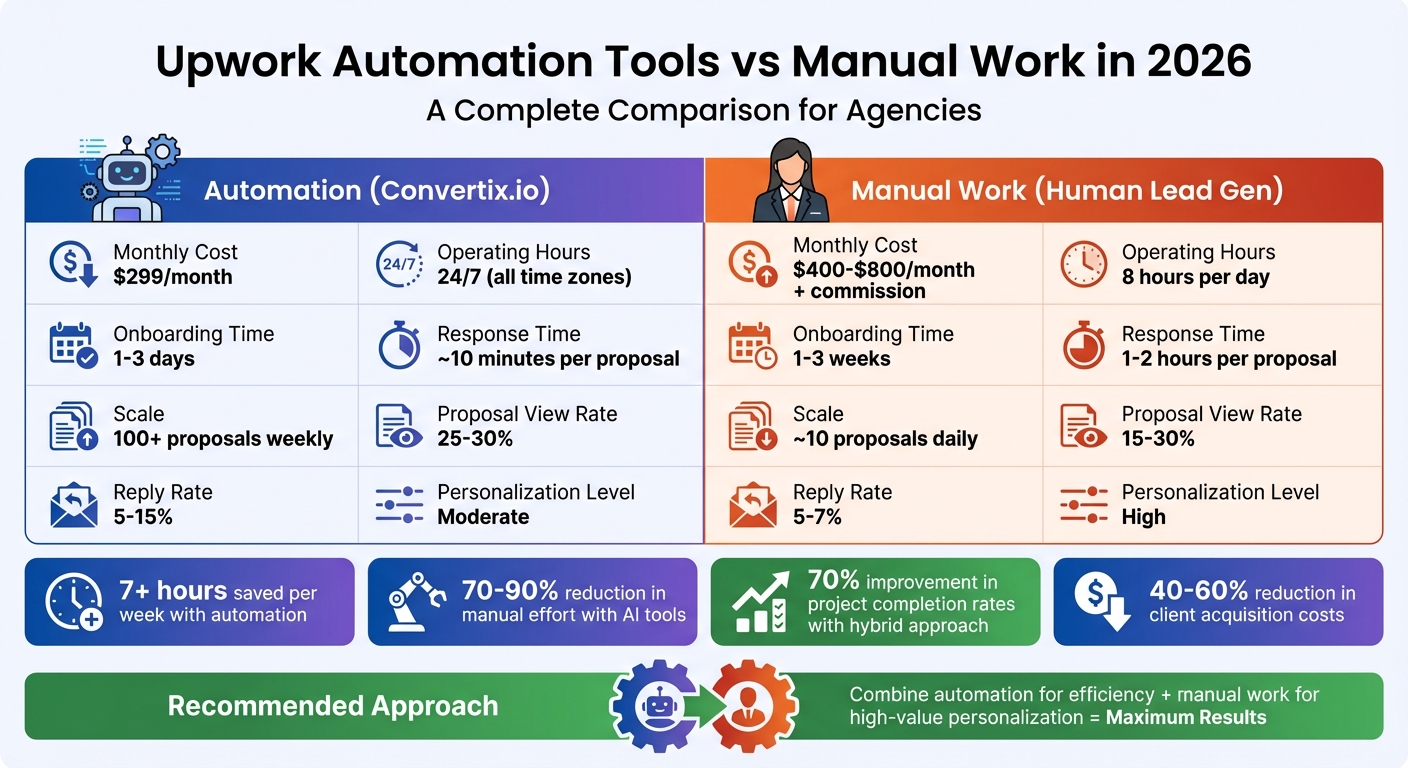
Upwork Automation vs Manual Work: Cost, Speed, and Performance Comparison 2026
Build An Ai UpWork Outreach Bot in Under 10 Minutes (N8N Template)
sbb-itb-5c5517e
How Upwork Automation Tools Work
Convertix.io acts as a round-the-clock automated lead generation powerhouse, managing everything from finding suitable job postings to sending out tailored proposals. It begins with real-time job monitoring, constantly scanning Upwork for opportunities. This quick response ensures your proposal lands in the client’s inbox early – before it gets buried under a flood of other applications. This speed is the backbone of the detailed features that follow.
What makes this AI automation unique is its two-step validation process. First, the system applies traditional filters like keywords, categories, and budget ranges. Then, it moves to the AI Job Validation layer. Here’s where things get smart: agencies provide custom prompts that outline what defines a "good fit", such as preferred technologies or project types to avoid. The AI treats this input like a training guide, evaluating job posts against your criteria before deciding to apply.
AI-Powered Job Matching
The platform’s matching engine doesn’t just stop at keyword searches. It dives into your agency’s uploaded portfolio and case studies to make informed decisions about job relevance. When it identifies a good match, the AI highlights the most appropriate portfolio piece in the proposal. This ensures every submission directly speaks to the client’s needs by showcasing relevant work.
For added flexibility, agencies can integrate notifications via Slack or Telegram. These notifications flag "Smart Custom Questions" – instances where the AI requires human input to address specific client queries it hasn’t encountered before.
Automated Proposal Generation
Writing proposals can be time-consuming, but Convertix.io simplifies this. The AI analyzes job descriptions, pinpoints client pain points and expectations, and then pairs these insights with relevant examples from your portfolio. Using custom cover letter prompts, it crafts proposals that feel personal and targeted.
The results speak for themselves: Convertix.io boasts a proposal view rate of 25–30% and a reply rate of 5–15%. Zoha, Co-Founder of Skip The Noise Media, shared her experience:
"Convertix reduced our proposal workflow from 15 hours to about 3–5 hours per week and made scaling our Upwork outreach much easier".
Importantly, the system is built to remain 100% compliant with Upwork’s Terms of Service.
Performance Analytics and Customization
Tracking performance is essential for refining your outreach strategy, and Convertix.io delivers with detailed analytics. Dashboards allow agencies to monitor metrics like view rates, reply rates, and hire rates. This data-driven approach helps agencies continuously improve their AI prompts and proposal templates.
Customization options go even further. You can instruct the AI to avoid jobs mentioning certain technologies or prioritize clients with verified payment methods and solid hiring histories. Plus, the system operates 24/7, covering all time zones so you never miss an opportunity – even during off-hours.
At $299 per month, including a 14-day free trial, Convertix.io offers an affordable alternative to hiring a dedicated lead generation specialist, who typically costs $400–$800 per month plus commission. It also provides faster onboarding (1–3 days compared to 1–3 weeks) and uninterrupted operation.
Automation Tools vs Manual Work: Direct Comparison
Efficiency and Scale
When it comes to efficiency, automation tools operate on a completely different level compared to manual work. For example, automated platforms work around the clock, capturing opportunities even during unconventional hours – like early mornings or weekends – times when human lead generation managers are usually off the clock. Automation can submit proposals in as little as 10 minutes, whereas manual efforts typically take 1–2 hours. This speed matters because being among the first five proposals a client reviews can significantly improve the chances of securing an interview.
In terms of scale, automation effortlessly handles over 100 targeted proposals per week without compromising quality. On the other hand, manual efforts often hit a wall after about 10 proposals per day, as fatigue and time constraints take their toll. A standout example is a Ukrainian QA agency that leveraged Convertix.io to achieve a 70% proposal view rate and a 40% reply rate within just 21 days, earning over $500,000 on Upwork. This efficiency paves the way for a deeper dive into how automation and manual methods differ in personalization and quality.
Personalization and Proposal Quality
Manual approaches shine when it comes to interpreting nuanced client needs. Human professionals can pick up on subtle cues in client briefs, identify potential red flags, and customize their tone and messaging to address specific concerns. They can also strategically highlight relevant proof points to make their proposals more compelling.
In contrast, automation ensures consistency by using structured frameworks like the "Hook–Problem–Plan–Proof–CTA" model. Tools like Convertix.io can automatically match the most relevant portfolio items to each job posting. The results speak for themselves: Convertix.io delivers a 25–30% proposal view rate and a 5–15% reply rate, compared to the 15–30% view rate and 5–7% reply rate typical of manual efforts. While automation guarantees reliability, manual efforts bring a level of personalization that’s hard to replicate. Beyond these differences, cost and risk factors further highlight the advantages of automation.
Cost, ROI, and Risk
Cost efficiency is another area where automation takes the lead. Convertix.io costs $299 per month, which is substantially lower than hiring a human lead generation manager, who typically charges $400–$800 per month plus commission on closed deals. For businesses looking to save time, automation is also quicker to implement. It takes just 1–3 days to set up an automated system, compared to the 1–3 weeks needed to hire and train a human manager.
Additionally, automation tools like Convertix.io are designed to stay compliant with platforms like Upwork. They use real browser simulation and dedicated hardware to ensure full compliance with Upwork’s Terms of Service. On top of that, AI-drafted proposals can be reviewed by humans before submission to maintain security and adherence to guidelines. This combination of speed, cost savings, and compliance makes automation a compelling choice for many businesses.
| Feature | Convertix.io (Automation) | Human Lead Gen (Manual) |
|---|---|---|
| Monthly Cost | $299 | $400–$800 + commission |
| Operating Hours | 24/7 | 8 hours per day |
| Onboarding Time | 1–3 days | 1–3 weeks |
| Response Time | ~10 minutes | 1–2 hours |
| Proposal View Rate | 25–30% | 15–30% |
| Reply Rate | 5–15% | 5–7% |
When to Use Automation vs Manual Work
Best Use Cases for Automation Tools
Automation tools, like Convertix.io, are designed for agencies aiming to scale quickly while managing high workloads. They are particularly effective when speed takes precedence over deep customization – especially in areas like bug fixes, performance optimization, and migrations where time is critical. For example, AI-driven lead generation systems can cut manual efforts by 70–90% while boosting the number of leads in your pipeline. In fast-paced, competitive markets, this kind of efficiency directly translates into more opportunities. Convertix.io’s Starter plan, priced at $299 per month, offers up to 300 proposals monthly, making it a practical choice for small to mid-sized agencies looking to grow without adding extra staff.
Another advantage of automation is its ability to handle multiple service areas at once. A single platform can continuously monitor opportunities in web development, UI/UX design, and SEO, ensuring leads are captured even when your team is offline. This is particularly useful on platforms like Upwork, where clients often post well-defined projects with clear budgets.
When Manual Work Is Better
There are times when manual effort is the better choice, especially for projects where trust and precision are more important than speed. For example, consultative projects like brand strategy, complex AI implementations, or high-stakes advisory work require a personal touch that automation can’t fully replicate. Skilled freelancers excel in these cases, as they can pick up on subtle client needs, spot potential issues in briefs, and tailor their messaging to address concerns that might not be apparent from the job posting.
For high-value bids, manual attention can make a significant difference. Investing extra time to craft a personalized proposal can boost your chances of success. This approach allows you to highlight key achievements, adapt your tone to match the client’s style, and frame your pricing to emphasize the value you bring rather than just the cost.
"Winning agencies don’t pick a side – they design a human-in-the-loop system where automation scouts and drafts, a VA enforces process, and a closer shapes value and tone".
Manual work is also crucial for data and AI projects. These types of engagements often require human oversight to fine-tune the approach and explain complex concepts in a way that builds client confidence. While automation might handle the initial draft, senior team members should finalize the bid and frame the pricing to resonate with decision-makers. Manual effort, therefore, plays a key role in tackling nuanced projects and setting the stage for a blended strategy.
Combining Automation and Manual Work
The best approach often lies in combining the strengths of both automation and manual work. By integrating these methods, you can achieve a balance between efficiency and personalization. The human-in-the-loop (HITL) model is particularly effective, using automation for tasks like discovery and drafting while leaving qualification and final touches to human expertise. Research shows that collaboration between humans and AI can increase project completion rates by up to 70%.
To implement this hybrid strategy, you can use automation to manage "P1" (perfect fit) jobs with real-time alerts for immediate action, while routing "P2" (secondary fit) jobs to a daily summary for manual review. For instance, Convertix.io can automatically match relevant portfolio items and draft initial proposals, allowing your team to focus on refining the final message and prioritizing high-touch efforts.
A lead scoring system can also help. Leads rated 4–5 out of 5, based on factors like fit, value, urgency, and authority, should receive manual attention, while lower-scoring leads can flow through automated processes. This ensures that your senior team members focus on high-priority opportunities without compromising quality.
For follow-ups, consider automating a T+24h value-add note (a follow-up sent 24 hours later) to address potential risks, and a T+72h mini-asset (such as a short video or two-slide plan) to keep clients engaged without requiring constant manual tracking. This approach keeps your pipeline active while allowing your team to concentrate on closing high-value deals.
"Professionals who can direct and refine AI outputs to enhance their work will stand out and find success".
Conclusion
Choosing between automation and manual work isn’t an all-or-nothing decision – it’s about recognizing the strengths of each. Manual work shines in areas requiring nuance, relationship-building, and high-stakes negotiations. On the other hand, automation tools like Convertix.io bring unmatched speed, consistency, and scalability to the table.
Consider this: agencies using AI tools report saving 25–35 hours per week on proposal-related tasks. Additionally, combining human effort with AI has been shown to improve project completion rates by up to 70%. While manual methods may produce fewer proposals, automation enables a far greater volume, making a hybrid approach the most effective. For example, AI can generate discovery and draft proposals in just 3–7 minutes, leaving humans to handle critical aspects like final adjustments, pricing, and building trust. This model not only saves time but also reduces client acquisition costs by 40–60%, all while maintaining a personalized touch.
"AI isn’t replacing people; it’s sharpening where human expertise matters most, with businesses continuing to invest in creativity, judgment, and problem-solving alongside AI." – Dr. Teng Liu, Economist, Upwork
As you assess your agency’s workflow, ask yourself: Are your senior team members stuck scanning job feeds and drafting proposals, or are they free to focus on closing deals and delivering value to clients? With Convertix.io’s Starter plan priced at $299 per month for up to 300 proposals, automation has never been more accessible. The real question isn’t whether you should automate – it’s how quickly you can implement a system that enhances your team’s strengths while eliminating inefficiencies. This is a critical step for those looking to scale your agency on Upwork.
Looking ahead, the professionals thriving in 2026 will be those who skillfully direct and refine AI outputs, using them to scale their efforts while maintaining the creativity, judgment, and problem-solving skills that clients value most.
FAQs
Will automation get my Upwork account flagged?
Using automation tools on Upwork comes with some risks, especially if they violate the platform’s Terms of Service. For instance, bots or scripts that automatically submit proposals or interact on your behalf without direct human involvement are strictly prohibited. Using these tools could result in account warnings or even suspensions.
That said, not all tools are off-limits. Certain tools, like AI-powered job alerts, are generally safe – as long as they align with Upwork’s policies. To avoid potential account issues, it’s crucial to stick to the platform’s guidelines and ensure any tools you use are fully compliant.
What should humans still handle in a hybrid setup?
In a hybrid work environment, people should prioritize tasks that demand negotiation skills, the ability to interpret unclear instructions, and handling nuanced client communications. Key responsibilities include adjusting tone during conversations, spotting potential issues early, and tailoring approaches to meet specific client needs. These tasks call for human qualities like judgment, emotional intelligence, and strategic thinking – things that machines simply can’t replicate. While automation excels at boosting efficiency and handling analytics, personalized interactions and navigating complex negotiations remain firmly in the human domain.
How soon should I expect ROI from automation?
You can usually see a return on investment (ROI) from automation within 60 to 90 days. To gauge how well it’s working, keep an eye on key metrics like your response rate, win rate, and overall ROI over time. These numbers will help you track progress and evaluate success with greater accuracy.
