
Most agencies on Upwork struggle to grow beyond five team members or hit $1M in annual revenue. Only 13% manage to scale past this point, and burnout or revenue plateaus often lead to a lifespan of just 18 months. What’s the difference between those who succeed and those who don’t? Specialization.
Agencies that focus on a specific niche outperform generalists by securing higher-value clients, implementing a robust lead generation strategy, streamlining operations, and commanding premium rates. This article explores how agencies like SelectiveDesign and Bystrov Agency used niche strategies to grow their monthly revenue to $180,000 and $350,000 respectively.
Here’s what you’ll learn:
- Why narrowing your focus increases credibility and simplifies scaling.
- Case studies of agencies that grew by specializing in SaaS, fintech, and Shopify.
- practical steps to scale your agency on Upwork by choosing a niche, refining your profile, and using data effectively.
Key takeaway: Specializing in a niche isn’t just about standing out – it’s about building systems that make growth sustainable.
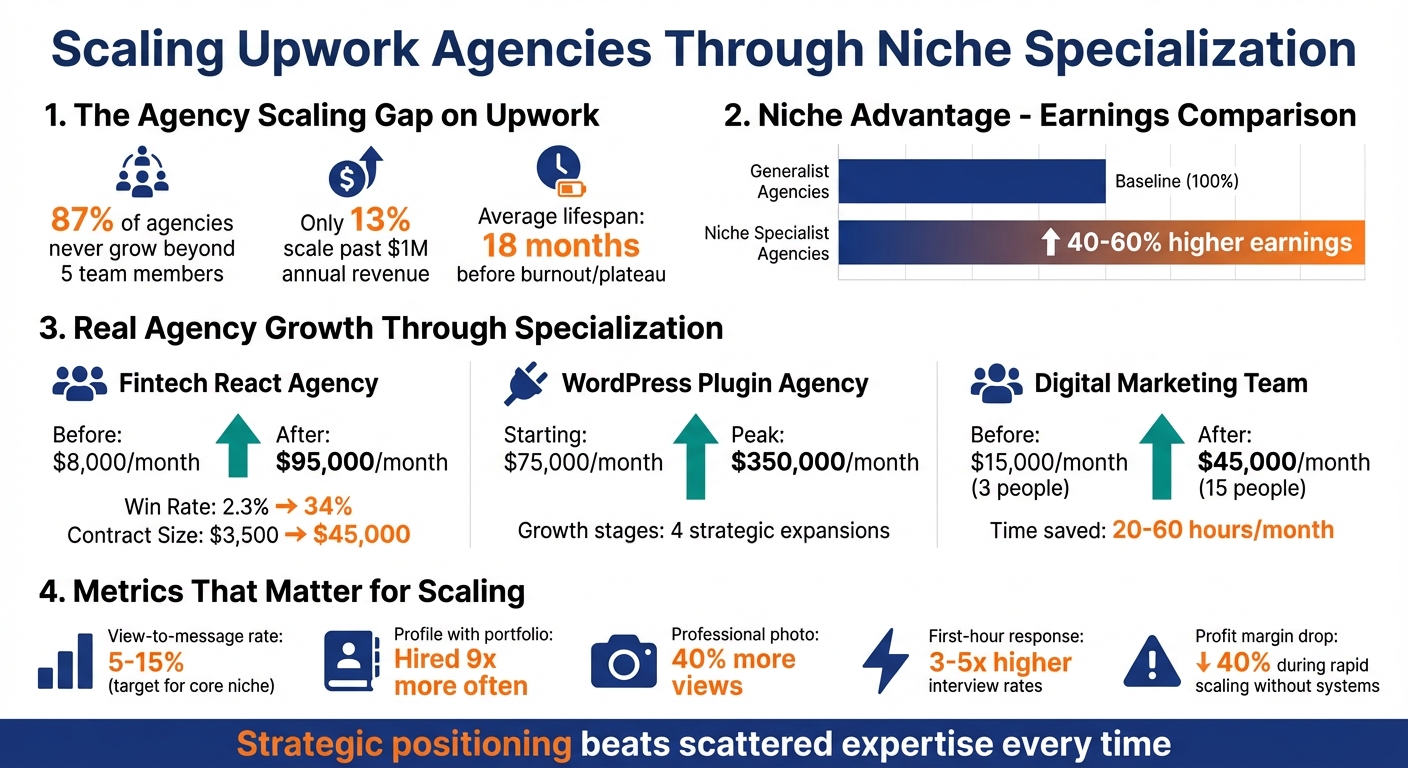
Upwork Agency Scaling Statistics: Niche vs Generalist Performance
Step by step approach to setup and scale your agency using Upwork to $1M
sbb-itb-5c5517e
Case Studies: Agencies That Scaled Through Niche Focus
Here’s how narrowing their focus helped three agencies achieve impressive growth.
Case Study 1: Web Development Agency Shifts to Fintech React Services
Back in 2025, a general web development agency earning around $8,000 per month found itself struggling to compete in a crowded market. The founder decided to lean into their strengths – React expertise and a background in finance – and rebranded the agency to specialize in “React development for fintech startups.” They backed this pivot with five fintech-specific case studies and updated their marketing materials to directly target this niche audience.
The results? Revenue skyrocketed to $45,000 per month within three months and hit $95,000 per month by the end of the year. Their proposal win rates jumped from 2.3% to 34%, and the average contract size soared from $3,500 to $45,000 per project.
“Strategic positioning beats scattered expertise every single time.” – Kyrylo Kozak
Case Study 2: WordPress Plugin Agency Hits $350K Monthly Revenue
A WordPress plugin development agency earning $75,000 per month found themselves stuck at a growth plateau. Instead of abandoning their niche, they expanded thoughtfully. First, they added WordPress theme development, which boosted revenue to $120,000 per month. Next, they transitioned to offering full-service agency solutions, pushing revenue to $200,000 per month. Finally, they introduced a SaaS product tailored for WordPress developers, which propelled them to an impressive $350,000 in monthly revenue.
Each step built on their existing expertise and the trust they had already established with their audience.
Case Study 3: Digital Marketing Team Triples Revenue in a Year
A small, three-person digital marketing team earning $15,000 per month faced challenges with inconsistent leads and low-value projects. They spent over 40 hours every week manually searching for jobs and writing proposals. To solve these problems, they streamlined their operations by optimizing five service-specific profiles and automating 80% of their proposal process with Upwork automation tools. They also narrowed their focus to e-commerce and SaaS clients.
Within 12 months, their team grew to 15 members, and they achieved $45,000 in monthly recurring revenue. Automation saved them 20–60 hours each month, giving them more time to focus on delivering high-value results.
“The difference between agencies that scale successfully and those that plateau isn’t talent, luck, or market timing – it’s systems.” – UpHunt Team
Lessons and Strategies from Niche Agency Owners
Scaling an agency on Upwork isn’t easy. In fact, research shows that 87% of agencies on the platform never grow beyond five team members. However, agencies that specialize in a niche often find a way to break through these barriers. Below are the strategies that successful agencies use to leverage their niche focus and achieve growth.
The 80/20 Approach: Core Niche Plus Experimentation
Top-performing agencies follow an 80/20 rule: they dedicate 80% of their resources to their core expertise while using the remaining 20% to explore adjacent markets. Take League Design Agency, for example. By September 2025, they had surpassed $4 million in total Upwork earnings. According to their Head of Lead Generation, Slava Bojka, tracking every dollar spent on acquiring leads was critical to their success. By analyzing cost per lead and profitability at each stage of their funnel, they managed to double their weekly invitation rate without sacrificing quality.
As Mikhail, the Co-founder of League Design Agency, puts it:
“If you don’t track it, you can’t control it.” – Mikhail, Co-founder, League Design Agency
Building Profiles and Portfolios for Your Niche
Your profile is often the first impression clients have of your agency, so it needs to be sharp and to the point. Start with a headline of 70–80 characters that pairs your primary skill with a measurable outcome. For example: “React Developer: 40% Faster Load Times for Fintech Apps”. The first 160–200 characters of your overview should act like a meta description, clearly addressing whether you understand the client’s problem, can deliver results, communicate effectively, and can be trusted with their budget.
When it comes to portfolios, use the SCARA model – Situation, Complication, Action, Result, Artifact – to build a portfolio with compelling case studies. Highlight the result in your project title, such as: “30% Time-to-Insight Reduction for SaaS Dashboard.” Agencies that showcase focused portfolios are hired 9 times more often than those that don’t.
Viktor Bystrov, founder of Bystrov Agency, offers a simple yet highly effective approach. Specializing in Shopify development, his agency earned over $2 million on Upwork. In September 2025, he shared his go-to strategy:
“In the last seven years, the most successful cover letter in my niche… is just to ask one question: What is your store URL? And can I send a collaborator access request to your store? That’s all. And it works.” – Viktor Bystrov, Founder, Bystrov Agency
A well-crafted profile and portfolio are essential, but scaling requires data-driven decisions.
Using Data to Scale at the Right Pace
Scaling too fast without proper systems in place can hurt profitability. On average, agency profit margins drop by 40% during rapid scaling if operational efficiencies aren’t maintained. To avoid this, track key metrics like view-to-message conversion rates (aim for 5–15% in your core niche), project profitability, and response times for qualified leads. These insights will help pinpoint where your funnel needs improvement.
As your agency grows, your focus will shift. Agencies with 1–3 members should prioritize creating repeatable offers. Once you reach 4–10 members, standardizing proposals and adding project managers becomes critical. For agencies with 10+ members, separating sales from delivery and planning capacity with a 10–20% buffer ensures smoother operations.
Tools like Convertix.io can simplify this process. This platform automates job matching and proposal generation, scanning opportunities 24/7 and submitting tailored, portfolio-based proposals. It saves time while keeping you in control of your strategy.
As Slava Bojka from League Design Agency explains:
“Optimization is not just about money growth. It’s about making your processes more efficient. When your investments drop and your profits increase, that’s when you know you’ve optimized.” – Slava Bojka, Head of Lead Generation, League Design Agency
How to Scale Your Agency with Niche Specialization
Here’s a step-by-step guide to scaling your agency by narrowing your focus to a specific niche.
Step 1: Choose Your Niche
Start by analyzing your past clients. Rate them on a scale of 1 to 5 based on ease of collaboration, profitability, and the results you delivered. This will help you spot trends – industries where you consistently excelled with less effort.
Then, assess the market size. Your chosen niche should include at least 10,000 businesses to ensure there’s enough demand. Tools like Ahrefs can help you check if people are actively searching for terms like “[your service] + [your niche] agency”. Additionally, scanning job boards for companies hiring full-time employees for your expertise can indicate opportunities for outsourcing.
Ask yourself these key questions:
- Does the niche have the budget to pay premium rates?
- Is there potential for long-term work rather than just one-off projects?
- Can you easily connect with this audience through online groups or professional associations?
For example, combining a specific service (like SEO) with a defined industry (like B2B SaaS) can create a highly targeted focus.
A real-world example: Between February and May 2024, Lauren, an agency owner, transitioned to exclusively serving medical practices. This pivot doubled her monthly revenue from $25,000 to $52,000 in under four months.
Before fully committing, test the waters with the “5-Client Test” – secure five clients in your chosen niche to confirm its viability.
Once your niche is validated, it’s time to refine your profile and integrate AI tools into your workflow.
Step 2: Refine Your Profile and Use AI Tools
Your profile should immediately communicate your expertise in the niche. Use a “Skill + Outcome + Market” structure for your title. For instance: “Shopify Conversion Designer | Turn Traffic Into Sales With Data-Backed UX”. The first 200 characters of your profile overview are crucial since platforms like Upwork truncate text in previews. Use this space to highlight a specific client problem and the risks of ignoring it.
Ensure consistency across your team. Everyone should have professional headshots with uniform backgrounds and titles like “Senior Developer at [Agency Name]”. Profiles with professional photos get 40% more views. Your portfolio should showcase concise case studies, detailing the client’s problem, your solution, and measurable results.
Timing is everything when submitting proposals. Responding within the first hour can boost interview rates by 3–5x. AI platforms like Convertix.io can streamline this process by scanning for relevant projects, crafting personalized proposals, and automatically including dynamic fields like Client Name, Project Title, and Key Skills.
Take inspiration from Max, an agency owner who adopted AI tools in early 2024. Over seven months, his Upwork reply rate jumped from 5–7% to 17–20%, tripling his agency’s total sales.
Step 3: Test Proposals and Improve Conversion Rates
Refining your proposal process is key to standing out. Focus on two metrics: View Rate (how many clients open your proposal) and Reply Rate (how many respond positively). A high View Rate but low Reply Rate suggests your opening line works, but the body or case studies might need adjustment.
Learning how to write winning proposals can make all the difference. Use modular sections – pre-written blocks like case studies, service descriptions, and pricing options – that you can quickly customize for each client.
| Strategy | Time Investment | Win Rate |
|---|---|---|
| Generic Template | 2 minutes | Low (1–3%) |
| Partially Customized | 8–12 minutes | Medium (4–7%) |
| Fully Personalized | 25–35 minutes | High (10–15%) |
| AI-Assisted | Under 10 minutes | High (8–30%) |
Use a structured follow-up approach to avoid losing leads. Send a nudge after 3 days, a value-driven message at 7 days, and a final check-in after 14 days. This sequence builds trust and keeps the conversation alive. Once a client responds, answer their questions quickly and propose a discovery call using a direct scheduling link to maintain momentum.
Lastly, keep an eye on your win rate at various price points. If your win rate exceeds 20%, you might be underpricing your services. Tailor your proposals with niche-specific terminology – such as LTV and churn for SaaS clients or AOV and conversion rate optimization for e-commerce. This demonstrates your expertise and builds credibility faster.
Conclusion
Main Takeaways from Niche-Focused Agencies
Here’s what stands out from the strategies used by niche-focused agencies and how they can shape your approach moving forward.
Focusing on a niche not only boosts growth but also allows agencies to charge higher rates while addressing specific client challenges head-on. The numbers back this up: niche specialists – whether freelancers or agencies – earn 40% to 60% more than their generalist counterparts in the same industry. As the Asrify Blog insightfully explains:
“Specialization doesn’t just increase your rate – it shifts who you compete with. You’re no longer one of thousands of generic freelancers. You’re one of a handful of obvious choices for a specific, urgent need.”
– Asrify Blog
To succeed in this space, there are three key steps to focus on. First, turn your services into repeatable packages. Think fixed-scope audits, goal-driven sprints, or ongoing retainers – these make your work predictable and scalable. Second, be selective. Say no to the majority of opportunities that don’t align with your Ideal Client Persona. This lets you zero in on projects that deliver both higher margins and greater impact. Finally, embrace automation. Tools like Convertix.io can cut down the time spent searching for jobs and crafting proposals by up to 85%, all while keeping a personalized touch. Together, these steps create a solid roadmap for growing a scalable and successful agency.
FAQs
How do I pick a profitable Upwork niche?
Start by identifying your skills, interests, and areas where you have proven expertise. Think of niche selection as a 30-day experiment – try it out and evaluate what clicks. Focus on fields with high demand and better pay, such as Artificial Intelligence or Machine Learning.
Once you’ve chosen your niche, specialize and refine your profile to attract premium projects. Highlight your unique value and make it clear why you’re the right fit for your ideal clients. This approach not only helps you stand out but also sets the stage for building long-term, high-value partnerships.
When should I add team members without hurting margins?
When growing your team, it’s crucial to have well-defined systems and processes in place first. Without these, adding new members can create confusion and inefficiency. Focus on a hiring strategy that aligns with your profitability goals. Additionally, make use of technology to streamline operations and enhance productivity. This approach helps you grow your business effectively while maintaining healthy profit margins.
Which metrics should I track to scale on Upwork?
To grow your presence on Upwork, keep an eye on key metrics such as proposal view rate, lead reply rate, interview rate, and proposal acceptance rate. These numbers give you a clear picture of how well your outreach efforts are performing and help pinpoint where adjustments might improve your ability to attract and secure clients.
