
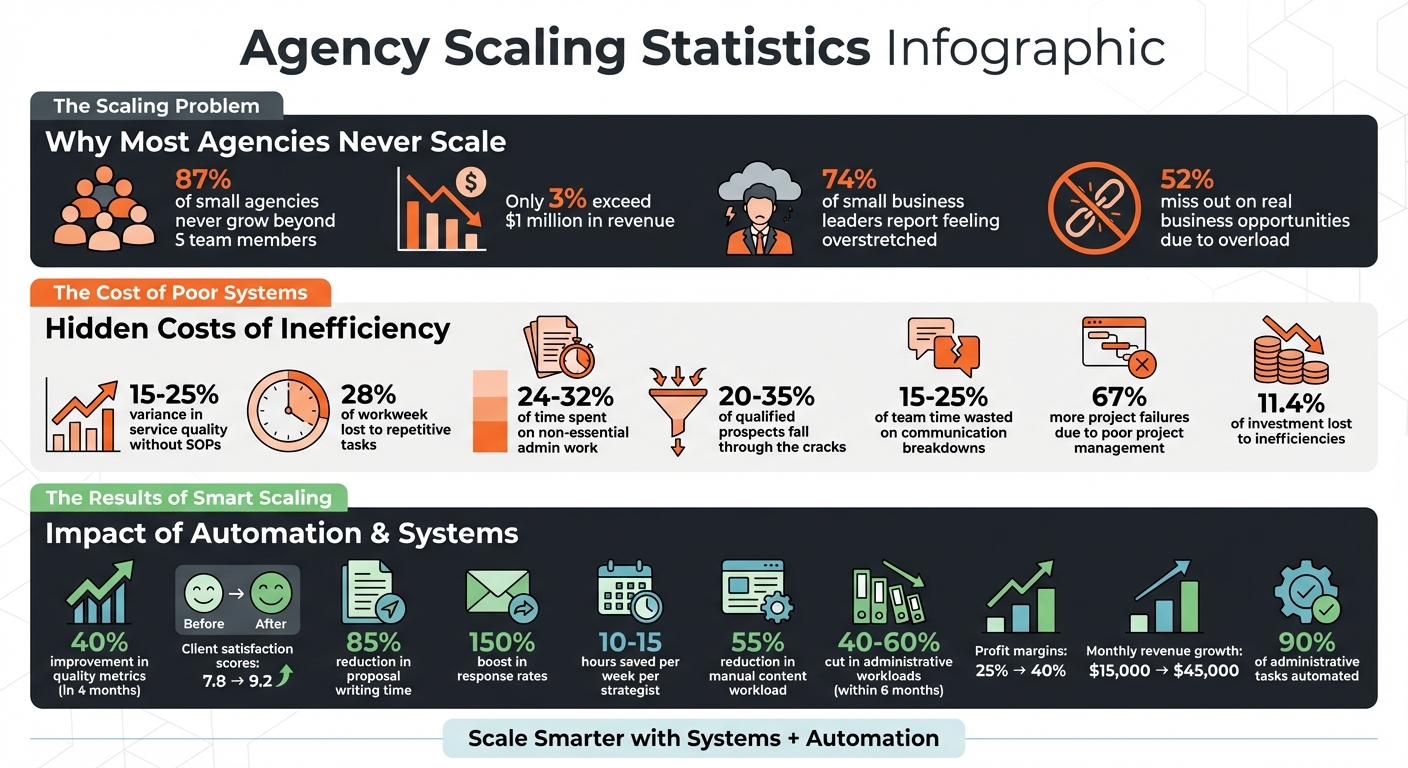
87% of small agencies never grow beyond five team members, and only 3% exceed $1 million in revenue. Why? Growth often breaks existing systems, leading to inefficiencies, burnout, and declining client satisfaction. But scaling your agency doesn’t have to mean sacrificing quality.
Key takeaways:
- Inconsistent processes lead to 15–25% service quality variance, frustrating clients.
- Teams lose 28% of their workweek to repetitive tasks, causing burnout and missed opportunities.
- Disconnected tools waste time, with 20–35% of prospects falling through the cracks.
Solutions for scaling effectively:
- Document workflows and create standard templates to reduce errors.
- Centralize tools to eliminate inefficiencies and improve communication.
- Use AI for automating repetitive tasks like lead generation and reporting.
Agencies that implement these strategies have seen profit margins grow by up to 40%, while cutting administrative workloads by 40–60%. Ready to grow smarter, not harder? Here’s how.
Agency Scaling Statistics: Growth Challenges and Solutions
Why Scaling Your Agency Is Killing It (And How to Fix It)
sbb-itb-5c5517e
Common Challenges When Scaling Agency Workflows
Scaling an agency isn’t just about bringing in more clients – it’s about maintaining the quality of service as you grow. The systems that work for a small team often crumble under the weight of new business. Growth amplifies repetitive tasks and exposes weaknesses in your processes, turning what should be wins into operational headaches. To keep up, agencies need standardized and automated systems.
Inconsistent Processes and Missing Standards
Small agencies often depend on "tribal knowledge" – critical information stored in the heads of a few key team members. When one of these individuals leaves, the delivery system can collapse, taking client satisfaction down with it. Without documented processes, tasks are handled inconsistently across the team, leading to a 15% to 25% variance in service quality. And clients notice.
"Agencies operating without defined, enforced SOPs experience a measurable 15% to 25% variance in service quality across their account managers and project teams. This inconsistency is the primary driver of client dissatisfaction." – Ahmed Ezat, Co-Founder, Pyrsonalize
The problem compounds as you scale. Managing five clients involves juggling ten communication relationships. But with 15 clients, that number jumps to 105, and at 25 clients, it skyrockets to 300 coordination points. Informal systems simply can’t handle this level of complexity. Mistakes happen, context gets lost, and client relationships suffer.
Limited Resources and Overworked Teams
Scaling too quickly without the right infrastructure can overwhelm your team. In fact, 74% of small business leaders report feeling overstretched, which often leads to burnout. Even worse, 52% say this overload causes them to miss out on real business opportunities. Instead of focusing on strategic growth, your team ends up in firefighting mode, spending 24% to 32% of their time on non-essential tasks like admin work or managing social media.
Repetitive and automatable tasks are another time drain. Knowledge workers lose 28% of their workweek to these activities. This inefficiency not only wastes time but also pulls focus away from high-impact work.
"You can have someone at 50% utilization that is a high performer relative to somebody who’s at 80% utilization and is burning time." – Kyle Hunt, Founder, Agency Operators: Level Up
Manual Tasks and Disconnected Tools
Fragmented tools are another hurdle. When your CRM, project management platform, and billing software don’t integrate, valuable time is wasted on manual data entry. This inefficiency causes 20% to 35% of qualified prospects to fall through the cracks. Communication breakdowns further drain productivity, eating up 15% to 25% of your team’s time.
The problem deepens during handoffs between departments. Moving work from strategy to design to development often results in lost context, delays, and extra revisions. Leads can go cold when follow-ups get buried in manual workflows, which doesn’t just hurt efficiency – it directly impacts revenue.
How to Scale Workflows While Maintaining Quality
The difference between agencies that grow and those that hit a wall often comes down to one thing: systems that can operate without constant oversight. By documenting processes, centralizing tools, and automating repetitive tasks, teams can focus on strategy rather than scrambling to keep up. Agencies that master this approach not only grow faster but also maintain better margins and keep clients longer. Let’s explore how to make this happen.
Creating Standard Templates and Processes
Standardizing your workflows is the first step to scaling effectively. Start by documenting your core services. Outline the key steps for every client – things like defining a value proposition, identifying the ideal customer profile, and setting up calls-to-action (CTAs). Then, divide tasks into two categories: judgment-based tasks (like creative strategy or client consultations) and procedural tasks (such as reporting or file handoffs). Templates work best for procedural tasks, streamlining repetitive work.
A RACI matrix (Responsible, Accountable, Consulted, Informed) can clarify ownership for each task, eliminating confusion and delays. Build feedback loops like regular internal reviews, client check-ins, and post-project evaluations to ensure consistency even as your workload grows.
In 2025, Milos Eric, General Manager at OysterLink, shifted his agency’s structure to a small-team ownership model. He assigned cross-functional teams of four (Strategist, Designer, Copy Lead, Project Owner) and held workshops on quality standards. Within four months, the agency improved its quality metrics by 40% and raised client satisfaction scores from 7.8 to 9.2.
"Structure is what allows for the flexibility for creative work since you are able to spend more time doing the creative work (the fun stuff) and less management (the boring stuff)." – Bradley Skaggs, Co-founder and Creative Director, Skaggs Creative
Using Centralized Workflow Management
Disconnected tools can slow down your team. If your CRM, project management software, and billing system don’t work together, your team wastes time re-entering data and hunting for information. A centralized system acts as a single source of truth, housing everything from briefs and drafts to deadlines and client feedback in one place.
For example, Skaggs Creative replaced email-based collaboration with Basecamp and custom-built CODA documents. These tools allowed them to track variables like formula codes, unit costs, and timelines in real-time, streamlining their operations and freeing up time for strategic work.
Centralized dashboards can also help prevent team overload. By mapping active projects against available hours and maintaining a 10% to 20% buffer for revisions, you can avoid overcommitting and burning out your team. Poor project management can lead to 67% more project failures, with agencies losing 11.4% of their investment due to inefficiencies. Once workflows are centralized, advanced AI tools can further optimize these processes.
Using AI for Automation and Quality Control
With centralized systems in place, AI can refine workflows by automating repetitive tasks. AI doesn’t replace your team – it takes over the mundane work, allowing your team to focus on strategy and creativity. Tasks like data collection, reporting, and even first-draft creation can be handled by AI.
Take Convertix.io, for example. It automates lead generation for Upwork agencies by using AI to match jobs with 95% accuracy. It then generates tailored Upwork proposals, cutting proposal writing time by 85% and boosting response rates by 150%. This system operates around the clock, ensuring no opportunities are missed.
Performance marketing agencies are using AI to summarize daily ad metrics and send alerts when performance changes. This saves strategists 10 to 15 hours per week per person. Content teams can also use AI to extract keywords, create outlines, and check readability, reducing their manual workload by 55%.
A hybrid AI-human workflow strikes the right balance. AI handles the volume, while humans refine the details. For instance, AI might draft a proposal or report, and a senior team member reviews it using a checklist. This layered approach ensures quality without sacrificing efficiency.
Between 2024 and 2025, a small digital marketing agency scaled from three to 15 team members using automated lead generation and centralized workflows. Their monthly revenue grew from $15,000 to $45,000, with profit margins jumping from 25% to 40% by cutting administrative overhead. Similarly, a web development agency scaled from a solo developer earning $8,000/month to a 20-person team generating $2 million annually in just three years, thanks to automating 90% of administrative tasks.
Agencies that integrate AI-driven automation can cut administrative workloads by 40% to 60% within six months. That’s not just time saved – it’s capacity unlocked for the kind of work that drives real growth.
Measuring Performance for Ongoing Improvement
Scaling without proper measurement is like driving with a blindfold – you’re moving forward but can’t see the obstacles ahead. Consistent tracking serves as an early warning system, helping identify budget overruns, scheduling delays, and quality issues before they snowball into larger problems. This approach works hand-in-hand with automation and centralized systems, ensuring that agencies can scale efficiently. The agencies that succeed at scaling are the ones that know which numbers matter and act on them in real time.
Key Metrics for Workflow Efficiency and Quality
Not all metrics are created equal. Focus on the ones that truly reflect how well your workflows are performing. Metrics like on-time delivery show how reliably deadlines are being met, while revision cycles per deliverable can highlight areas where quality control may need improvement. Another critical metric is utilization rate (billable hours ÷ total hours), which helps you understand how much time is being spent on revenue-generating tasks versus administrative work.
For agencies on Upwork, monitoring your conversion funnel is essential. Break it down into three key stages: Reply → Shortlist (Interview) → Win (Hire). Healthy benchmarks include a 20–35% reply rate, 10–20% shortlist rate, and 5–12% win rate. Well-organized agencies often achieve even better results, with 30–45% reply rates and 10–20% win rates. Tracking these numbers over a 60–90 day rolling period helps filter out short-term fluctuations, giving you a clearer picture of long-term trends.
Another important metric is Revenue per Proposal (RPP). Mixed-lane agencies should aim for $80–$250, while high-ticket specialists can target over $800. Breaking this down by project type and budget tier allows you to identify which areas are driving growth. Combine this with a weekly review of the top three reasons for lost deals, and your team can stay laser-focused on what’s driving results.
Real-time dashboards bring all these metrics to life, turning data into actionable insights.
Using Dashboards for Real-Time Data
Centralized dashboards act as a live command center for your agency. In fact, 72% of leading agencies rely on dashboards to identify bottlenecks and ensure projects stay on track. Without this kind of visibility, 54% of workers report lacking access to current project data, making it harder to adapt to changing deadlines or budgets.
An effective dashboard offers tailored views for different roles. Executives can monitor high-level trends, managers can track team workloads and resource allocation, and team members can focus on their daily tasks. Automated alerts for critical thresholds shift management from reactive problem-solving to proactive decision-making.
"A metric you can act on today is worth more than five vanity stats." – Timetracker Productivity Guide
Platforms like Convertix.io make performance tracking seamless for Upwork agencies. Their tools provide real-time visibility into the entire lead generation pipeline, monitoring job matches, proposal performance, and conversion rates. This eliminates the need for manual data collection and helps agencies quickly identify what’s working. One digital marketing agency even reported saving over 85 hours per week in non-billable administrative work by integrating automated tracking and AI tools into their workflows.
Conclusion
Scaling an agency isn’t about working harder – it’s about working smarter. Many agencies hit a wall when trying to grow beyond a small team, but those that break through often share a few key strategies: they streamline their processes, consolidate their tools, and automate repetitive tasks. To overcome these common hurdles, focus on three main areas: developing clear SOPs and templates, centralizing communication and project management, and automating routine tasks like lead generation and proposal drafting. Research shows that strategic planning can improve success rates by 12%, while well-organized systems can boost efficiency by 16%.
For agencies on platforms like Upwork, lead generation often becomes the biggest bottleneck. Manually sifting through job posts, writing personalized proposals, and juggling performance metrics across scattered spreadsheets can eat up valuable time that could be spent on billable work. Tools like Convertix.io tackle this problem by automating job matching, proposal creation, and performance tracking – all while keeping proposals tailored and relevant. This kind of automation not only saves time but also ensures quality, empowering agencies to scale without sacrificing their standards.
The ultimate goal is growth that’s sustainable – growth that keeps your team energized and your clients happy. By combining proven processes with smart automation, your agency can scale efficiently while maintaining excellence. This shift from relying on individual effort to building dependable systems can lead to impressive results, like increasing monthly revenue from $15,000 to $45,000 and boosting profit margins from 25% to 40%.
FAQs
What should we standardize first to scale without hurting quality?
To grow successfully while keeping quality intact, begin by creating clear and detailed Standard Operating Procedures (SOPs). These should outline essential workflows such as client onboarding, project management, and quality assurance. Well-documented processes help ensure consistency and minimize errors across the board.
Once your SOPs are established, consider leveraging tools like Convertix.io. This platform can automate tasks like lead generation and simplify operations, enabling your business to expand while still delivering the level of service your clients rely on.
How do we choose one system to centralize our tools and communication?
To keep everything organized and efficient, pick a platform that brings tools and communication into one place. Look for something that simplifies workflows, combines communication channels, and connects with project management and automation tools. This helps avoid scattered conversations and delays, making it easier to grow smoothly.
AI tools like Convertix.io can take over tasks like lead generation and creating proposals, saving time while keeping the quality high. The right system should make teamwork easy and allow for growth without sacrificing coordination or the quality of work.
Where can AI help most without losing the human touch?
AI shines brightest in tasks that improve efficiency while maintaining a personal touch. For instance, it can automate processes like proposal creation, job matching, and lead generation. These tools take care of repetitive, data-heavy work, freeing up teams to concentrate on building relationships and making strategic decisions. By managing routine tasks, AI enables agencies to expand their operations without losing the human connection that builds trust and ensures high-quality results.
