
AI is transforming how agencies track and manage KPIs, saving time, improving accuracy, and enabling faster decision-making. Here’s what you need to know:
- Old Way: Manual tracking took 15–20 hours per client monthly, with outdated reports and high error rates.
- New Way: AI automates data collection, anomaly detection, and real-time reporting, cutting hours to minutes and boosting productivity by up to 86% as agencies scale with AI tools.
- Key Metrics: AI enhances tracking for client acquisition cost, conversion rates, recurring revenue, and team utilization.
- Tools: Platforms like Convertix.io optimize proposal tracking for agencies, reducing manual effort while increasing response rates and ROI.
Why it matters: AI-powered KPI tracking gives agencies real-time insights, helping them respond to trends and improve client retention. It’s no longer a luxury but a must-have for staying competitive.
Key KPIs That AI Can Track and Improve
Client Acquisition Cost and Conversion Rates
AI is reshaping how businesses track and improve client acquisition costs and conversion rates. For instance, AI-referred visitors boast a conversion rate of 15.9%, compared to just 1.76% for Google organic search. That’s nearly 10 times higher – a game-changer for lead generation.
Yet, traditional analytics platforms often fail to capture this impact. AI-driven leads are frequently misclassified as “direct” traffic, meaning the actual influence of AI on traffic and revenue could be 2–3 times greater than what standard analytics report. Speed also plays a critical role. Responding to a lead within one minute can increase conversion rates by an astounding 391%. AI automates proposals and qualifies leads instantly, eliminating the delays that manual processes often introduce.
But AI’s capabilities go beyond improving lead management – it also transforms how revenue is tracked.
Monthly Recurring Revenue and Revenue Growth
Manual revenue tracking is prone to errors, with inaccuracies in CRM systems reaching as high as 30%. AI eliminates these discrepancies by automating data collection from sources like chat platforms, email, and CRM systems. Tools like Snowflake and BigQuery ensure this data is synchronized in real time. This means agencies no longer have to wait weeks for monthly reports – they can identify issues like sudden dips in conversion rates using an Upwork conversion rate analyzer or unexpected spikes in acquisition costs as they occur.
AI also excels at predictive revenue forecasting. By analyzing historical data and external factors such as seasonality and economic trends, it delivers more precise predictions. This level of insight is critical for agencies planning expansions or new hires. It’s no surprise that agencies tracking KPIs thoroughly are 74% more likely to achieve year-over-year revenue growth.
This same level of precision extends to team performance, where AI offers new ways to measure and enhance productivity.
Focus Time and Team Utilization Rates
Tracking work hours alone doesn’t reveal true productivity. As Kyle Hunt, Founder of Agency Operators, explains:
Utilization is a very poor metric. It only tells you the number of hours worked. It doesn’t tell you anything about the value delivered.
AI shifts the focus to meaningful metrics like operating rhythm and focus time. Research shows that workers typically achieve only 2–3 hours of deep focus per day. AI tools can identify when these productive windows occur and help protect them from distractions like excessive meetings or interruptions. It also uncovers hidden productivity blockers, such as frequent context switching or task fragmentation.
One emerging trend AI has identified is the rise of “triple-peak workdays”, where employees work in three distinct bursts – morning, afternoon, and late evening. This pattern now appears in 1 in 5 weekdays and often signals burnout risks before they escalate into retention problems.
AI’s ability to analyze messy time logs and detect inefficiencies is unmatched. Despite 85% of professionals using AI at work, it currently accounts for only 4% of total work time, highlighting a gap between adoption and full integration. By combining focus time metrics with traditional utilization data, agencies can better understand not just how much their teams are working, but how effectively they’re working.
sbb-itb-5c5517e
How AI Improves KPI Tracking
Predictive Analytics and Anomaly Detection
AI has reshaped KPI tracking by moving from a reactive approach to a more forward-thinking, predictive model. Through predictive analytics, AI taps into historical data, seasonal trends, and external factors like market shifts to forecast future outcomes. This means businesses can now run “what-if” scenarios – like reallocating budgets or tweaking team capacity – to predict results before making costly commitments.
Anomaly detection is another game-changer, acting like a round-the-clock monitor for your KPIs. By setting statistical baselines for normal performance, AI can quickly flag irregularities. With an impressive 92% accuracy rate, AI-driven anomaly detection slashes issue identification time from 8–12 hours to just 30–60 minutes.
Take Walmart as an example. In 2025, the retail giant adopted AI-powered predictive analytics for inventory tracking. By analyzing past sales, customer behavior, and even weather patterns, Walmart reduced forecast errors by 30%, cut stockouts by 20%, and lowered excess inventory by 15%. This kind of precision isn’t just for retail – it can revolutionize KPI tracking for agencies, too.
These predictive tools integrate seamlessly into real-time dashboards, making KPI tracking more dynamic and actionable.
Real-Time Dashboards and Pattern Recognition
Building on predictive insights, real-time dashboards provide instant visibility into performance trends. Unlike traditional monthly reports, which often lag behind, live dashboards allow businesses to react in the moment. No wonder 80% of agencies now prefer this approach. With real-time data, teams can spot shifts as they occur and adjust strategies without delay.
But these dashboards do more than just display numbers – they reveal hidden connections that can drive smarter decisions. For instance, AI might identify that a surge in social media engagement today correlates with higher customer lifetime value six months down the line – something static reports might miss. As Bodie Czeladka, Creative & Managing Director at Dilate Digital, puts it:
Real-time dashboards are great for those more savvy business owners or decision-makers who understand the need to look longitudinally at their marketing investment. The transparency always helps to strengthen long-term relationships.
AI also ensures the data feeding these dashboards is accurate. By cleaning and validating incoming information, AI eliminates the 30% error rate often caused by manual data entry. This efficiency speeds up decision-making by 85% and can save organizations up to $45,000 annually by cutting out the tedious “spreadsheet slog”.
These advancements in predictive analytics and real-time dashboards are revolutionizing how organizations track and manage KPIs, making the process faster, smarter, and far more reliable.
Recent Studies and Industry Benchmarks
Performance Improvements Through AI Tools
Recent data from 2025-2026 underscores how essential AI has become in the agency landscape. A staggering 92% of agencies report that AI enhances their daily productivity, and 91% view it as a critical part of their operations. However, a persistent “measurement gap” remains, as many AI-driven tasks still go untracked in traditional time logs.
The benefits of AI are clear: 86% of agency teams report measurable productivity gains, while 67% say they work faster and 69% focus more effectively on high-impact tasks thanks to AI integration.
AI’s financial impact is equally striking. 42% of agency leaders point to improved profit margins as the top benefit of AI adoption, with some agencies reporting a 25% to 40% increase in average project values through AI-enhanced financial management. In outreach efforts, AI-assisted campaigns achieve response rates of 15% to 25%, far outpacing the 2% to 5% rates seen with manual methods. Looking ahead, the momentum continues: 89% of agencies plan to increase their AI budgets in 2026, with 41% specifically investing in data intelligence tools.
These trends highlight how AI-driven tracking and optimization are reshaping the industry.
Benchmarking Against Industry Standards
When comparing AI-driven tracking to traditional methods, the advantages are hard to ignore. Organizations using AI-enabled KPIs are five times more likely to align incentive structures with business objectives than those relying on legacy systems. The speed factor is just as compelling – companies leveraging AI for business intelligence report decision-making that is up to 85% faster.
AI’s role in data and insights is particularly prominent, with 74% of agencies using it for this purpose, followed closely by campaign strategy and optimization at 72%. This shift is also transforming pricing models: 28% of agencies have transitioned from billable hours to value-based pricing, capitalizing on AI’s efficiency gains. Additionally, 45% of agencies now offer AI-based solutions as a standalone service tier, turning AI into a direct revenue stream.
As Team NinjaCat aptly puts it:
AI isn’t just a back-office tool that shaves time off everyday tasks. It’s quickly becoming a core differentiator – one that forward-thinking agencies can package, promote, and sell.
How to Use AI to Generate Metrics and KPIs
Convertix.io: AI-Powered KPI Tracking for Upwork Agencies
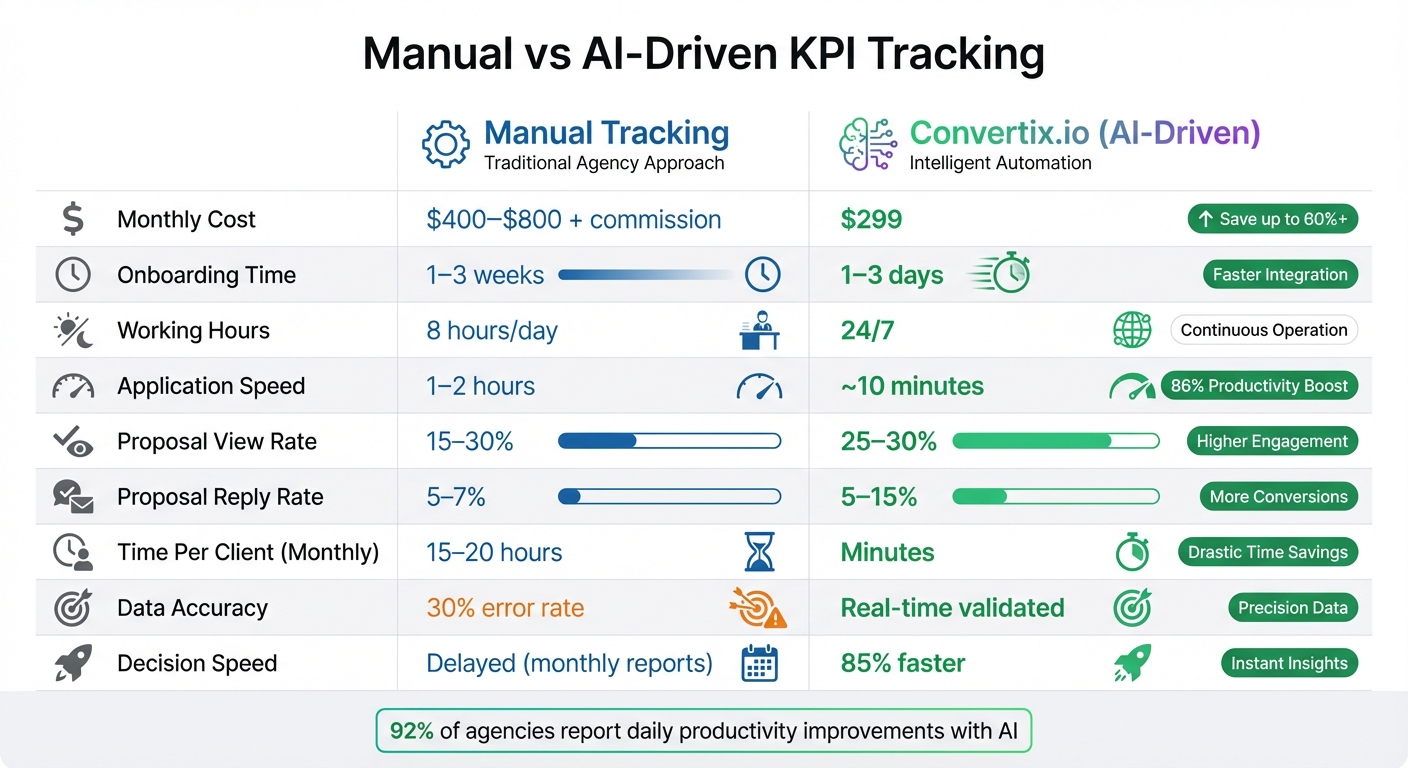
Manual vs AI-Driven KPI Tracking: Cost, Speed, and Performance Comparison
Automating Proposal Conversion Rate Tracking
Convertix.io takes the guesswork out of tracking proposal performance for Upwork agencies by offering a real-time, automated solution. With its advanced web dashboard, agencies can monitor crucial metrics like proposal view rates, reply rates, and hire rates. These metrics are further broken down by job stream, cover letter template, and business manager, providing granular insights into performance.
How does this translate in practice? Agencies using Convertix.io typically see proposal view rates of 25% to 30% and reply rates of 5% to 15%. A standout example involves a new Upwork profile for a software development agency, which achieved a 42% view rate and a 28% reply rate in just two days. Plus, the AI drastically reduces the time spent applying to jobs – from 1–2 hours manually to just 10 minutes per application.
“Convertix reduced our proposal workflow from 15 hours to about 3–5 hours per week and made scaling our Upwork outreach much easier.”
– Zoha, Co-Founder, Skip The Noise Media
Portfolio-Centric Analytics for Job Matching
Convertix.io takes a smart approach to job matching by focusing on an agency’s portfolio. By analyzing past projects, skills, and performance data, it identifies the most relevant opportunities. The system even selects specific portfolio items – like project titles, URLs, and technology stacks – to highlight a perfect fit for each job. This targeted strategy helps agencies cut down on wasted Upwork connects, reportedly saving around 30% by avoiding irrelevant bids.
Running 24/7, Convertix.io ensures constant lead generation. To further fine-tune the process, agencies can use AI job validation prompts to set specific criteria for technologies or domain expertise. This level of customization ensures that only the most suitable jobs are pursued, streamlining operations and reducing overhead.
Manual vs. AI-Driven KPI Tracking Comparison
When comparing manual tracking to Convertix.io’s AI-driven approach, the advantages become crystal clear. Here’s a breakdown:
| Feature | Manual Tracking | Convertix.io (AI-Driven) |
|---|---|---|
| Monthly Cost | $400–$800 + commission | $299 |
| Onboarding Time | 1–3 weeks | 1–3 days |
| Working Hours | 8 hours/day | 24/7 |
| Application Speed | 1–2 hours | ~10 minutes |
| Proposal View Rate | 15–30% | 25–30% |
| Proposal Reply Rate | 5–7% | 5–15% |
In addition to faster application speeds, Convertix.io offers real-time insights into performance trends. This means agencies can spot issues or opportunities as they arise, instead of waiting for delayed manual reports. The result? A more agile and efficient approach to scaling Upwork outreach.
Future Trends in AI for KPI Tracking
As AI reshapes the way agencies approach KPI tracking, new methods like multi-dimensional testing and innovative visibility metrics are emerging to provide deeper, more actionable insights.
Multi-KPI Testing for Campaign Optimization
Agencies are no longer limiting themselves to basic metrics – they’re now evaluating multiple KPIs simultaneously to refine their campaigns. AI-driven platforms like Google PMAX and Meta Advantage+ integrate prospecting, retargeting, and retention into a single automated system, ensuring campaigns align with strategic objectives.
This approach involves analyzing performance across various dimensions, such as new versus returning customers, high-lifetime-value product sales, and upper-funnel metrics like awareness and consideration. For instance, in 2025, Bayer used predictive marketing by combining Google Trends data, climate insights, and Google Cloud ML models. This allowed them to anticipate regional flu outbreaks and reallocate budgets effectively, resulting in an 85% increase in click-through rates (CTR) and a 33% reduction in cost-per-click (CPC).
“Consideration lift carries value that purchase-only incrementality experiments won’t capture.”
– Nick Stoltz, Chief Strategy Officer, Measured
To make the most of AI, agencies are encouraged to establish multi-tactic baselines and experiment with different KPI combinations. For example, pairing customer acquisition costs with repeat purchase rates can reveal which channels attract high-value, loyal customers rather than one-time deal-seekers. These advanced tests pave the way for developing metrics that better capture AI’s impact on campaigns.
New Visibility Metrics for Better Insights
Expanding on the concept of multi-KPI evaluation, agencies are introducing new metrics to measure AI-driven visibility. With over 80% of searches in 2025 resulting in zero clicks – thanks to AI summaries providing answers directly – traditional click-based measures have become less relevant. This shift has led to the creation of metrics like AI Share of Voice and Citation Rate, which quantify how often brands are featured in AI-generated responses.
In one example, Seer Interactive analyzed 100 AI-generated queries for a major digital solutions provider in early 2025. They discovered the client was recommended in 60% of those queries, establishing a reliable way to track AI visibility.
Another innovative metric is Share of Model, which estimates how frequently a brand is selected by AI systems like ChatGPT, Gemini, or Perplexity. Agencies are also monitoring city-level AI mention rates, as AI recommendations can vary regionally. A telecom brand that partnered with iPullRank in 2025 shifted its focus to AI inclusion over traditional rankings. This strategy led to a 253% increase in AI Overviews visibility and 1.4 million impressions.
“Success now looks like inclusion instead of ranking, exposure instead of clicks, and influence instead of control.”
– Ramesha Kamran, Senior Executive, Wellows
These new metrics highlight a key insight: website visitors arriving via tools like ChatGPT are 4.4 times more likely to be highly qualified leads compared to those from traditional organic search. Agencies that adopt these metrics early are better equipped to demonstrate their value in an AI-driven world.
Conclusion
AI has completely reshaped how agencies manage and improve performance. The move from manual workflows to API-driven pipelines means agencies now have real-time, 24/7 access to their data, eliminating the need to wait weeks for monthly reports. Tasks that once consumed 15–20 hours per client are now automated, allowing teams to shift their focus to strategy and innovation rather than repetitive data gathering.
The numbers make a strong case for this shift. 96% of agency decision-makers recognize AI as essential for scaling their agency, while 92% report noticeable daily productivity improvements. However, there’s still a gap in measurement – only 4% of logged hours are categorized as AI-related tasks. This means many of the efficiency gains brought by AI go untracked. This disparity underscores the importance of tracking the right KPIs: if you don’t measure it, you can’t improve it.
For Upwork agencies, tools like Convertix.io directly address this issue by automating the tracking of proposal conversions and portfolio analytics. Convertix.io closes the measurement gap by focusing on metrics like View Rate, Response Rate, and Win Rate, which have benchmarks of 50%, 20%, and 10–20% respectively. By automating these processes, agencies can eliminate manual tracking while gaining actionable insights to fine-tune their outreach strategies and boost ROI.
The agencies that thrive in the future will be those that prioritize predictive analytics over outdated, reactive reporting. With 89% of agencies planning to increase their AI budgets this year, the real question isn’t whether to adopt AI-driven KPI tracking – it’s how quickly you can integrate it to stay ahead. In short, adopting AI for KPI tracking isn’t just an operational improvement – it’s a critical step for long-term growth and staying competitive.
FAQs
Which KPIs should agencies automate first with AI?
Agencies should prioritize automating key performance indicators (KPIs) related to tasks like lead qualification, proposal response rates, client onboarding, and overall workflow productivity. These areas tend to be both time-consuming and critical to success. By leveraging AI, agencies can simplify these processes, improve efficiency, and ultimately increase profitability.
How do you connect AI KPI dashboards to your CRM and ad platforms?
To link AI KPI dashboards with your CRM and ad platforms, choose tools that offer real-time data syncing and integration capabilities. Begin by picking a dashboard platform compatible with your data sources. Then, set up the necessary integrations and tailor the dashboards to showcase your KPIs effectively. For ongoing monitoring, automate updates and alerts to keep track of performance and gain actionable insights without interruptions.
How can Upwork agencies track proposal ROI automatically with Convertix.io?
Upwork agencies can now keep a close eye on their proposal performance using Convertix.io’s analytics dashboard. This tool delivers real-time insights into crucial metrics such as view rates, reply rates, and conversions for every proposal. By tracking these numbers, agencies can better understand their performance and make informed adjustments to improve results quickly and efficiently.
