
Want to grow your revenue without constantly chasing new clients? The secret lies in focusing on Client Lifetime Value (LTV) – the total revenue a client generates over their relationship with your business. Retaining clients is far less expensive than acquiring new ones, and boosting retention by just 5% can increase profits by 25% to 95%. Automation tools make this process easier by identifying at-risk clients, streamlining follow-ups, and uncovering upselling opportunities.
Key Takeaways:
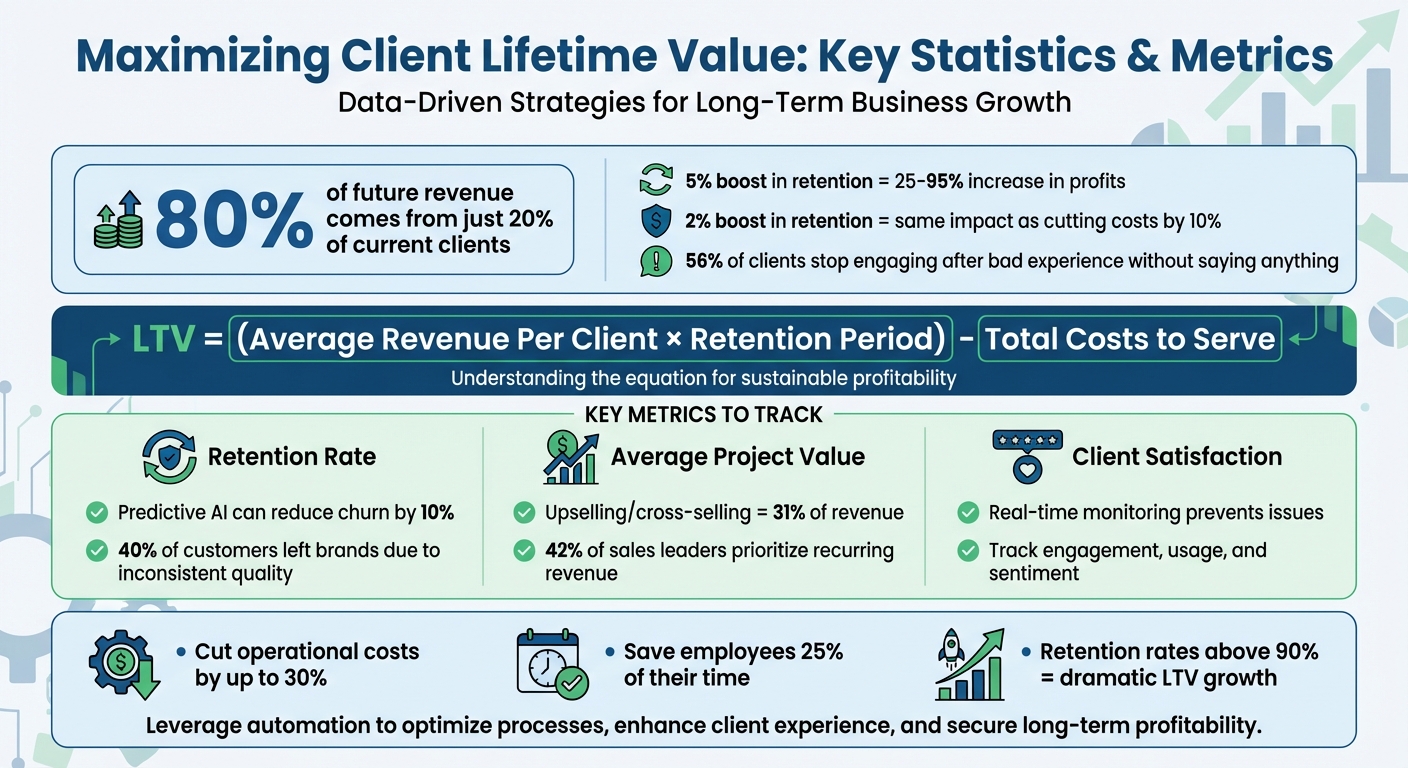
- Why LTV matters: 80% of future revenue comes from just 20% of current clients.
- How to calculate LTV: Average Revenue Per Client × Retention Period.
- Automation benefits: Reduce churn, improve engagement, and increase upsells.
- Metrics to watch: Retention rate, average project value, and client satisfaction scores.
Automation tools like Convertix.io are game-changers, especially for Upwork agencies, by saving time on repetitive tasks and enabling stronger client relationships. Ready to turn one-time clients into long-term partners? Let’s dive in.
Client Lifetime Value Statistics and Key Metrics for Agencies
Set up Self-Service Automation and increase Lifetime Value by 20%+
sbb-itb-5c5517e
Key Metrics to Track for Client Lifetime Value
Understanding the right metrics can highlight how automation impacts your business. Client Lifetime Value (LTV) is calculated as (Average Revenue Per Customer × Customer Lifespan) − Total Costs to Serve. To break this down further, focus on three key metrics: retention rate, average project value, and client satisfaction scores. These provide insights into the health of your client relationships and point to actionable improvements.
For example, a 2% boost in customer retention delivers the same financial impact as cutting costs by 10%. By tying these metrics to real-time data, automated tools can track patterns like engagement levels, spending habits, and satisfaction signals. This allows you to shift from reacting to problems to proactively managing client relationships.
Retention Rate
Retention rate measures how many clients stay with you over time, making it a critical driver of LTV. Automation plays a key role here by detecting early signs of disengagement and triggering alerts to address issues before they lead to cancellations.
For instance, automated systems can track behaviors like reduced logins or stalled feature use and then prompt tailored outreach. Research shows that predictive AI models delivering personalized interactions can reduce churn by 10%.
The importance of consistency is clear: 40% of customers stopped buying from a brand last year due to inconsistent quality. Automation ensures consistency by flagging at-risk accounts and enabling timely interventions. Tracking onboarding metrics – like training completion and tool adoption within the first 30 days – can also predict long-term loyalty.
Average Project Value
This metric, calculated by dividing total revenue by the number of projects or purchases, reveals the financial value of each client engagement. Automation can increase this value by identifying opportunities for upselling and cross-selling.
Upselling and cross-selling account for 31% of revenue, with 42% of sales leaders emphasizing recurring revenue as critical. Automated systems monitor client usage patterns to pinpoint the best moments for expansion. For example, if a client nears 80% of their plan limits or successfully adopts a key feature, automation can alert your team to discuss upgrades.
A real-world example: In 2024, Turkish retailer Boyner used Google’s AI tools to target high-value customers. The result? A 310% increase in lifetime value, 240% more new customers, and a 20% drop in acquisition costs. While this example isn’t agency-specific, the lesson holds: automation helps identify high-potential clients and the right timing for expansion efforts.
Client Satisfaction Scores
Client satisfaction scores offer a window into retention risks and opportunities. As Candice Gervase, Salesforce Team Manager at JMP Statistical Discovery, puts it: > "Customer lifetime value is a measure of customer satisfaction and commitment. How engaged are they? Are they expanding their usage and renewing each year?".
Automation can monitor satisfaction signals in real time. AI-powered tools analyze emails, chat logs, and support tickets for shifts in tone or emotional cues. If a client’s language becomes more formal or expresses frustration, the system flags the account for immediate follow-up.
This real-time feedback loop helps prevent minor issues from escalating. Automated systems can send quick surveys after milestones, acknowledge feedback instantly, and escalate negative responses to account managers for personal outreach. It’s worth noting that 80% of future revenue will come from just 20% of your existing customers, making satisfaction scores essential for identifying and retaining your most valuable clients.
How Automation Prevents and Resolves Client Issues
Keeping clients happy often depends on catching problems early. The tricky part? Most clients won’t tell you when something’s wrong – 56% of them simply stop engaging with a brand after a bad experience without saying a word. This is where automation steps in, identifying and addressing issues before clients even notice them.
Real-Time Monitoring and Alerts
Automation excels at spotting trouble quickly. By tracking behavioral signals, automated systems can detect potential issues as they arise. For example, if a client suddenly reduces their usage, a payment fails, or support tickets spike, the system flags the account as at-risk.
Health scoring tools take this a step further by combining factors like activity levels, support requests, and sentiment analysis into a single score. If a client’s score dips below a certain threshold, the system immediately alerts account managers and creates a support ticket. AI chatbots also play a role, picking up on churn signals like repeated error messages or phrases like "cancel account", and triggering follow-up actions.
Automation also tackles "passive churn", which can happen due to things like failed payments or technical issues. Automated workflows handle these hiccups by retrying payments or sending notifications, ensuring these small problems don’t snowball into bigger ones. These systems work seamlessly behind the scenes, resolving issues before they escalate.
Automated Workflow Management
Automation keeps clients engaged by scheduling follow-ups at critical points – like 30, 60, and 90 days into a project. This ensures no client gets overlooked.
The operational perks are hard to ignore. Automation can cut operational costs by up to 30% and save employees 25% of their time by handling repetitive tasks. This gives teams more time to focus on building relationships and delivering personalized service, which boosts client loyalty and lifetime value.
It’s not just about fixing problems – it’s about turning them into opportunities. For instance, if a client is nearing their plan limits, the system notifies the account manager to discuss upgrades before service interruptions occur. Similarly, automated renewal workflows kick off weeks before a contract ends, complete with value reports that showcase the client’s ROI. As Chaviva Gordon-Bennett from monday.com puts it:
"CLV changes how you make revenue decisions every single day".
Performance Dashboards and Insights
Dashboards tie everything together by providing a clear view of client data in real time. They pull information from CRM systems, billing platforms, and support tickets into one place, making it easier to spot trends – like which onboarding steps improve retention or which features drive the most engagement.
What makes dashboards powerful is their focus on actionable insights. Instead of overwhelming teams with raw data, they pinpoint specific friction points where clients often struggle. Agencies can then deploy automated solutions, such as help articles or in-app tooltips, exactly when and where clients need them. For example, Intercom’s AI chatbot, Fin, resolves 50% of support queries without human involvement using this approach.
Automated exit surveys add another layer of learning. When clients cancel, these surveys capture their reasons and feed the data back into dashboards. This helps identify recurring problems and implement fixes, creating a feedback loop that continuously improves service delivery. Together, these tools ensure businesses stay proactive, solving issues before they affect client satisfaction.
Using Convertix.io to Increase Client Lifetime Value on Upwork
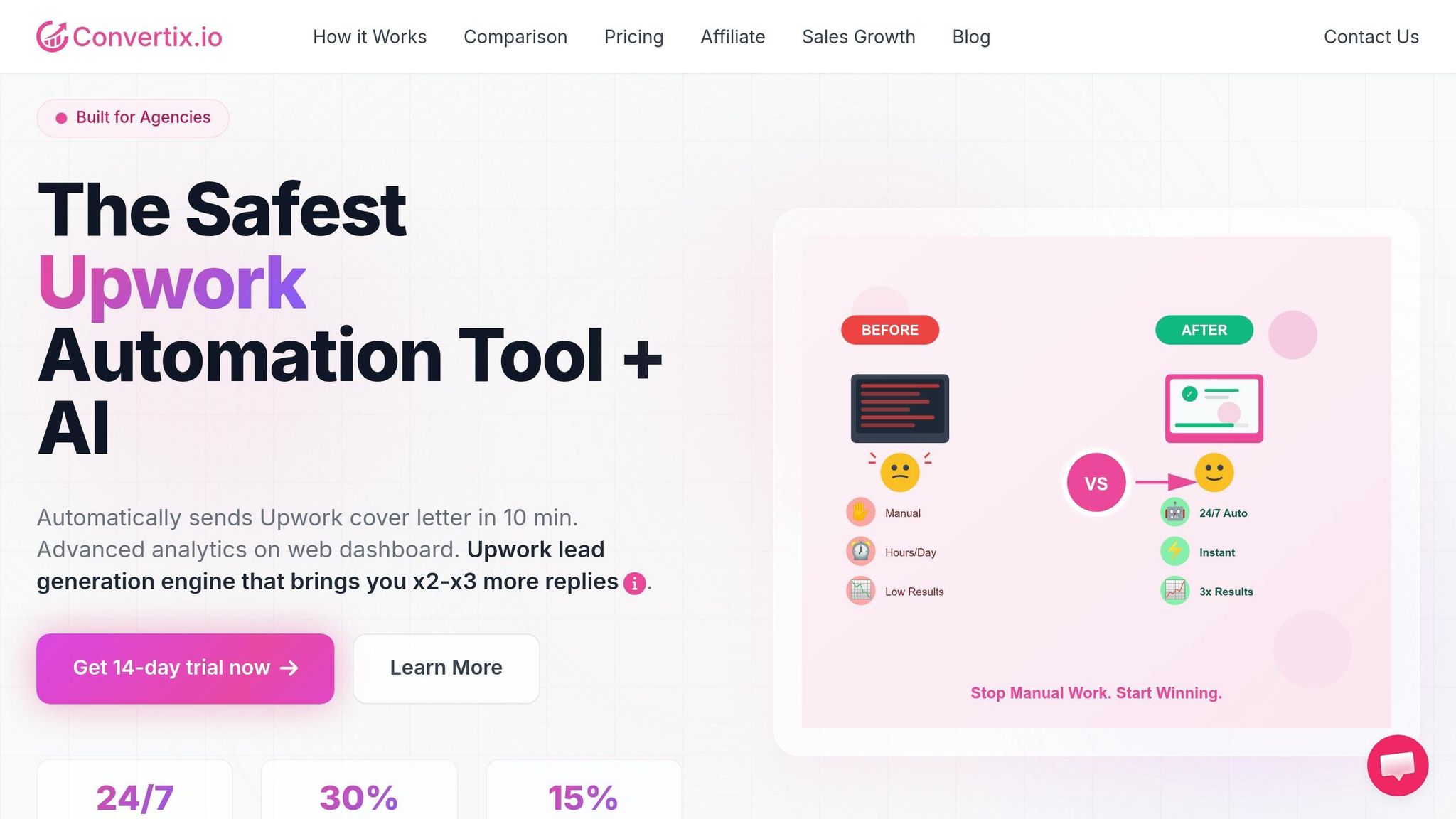
For agencies on Upwork, the real challenge often lies beyond acquiring clients – it’s about retaining them. Automation can turn short-term projects into lasting collaborations, and that’s where Convertix.io shines. By automating tasks like manual vs. automated lead generation, job matching, and proposal creation, agencies can spend less time on admin work and more time nurturing client relationships. This shift in focus helps convert one-off projects into steady, long-term income streams.
Convertix.io Features for Client Retention and Growth
Convertix.io leverages AI to simplify and optimize the client acquisition process. Its Job Relevance Check ensures agencies target projects that align with their skills and expertise. By focusing on the right opportunities, agencies increase the likelihood of delivering quality work, which naturally leads to happier clients and repeat business.
The platform also offers portfolio-centric proposal generation, which automatically selects the most relevant case studies from an agency’s portfolio. These tailored proposals highlight technical skills and past successes, giving potential clients a clear picture of the agency’s capabilities.
Speed is critical on Upwork, and Convertix.io ensures agencies stay ahead. It applies to jobs within 10 minutes of posting, operating 24/7 to capture opportunities as they arise. This quick response, combined with customized proposals, has led to impressive results: a 25–30% view rate and a 5–15% reply rate – far better than what manual outreach typically achieves.
To help agencies refine their strategies, Convertix.io includes a performance analytics dashboard. This tool tracks metrics like view rates, reply rates, and hire rates across different job categories and proposal templates. These insights help agencies identify which niches and tactics are most effective, reducing client churn and encouraging repeat engagements.
Case Study: Improving Retention with Convertix.io
The benefits of Convertix.io are evident in real-world examples. Take Skip The Noise Media, a Canadian marketing agency that has earned over $100,000 on Upwork. In 2024, they adopted Convertix.io to streamline their outreach process. According to Co-Founder Zoha, the tool reduced their weekly proposal time from 15 hours to just 3–5 hours, allowing the team to focus more on client communication and delivering quality work.
"Convertix reduced our proposal workflow from 15 hours to about 3–5 hours per week and made scaling our Upwork outreach much easier."
- Zoha, Co-Founder, Skip The Noise Media
Another success story comes from a software development agency in India that was new to Upwork. Using Convertix.io, the agency automated its outreach and, within just two days, achieved a 42% proposal view rate and a 28% reply rate. This resulted in two client replies – from the US and Israel – setting the stage for successful project delivery and potential long-term partnerships.
These examples highlight how Convertix.io not only saves time but also boosts efficiency, making it easier for agencies to secure and retain high-value clients.
Conclusion: Long-Term Benefits of Automating Client Retention
Automation transforms how agencies build and maintain client relationships. By integrating automated client management, agencies can address issues in real time while creating a foundation for consistent revenue growth. Shifting from reactive problem-solving to proactive retention strategies allows agencies to turn one-off projects into steady, predictable income. Once retention rates climb above 90%, customer lifetime value can grow dramatically.
What makes automation so effective is its ability to combine efficiency with personalization. Instead of treating all clients the same, automated systems develop unified profiles that highlight high-value accounts and flag those at risk of leaving. This enables agencies to direct their expertise toward high-priority clients while still ensuring smooth interactions with everyone. Interestingly, marketing leaders are nearly twice as likely (1.9 times) to focus on lifetime value rather than traditional metrics like click-through rates. These tailored approaches lead to noticeable gains in both client retention and revenue.
The numbers back this up. For instance, ZoomInfo achieved an impressive 98.5% retention rate in 2024 by emphasizing automated educational touchpoints. Similarly, Love, Bonito reported a 300% boost in onsite traffic within six months of launching automated email flows in 2020. Even in academia, the Carlson School of Management saw a 28% increase in applications after shifting their focus from cost-per-lead metrics to a lifetime value approach.
Key Takeaways for Agencies
Here’s how agencies can take advantage of automation to improve retention and revenue:
- Track the right metrics: Use the LTV formula – (Average Project Value) × (Project Frequency) × (Client Lifespan) – to measure long-term success.
- Set up proactive triggers: Monitor declines in communication or project activity and respond with automated workflows.
- Engage clients thoughtfully: Implement automated welcome journeys for new clients and re-engagement flows for those who’ve gone quiet.
Tools like Convertix.io make these strategies accessible for Upwork agencies by automating tasks like job matching and proposal generation. As Dan Jovevski, Founder & CEO at WeMoney, explains:
"By building look-alike audiences… we’ve reduced our customer retention costs by 2x".
Agencies that adopt automation today position themselves not just to compete but to thrive, building scalable, loyalty-driven businesses.
FAQs
What are the earliest signs a client is about to churn?
Early indications that a client may churn include less frequent logins, reduced use of features, a spike in support tickets, and visible disengagement. These patterns often emerge 30–90 days before a cancellation and can be detected through proactive monitoring and automated tools.
Which automation workflows improve retention the fastest?
The best automation workflows for improving client retention focus on proactive and personalized engagement. These workflows often rely on tools like behavioral triggers, lifecycle marketing, and predictive analytics to deliver targeted messages tailored to customer actions or stages. For example, automating renewal reminders or proactive support initiatives – such as re-engagement campaigns or customized offers – helps tackle potential issues early, reducing churn and building stronger customer loyalty.
How can Convertix.io help Upwork agencies increase LTV?
Convertix.io supports Upwork agencies in increasing client lifetime value (LTV) by streamlining crucial tasks such as job matching, creating customized proposals, and ensuring prompt client communication. By leveraging AI, it speeds up proposal submissions and monitors key metrics like reply rates, allowing agencies to work more efficiently while improving client interactions. This results in securing more projects, building trust, and nurturing lasting relationships – key factors in boosting retention and LTV.
