
Want your proposals to stand out? Use your portfolio as proof of your expertise. This is a core strategy for writing winning proposals that capture client attention. Generic proposals often fail because they list skills without showing results. By referencing specific past projects, you demonstrate your ability to solve problems and deliver outcomes clients care about.
Key Takeaways:
- Show, don’t just tell: Use portfolio examples to prove you’ve handled similar challenges.
- Tailor your examples: Match your portfolio to the client’s needs for a more targeted approach.
- Focus on results: Highlight measurable outcomes like increased sales or improved performance.
- Be concise and clear: Provide brief, impactful case studies in your proposals.
- Track your success: Monitor top metrics to track for proposal success like response and win rates to refine your strategy.
Using AI tools like Convertix.io can streamline this process, helping you scale personalized proposals while maintaining quality.
Your portfolio isn’t just a collection of work; it’s your competitive edge. Use it wisely to win more clients.
What Portfolio Insights Are and Why They Work
What Portfolio Insights Mean
Portfolio insights are the valuable takeaways you uncover by analyzing your past projects, client feedback, and outcomes. Think of them as the hidden highlights of your professional journey – those recurring patterns of success and standout moments that can give your proposals an edge.
These insights go beyond simply listing your accomplishments. They reveal which clients have praised your work, the results that consistently stand out, and the industries where you excel. By taking a closer look, you can connect the dots between your experience and the challenges you’re best suited to tackle.
Take a web developer, for example. If you notice a trend of high client satisfaction with your e-commerce projects, or clients frequently mention how your work improved website performance, that’s an insight worth leveraging. It doesn’t just show what you’ve done – it explains why your work made a difference. These insights lay the groundwork for crafting proposals that are not only specific but also persuasive.
The real difference between portfolio insights and a standard portfolio lies in the details. A basic portfolio might list your projects, but portfolio insights dig deeper. They help you pinpoint the factors behind your success and connect them directly to future opportunities. This deeper understanding allows you to align your expertise with exactly what potential clients are looking for.
Why Matching Your Portfolio to Jobs Works
Tailoring your portfolio to match a client’s needs creates an immediate and powerful connection. It’s a targeted approach that eliminates much of the guesswork for clients, making it easier for them to see you as the perfect fit for their project.
On platforms like Upwork, where many proposals can blur together, referencing specific, relevant work makes you stand out. Using an Upwork proposal generator to highlight these examples ensures you provide clear, concrete proof of how you’ve solved similar problems before.
This approach shifts the focus from vague claims to solid proof. For instance, rather than saying you’re experienced in social media marketing, you could share an example of how your content strategy boosted a company’s online engagement. That’s evidence clients can trust.
The result? Clients gain confidence in your ability to deliver, and they’re more likely to see the value in your services. Plus, this focused strategy saves time for both you and the client, while making your proposals far more impactful. By aligning your portfolio with client needs, you not only build trust but also create the foundation for a winning proposal.
Upwork proposal sample: 11 tips from a $500k freelancer
Writing Proposals Using Your Portfolio as Proof
Your portfolio can be more than a collection of past work – it’s your chance to turn a generic pitch into solid proof of your ability to tackle a client’s challenges. Think of each portfolio piece as a success story, showcasing how you’ve solved specific problems or achieved goals for previous clients. This approach not only highlights your skills but also builds trust and sets the stage for the steps outlined below.
Picking the Right Portfolio Examples
Choosing the right portfolio examples starts with understanding what the client truly needs. Carefully review the job posting, paying close attention to keywords, pain points, and desired outcomes. Then, match your examples to their specific requirements.
For instance, if a client is looking for help with responsive web design, prioritize projects that demonstrate your expertise in this area. Highlight measurable results, like improved user experience or increased conversion rates, to show the impact of your work. Understanding how to measure proposal conversion rates can help you identify which portfolio pieces perform best.
It’s also important to consider the client’s industry and audience. A project that wowed a tech startup might not resonate with a more traditional business, like a law firm. Focus on quality over quantity – it’s often more effective to showcase two highly relevant projects than to include several that only loosely align with the client’s needs. Always emphasize results, such as higher website traffic, better engagement, or delivering a project on time and within budget.
Adding Portfolio Examples to Your Proposals
Once you’ve selected the right examples, the way you present them in your proposal can make all the difference. Don’t just drop links – provide context that directly connects each example to the client’s needs.
A concise case-study format works well. Briefly explain a past project by outlining the challenge, describing your solution, and highlighting the outcome. For example, Junaid Bin Jaman, in "How to Write a Winning Upwork Proposal: A Step-by-Step Guide" (Jan 2, 2025), suggests including examples like:
"Check out my portfolio! Here are two websites I’ve developed and am particularly proud of: Reality Capture Network, Be a Happy Camper."
Make sure your examples are easy to access by including direct links or attaching files. Keep your descriptions short – just four or five sentences focused on how you solved the client’s problem. Finally, ensure your proposal aligns with the information on your Upwork profile. Any inconsistencies could lead to doubts about your credibility, so consistency is key.
Customizing Proposals with Portfolio Data
The difference between a proposal that gets ignored and one that wins the project often lies in personalization. A generic proposal can feel impersonal, while a tailored one demonstrates that you’ve taken the time to understand the client’s unique needs. Your portfolio isn’t just a collection of past work – it’s a powerful tool to craft responses that speak directly to each client. Here’s how to use it effectively to align your experience with their expectations.
Connecting Your Past Success to Client Problems
Every job posting provides clues about the challenges a client is facing. Your task is to connect the dots between their problems and your proven solutions. This goes beyond listing your skills; it’s about showing how you’ve used those skills to solve real-world business problems.
Start by identifying their key issue. For instance, if a client mentions low website conversion rates, don’t just say, “I’ve built websites before.” Instead, reference a specific project in your portfolio where you tackled similar challenges. Detail the pain points, the steps you took to address them, and – most importantly – the measurable results you achieved.
For example, instead of saying, “I improved a client’s website,” you could explain how you redesigned their checkout process, reducing cart abandonment by 20% and boosting overall sales by 15%. This level of detail shows you understand not only the technical side of the work but also its broader business impact.
Be mindful of the client’s industry. Tailor your examples to their specific context. If they’re in e-commerce, highlight your successes in online retail. For a B2B software company, focus on metrics relevant to their market, such as lead generation or user retention. The skills may be the same, but the way you frame them should resonate with their particular needs.
Answering Client Questions Before They Ask
Clients often have unspoken concerns when reviewing proposals. By addressing these proactively, you can build trust and confidence before they even voice their doubts. Your portfolio can help you tackle common worries like missed deadlines, subpar quality, or poor communication.
Timelines are a frequent concern. If a client needs a project completed within a tight window, they’ll want proof that you can deliver on time. Use your portfolio to showcase projects where you met – or even exceeded – deadlines. Share details about how you managed your time and kept the project on track under pressure.
Quality assurance is another key factor. Clients want to know they’ll get high-quality results that meet their expectations. Highlight examples of past work where you adhered to strict standards or navigated complex requirements. If you’ve worked in industries with regulatory demands, mention how you successfully met those challenges.
Communication and collaboration are often overlooked but critical concerns. Some clients worry about freelancers who are unresponsive or hard to work with. Include stories in your portfolio that demonstrate your ability to collaborate effectively – whether it’s adapting to a client’s preferred communication style, managing multiple stakeholders, or maintaining clear and consistent updates throughout a project.
Finally, budget considerations are always top of mind. Clients want to see that hiring you will provide tangible value. Use your portfolio to highlight outcomes like increased revenue, cost savings, or improved efficiency. For instance, if your work led to a 30% increase in customer retention or a 10% reduction in operational costs, share those results. These examples show not just what you did but how it benefited the client’s bottom line.
sbb-itb-5c5517e
Using AI to Write Portfolio-Based Proposals
Creating personalized proposals can be a time-consuming process, and scaling them without losing the quality clients expect is no easy feat. AI-powered tools are stepping in to change the game, automating much of the work while still delivering that tailored touch clients appreciate.
AI tools streamline the process by identifying the best portfolio matches and crafting customized narratives. This ensures every proposal feels targeted and relevant to the client’s needs, all while saving you precious time. Let’s take a closer look at how Convertix.io leverages AI to make this possible.
Main Features of Convertix.io
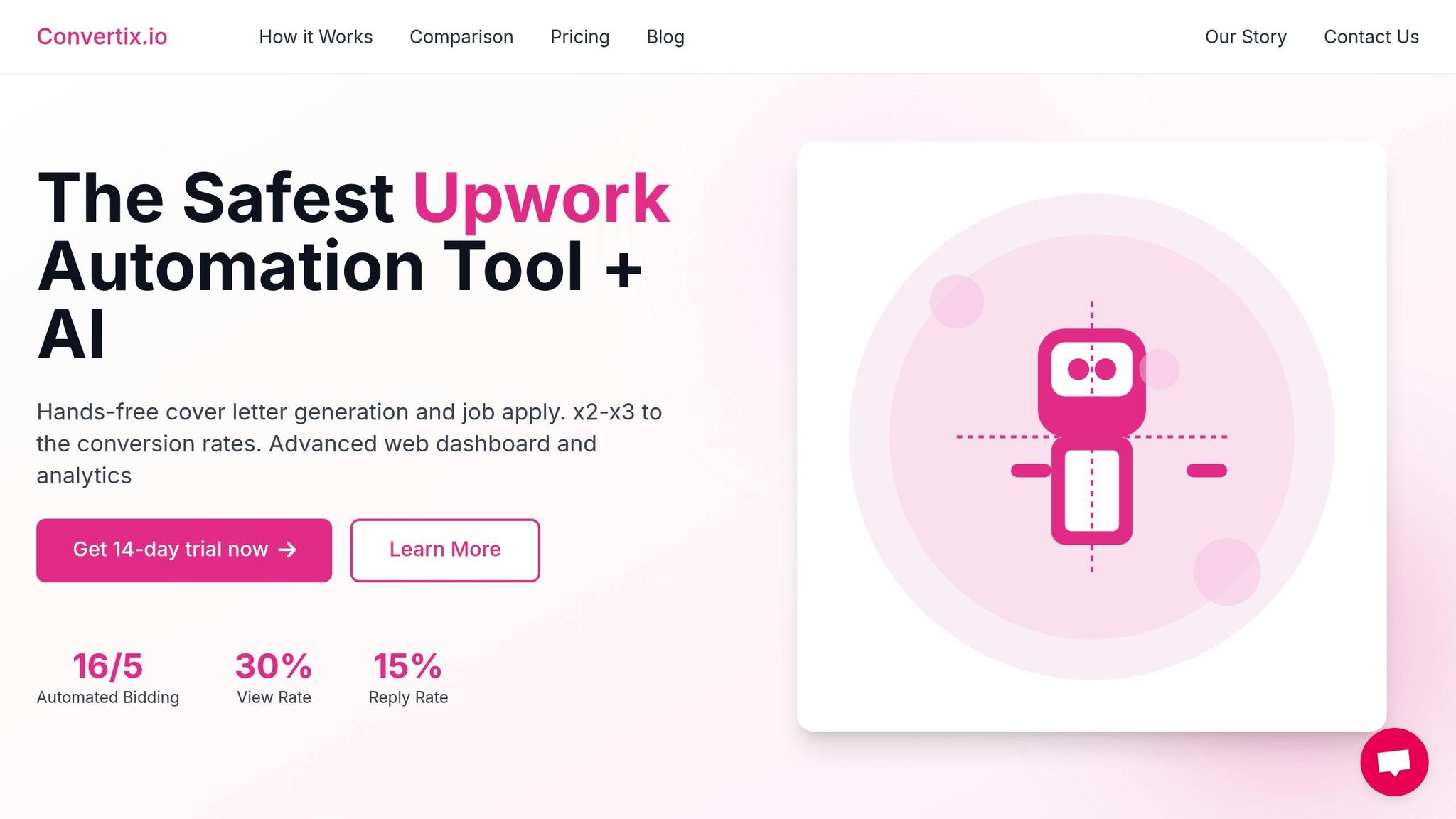
Convertix.io is a specialized AI-driven platform designed for Upwork agencies with up to 50 employees. It scans Upwork for job opportunities that align with your agency’s portfolio strengths and generates proposals that include specific project examples and performance insights tailored to each client.
Here’s what makes Convertix.io stand out:
- Performance Analytics: The platform tracks key metrics like proposal success rates, response times, and conversions. This data helps you refine your approach, identifying which portfolio examples resonate most with different clients.
- Automated Bidding: Proposals are submitted promptly, ensuring you never miss an opportunity – even when time zones work against you. The platform operates 24/7, so your agency is always in the game.
- Customizable Job Preferences: You can define the types of projects you want to target, and the system respects those choices. Over time, it learns from your feedback to improve its accuracy in matching opportunities to your strengths.
How AI Makes Proposal Writing Better
AI doesn’t just save time – it transforms the entire proposal-writing process. Tasks that might take a human writer 30 minutes can now be completed in just a few minutes, all while maintaining consistent quality. Unlike humans, who may struggle with fatigue or workload, AI delivers the same high standard every time.
The system also ensures compliance with Upwork’s guidelines, reducing the risk of proposal rejections. It adapts to platform-specific requirements and adjusts to any updates in Upwork’s rules, taking one more headache off your plate.
Higher conversion rates are another big win. AI excels at matching portfolio examples to client needs with precision. While human writers might overlook relevant projects or fail to clearly connect past work to current requirements, AI systematically analyzes all available data to find the strongest matches.
For agencies on Upwork, scaling personalization is a common challenge. As your agency grows, it becomes harder to maintain the individual touch that wins projects. AI bridges this gap by ensuring that even a high volume of proposals retains the level of customization clients expect.
What’s more, AI systems improve over time. As they process more proposals and receive feedback on their success, the system fine-tunes its approach. This means your proposals become increasingly effective the longer you use the platform.
Finally, AI reduces risks. By automating the proposal process and staying within Upwork’s terms of service, agencies can scale their operations without worrying about manual errors or guideline violations that could jeopardize their accounts. It’s a smart way to grow your business while keeping things secure.
Tracking Proposal Results and Improving with Portfolio Data
Measuring how well your proposals perform goes beyond just counting wins and losses. The real game-changer is understanding which portfolio examples are driving client engagement and conversions. Without proper tracking, you’re essentially flying blind, missing out on opportunities to refine your strategy and land more projects.
The secret lies in mapping your entire proposal process and spotting trends in how you use your portfolio. When you identify the projects that resonate most with clients, you can lead with your strongest examples and continuously improve your approach based on actual data. This feedback loop is the backbone of a smarter proposal strategy.
Key Metrics to Monitor
Your proposal success hinges on several metrics that work together to tell the full story. Here are the most critical ones:
- Response rates: This measures how many clients reply to your proposals. A solid response rate on Upwork typically falls between 20-40%, meaning about one in three to one in five clients will engage with you. If this number is low, your initial hook or portfolio examples may not be catching attention.
- Interview rates: This metric shows how well your portfolio and project plans convince clients to take the next step. Aim for 10-25% of your proposals to result in interview requests. If responses are coming in but interviews aren’t, your portfolio might not be aligning with the client’s specific needs.
- Win rates: This reveals how often you close deals after getting a client’s attention. A healthy win rate ranges from 3-10%, with interview-to-hire conversions hitting 15-30%. Low win rates may signal that your portfolio isn’t showcasing value effectively or addressing client concerns.
- Proposal freshness: Timing plays a huge role. Response rates tend to drop after 60-90 minutes of a job posting going live, and they decline even further once more than 10 competitor bids are submitted. This also impacts how your portfolio is perceived by clients, so speed matters.
To track all this, you don’t need complex tools – just a detailed spreadsheet. Include around 20 columns to log job details, portfolio examples used, client responses, and costs. You can even create a Proposal Quality Score (PQS) on a 1-5 scale to rate each proposal based on engagement factors.
A great example of the power of tracking comes from a case study where 15 digital marketing agencies implemented systematic proposal tracking. The results? They saw a 120% increase in proposal view rates, a 150% boost in lead responses, and secured $8 million in new business on Upwork.
Leveraging Portfolio Data for Better Proposals
Once you’ve set benchmarks using these metrics, you can dive into your portfolio data to fine-tune your proposals. By analyzing trends, you’ll quickly see which examples generate the best results. For instance, you might notice that certain projects consistently lead to higher response rates, while others fail to connect with specific client types. This insight becomes your guide for refining your portfolio.
To dig deeper, segment your results by factors like service type, industry, budget, and timing. For example, you might find that your e-commerce projects resonate with retail clients but not as much with B2B companies. Or perhaps mobile app examples drive more interviews than web development ones. These patterns can help you tailor your proposals more effectively.
Experimentation is key. Test different portfolio examples across 20-30 proposals each week and analyze the results. This approach helps you identify what truly drives conversions rather than relying on guesswork.
Don’t forget to factor in the cost per proposal (CPP) when evaluating portfolio effectiveness. Include costs like Upwork Connects, writing time, and tools. If certain portfolio examples consistently lead to higher-value projects, it’s worth investing more time in crafting detailed proposals around those strengths.
Timing also matters. Conduct daily "Bid Sprints" where you submit proposals within 30-90 minutes of a job posting. Use your best-performing portfolio examples first, as early submissions tend to get more attention.
Let the data guide your decisions. For example, low response rates might mean your job filters are too broad or your portfolio isn’t specific enough for the client’s industry. On the other hand, low interview rates could indicate that your portfolio examples aren’t clearly tied to project outcomes or that you’re not proposing actionable next steps.
The most successful agencies don’t leave this to chance. They review their metrics weekly, doubling down on strategies that work and eliminating those that don’t. By turning proposal writing into a data-driven process, you can transform it from a guessing game into a reliable system for winning more clients.
Conclusion: Improve Your Proposals with Portfolio-Based Methods
Your portfolio isn’t just a collection of past work – it’s your strongest tool for landing Upwork projects. In fact, freelancers with a portfolio are hired 9x more often than those without one. If that statistic doesn’t grab your attention, it should. A portfolio isn’t optional; it’s essential.
To truly elevate your proposals, start treating your portfolio as a strategic asset. Use it to showcase specific projects with outcome-focused titles, clear context, and measurable results. These examples become undeniable proof of your expertise, making it hard for clients to say no.
Personalization becomes much easier when your portfolio is well-organized. You can quickly pull relevant examples that align with a client’s needs, then highlight those directly in your proposal. This approach demonstrates that you not only understand their challenges but have already solved similar ones.
Structured portfolio narratives are key to building client confidence. Using the STAR method – Situation, Task, Action, Result – lets you present your projects in a way that’s both concise and impactful. Focus on measurable results when referencing portfolio items, such as “PDP Speed Pack (LCP 4.1s → 2.3s)”. These details grab attention and show real value.
Since clients often skim through proposals, make it easy for them to see your expertise. Include portfolio links that provide immediate, verifiable proof of your skills. For jobs requiring specific experience, attach work samples that aren’t in your public portfolio but are directly relevant.
For agencies looking to scale this approach, Convertix.io offers a solution. It automates portfolio-based proposal creation, matching your work to job requirements while maintaining quality. With plans starting at $299/month for 300 proposals, it’s a way to scale your efforts without losing the personal touch.
By tracking which portfolio examples generate the best response and win rates, you can increase your Upwork reply rate and refine your proposals even further. Focus on the examples that resonate most with clients, and let the data guide your strategy.
Your portfolio is your edge. Use it wisely, track its performance, and you’ll see your proposal success rates soar. Agencies and freelancers alike can prove their value with clear, results-driven examples.
FAQs
How can I use my portfolio to create proposals that meet a client’s specific needs?
When putting together proposals that truly connect with clients, it’s important to feature portfolio examples that directly relate to their industry or the specific project at hand. Include key details for each example, such as the challenges you tackled, the solutions you provided, and the results you delivered. This not only highlights your skills but also shows how your work aligns with their objectives.
Customizing your proposal with relevant examples shows that you understand their needs and have the experience to meet them. A well-targeted and thoughtfully crafted portfolio can significantly boost your chances of securing the project.
How can I use portfolio insights to track and improve my proposal success rates on Upwork?
To boost the success of your proposals, start by diving into the data from your portfolio. Pay attention to metrics like win rates, client feedback, and the types of projects where you’ve had the most success. Spotting trends in these areas can help you focus on the kinds of work you’re most likely to win, allowing you to craft proposals that highlight your strengths.
Take a close look at how quickly you respond to opportunities, the quality of your proposal content, and how well your skills align with what clients are asking for. Use this information to fine-tune your approach – emphasize your most relevant experience and showcase past projects that directly support the client’s objectives. By regularly refining your proposals based on these insights, you’ll improve their relevance and increase your chances of winning more work.
How can AI tools like Convertix.io make writing proposals more effective and personalized?
AI tools such as Convertix.io simplify the creation of personalized proposals by automating tasks like job matching and proposal writing. This not only saves time but also ensures that each proposal aligns closely with the unique needs of individual clients.
By evaluating client requirements and leveraging a portfolio-driven approach, Convertix.io creates proposals designed to connect with clients on a deeper level. This focused method enhances client engagement and increases conversion rates, giving freelancers and agencies a competitive edge in a crowded market.
