
When it comes to winning projects on Upwork, agencies often face a choice: AI for speed or humans for precision. AI tools can quickly draft proposals and monitor job feeds 24/7, while humans excel at interpreting complex briefs, building client trust, and tailoring pricing. The best strategy? A hybrid approach that combines the strengths of both. Here’s a quick breakdown:
- AI Bidding: Fast, scalable, and consistent. Great for repetitive tasks but struggles with nuance and personalization. Costs $150–$300/month.
- Human Bidding: Precise, relationship-focused, and better at pricing. Limited by time and fatigue. Costs $5–$12/hour.
- Hybrid Model: AI drafts proposals; humans refine them. Balances speed and quality, making it ideal for growth.
Key Insight: Agencies using a hybrid system report higher win rates and better ROI, blending AI efficiency with human expertise.
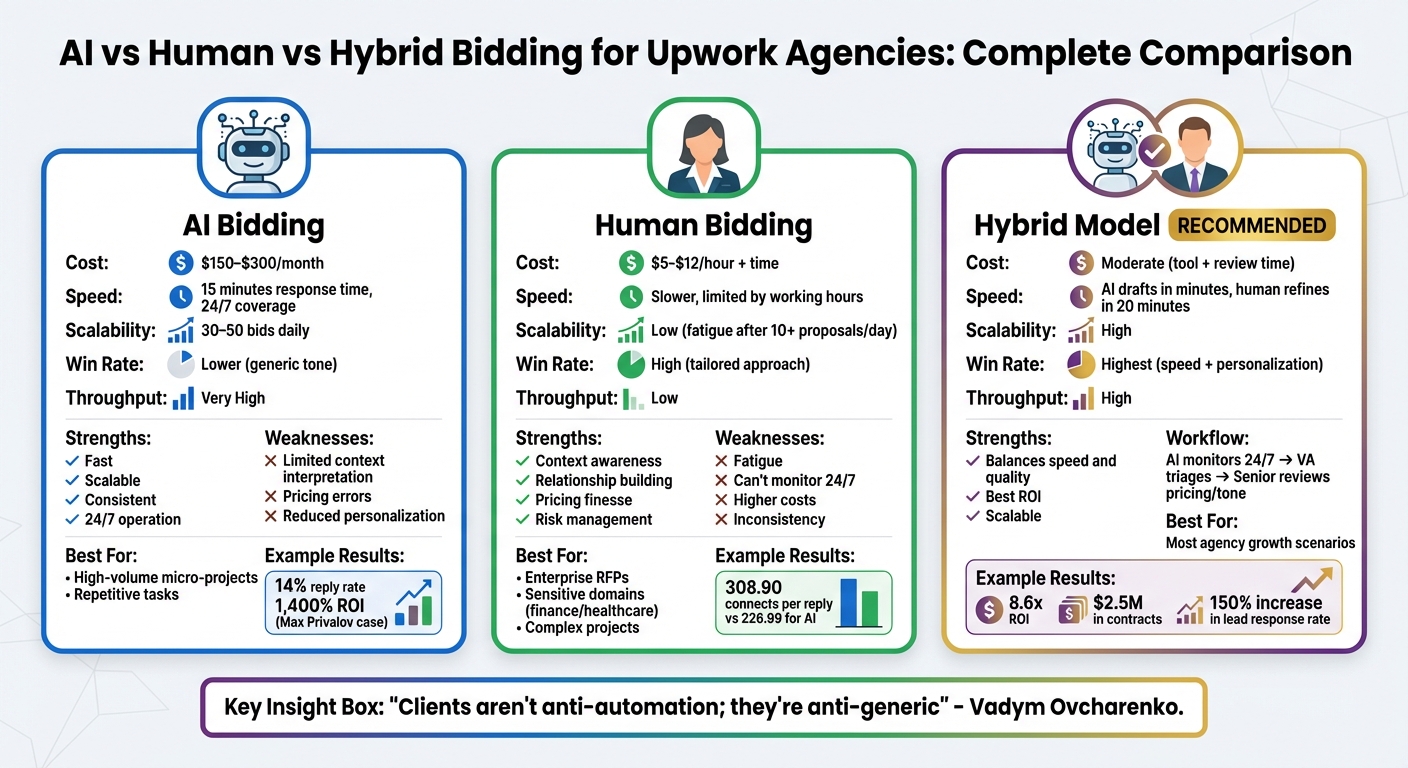
AI vs Human vs Hybrid Bidding: Cost, Win Rate, and Throughput Comparison for Upwork Agencies
I Built An AI Agent That Automates Upwork ($500K+ Earned)
sbb-itb-5c5517e
AI Bidding for Agencies: Pros and Cons
AI bidding tools are designed to streamline repetitive tasks like monitoring job postings, parsing project details, and creating proposals. By automating these routine processes, agencies can focus on more strategic activities. However, while these tools offer some clear advantages, they also come with challenges that agencies need to weigh carefully.
Benefits of AI-Powered Bidding Tools
One of the biggest strengths of AI bidding tools is speed. These tools can generate and submit tailored proposals within 15 minutes of a job being posted – a huge advantage when job postings often receive dozens of proposals within the first hour. For example, IT Squad, a web development agency founded by Max Radko, used AI to reduce its response time from 2 hours to under 10 minutes. This change increased their reply rate from 5–7% to 15–25% and helped them earn over $80,000 in their first year on Upwork. By leveraging AI, agencies can secure early visibility while saving their team’s energy for meaningful client interactions.
Another major perk is scalability. With AI, agencies can submit 30–50 well-crafted bids daily while saving up to 30 hours a week on repetitive tasks. A great example is Max Privalov, an agency executive, who used AI tools to send 1,000 bids with a $4,000 monthly budget, resulting in 140 replies (a 14% reply rate) and closing 3 deals – a return on investment of 1,400%. This level of efficiency allows agencies to ramp up their bidding efforts without increasing their workload, letting teams focus more on closing deals rather than drafting proposals.
24/7 operation is another game-changer. AI tools work around the clock, capturing opportunities from different time zones that might otherwise be missed. Some agencies report a 20–30% increase in qualified leads from international clients by securing projects posted during off-hours.
AI also delivers consistency. It ensures every proposal aligns with your brand’s tone and uses a library of case studies and performance metrics to enhance quality. Unlike humans, who might overlook details when tired, AI tools consistently draw from proven examples to put your agency’s best foot forward. They also help filter out scams and low-value projects, saving your team’s time and resources. Some tools even automate follow-ups, sending reminders at 24 and 72 hours to keep your agency top-of-mind without requiring manual effort.
While these benefits are compelling, there are some trade-offs to consider when comparing manual vs. automated lead generation.
Drawbacks of AI Bidding
Despite its advantages, AI bidding has its limitations. A key issue is limited context interpretation. AI often struggles with vague job descriptions, missing subtle clues about project scope or risks that a human might catch. This can lead to misunderstandings about what the client actually needs.
Another common problem is pricing and scoping errors. AI relies heavily on templates and may not account for project-specific variables. This can result in proposals that either underprice complex work or overprice simpler tasks, both of which can hurt your chances of winning the bid.
Reduced personalization is another concern. Without human input, AI-generated proposals can feel generic or impersonal, which might erode trust and weaken your brand’s reputation. AI can’t read a client’s tone, address objections in real time, or establish the kind of credibility that builds strong client relationships.
There’s also a platform compliance risk. Over-automation or patterns that resemble spammy behavior can trigger Upwork’s algorithms, potentially putting your account at risk. To avoid this, many agencies adopt a "human-in-the-loop" approach, where a person reviews and approves every proposal before it’s sent. This ensures both quality and compliance.
| Feature | AI Bidding | Human Bidding |
|---|---|---|
| Speed | Real-time; 24/7 coverage | Slower; limited by working hours |
| Context Awareness | Low; misses subtle "red flags" | High; interprets vague briefs |
| Consistency | High; follows strict tone guides | Variable; prone to human error |
| Pricing Finesse | Limited; uses static templates | High; frames options and value |
| Relationship Building | None; generic output | High; reads tone and builds trust |
Human Bidding for Agencies: Pros and Cons
AI might dominate when it comes to speed and handling large volumes, but human bidders bring something irreplaceable to the table: judgment. They can interpret ambiguous job postings, spot subtle details, and build trust with clients in a way that machines simply can’t. That said, these strengths come with trade-offs, particularly in terms of time and scalability. The ideal approach often lies in combining human expertise with AI efficiency for a well-rounded bidding strategy.
Benefits of Human-Led Bidding
Human bidders shine when it comes to understanding nuance. For example, if a client says they need "a simple website", a human can dig deeper to figure out whether they’re looking for a basic landing page, a full-fledged e-commerce site, or something else entirely. They also pick up on unspoken details – like budget constraints or potential risks – that might not be immediately obvious in the job post.
Another strength is managing risk. Skilled bidders often recommend starting with a small, paid milestone, such as a prototype or an audit. This approach allows clients to test the waters before committing to a larger project, which can build confidence and set the stage for a long-term partnership.
Pricing is another area where humans excel. They can create tailored pricing models, offering options like tiered packages (e.g., a basic MVP versus a full build), retainers, or even performance-based pricing. This flexibility often aligns better with client needs and reinforces trust.
Building relationships is perhaps the most critical advantage. Humans can handle objections, read tone, and provide thoughtful, senior-level responses that reassure clients. Yaroslav Golovach, founder of Codemotion, emphasized this when he said:
"Our goal was to build a solid reputation. Even if something went wrong, we would refund the money. It was all about keeping the client happy and getting good feedback".
This focus on relationships helped Codemotion grow to over 100 employees and $10 million in revenue by 2024, all while maintaining a reputation for niche expertise.
Finally, humans can qualify leads quickly and strategically as part of a lead generation strategy. An experienced bidder can assess a job post in under a minute, evaluating factors like budget and client alignment far more effectively than automated filters.
Drawbacks of Human Bidding
Despite their strengths, human bidders face limitations that can hinder scalability and efficiency. One major issue is fatigue. The quality of proposals tends to drop after more than 10 targeted submissions in a single day. Crafting a high-quality proposal involves significant time – 5–10 minutes to qualify a post and another 10–20 minutes to draft – which makes scaling difficult without additional resources to grow your agency.
Another challenge is speed-to-lead. Humans can’t monitor job feeds 24/7, meaning they often miss the critical first hour when response rates are highest. Data from Summer 2024 shows that manual proposals required 308.90 connects per reply, compared to 226.99 connects for AI-generated proposals. Similarly, manual bidding cost 191.75 connects per view, while AI-driven methods needed just 99.20.
Scaling human-led bidding also introduces higher costs and complexity. Hiring a virtual assistant for bidding typically costs $5–$12 per hour, not including the time and resources needed for training and oversight. Add in missed leads and duplicated efforts, and the overall cost of manual bidding can climb significantly.
Inconsistency is another issue. Proposal quality can vary from person to person, and fatigue often leads to mistakes like using generic templates, attaching irrelevant work samples, or poorly defining milestones. These missteps can erode client trust and hurt the agency’s reputation.
While human bidders bring undeniable value, these challenges highlight the importance of integrating automated methods to strike a balance.
| Feature | Human Bidding | AI Bidding |
|---|---|---|
| Speed-to-Lead | Slow; limited by active hours | Instant; 24/7 monitoring |
| Context & Nuance | High; excels at interpreting vague briefs | Limited; may miss subtle cues |
| Scalability | Challenging; requires additional hiring | High; efficiently handles large volumes |
| Cost Model | High labor costs | Fixed subscription; lower marginal costs |
| Relationship Building | Strong; builds trust and rapport | Weaker; best used for initial preparation |
Choosing Between AI, Human, and Hybrid Bidding
When deciding how to approach bidding – whether through AI, human expertise, or a mix of both – it’s essential to align your choice with the unique demands of your projects and the resources your agency has at its disposal. Many agencies find that blending these approaches yields the best results, with the exact combination depending on factors like project complexity, response speed, and team capacity.
When to Use AI, Human, or Hybrid Approaches
Pure AI bidding is ideal for repetitive, high-volume tasks where speed outweighs the need for deep customization. For example, projects like bug fixes or website migrations benefit from AI’s ability to monitor continuously and draft proposals in a matter of minutes.
Human-led bidding shines in scenarios where trust, nuance, and expertise are critical. This includes enterprise-level RFPs, audits, and industries like finance or healthcare, where precision and understanding of complex requirements are necessary. When jobs involve interpreting vague details, identifying hidden risks, or creating custom pricing structures, human judgment plays a key role. Fields like Data/AI services or brand strategy often require a consultative approach that relies heavily on human insight and relationship-building.
Hybrid models combine the advantages of both, offering a balanced approach that many agencies find highly effective. For example, in 2025, five bookkeeping and accounting agencies used a hybrid system where AI handled intake, and senior leads focused on pricing. This strategy led to $2.5 million in secured contracts and a 150% increase in Upwork reply rates. Similarly, an AI-automation agency achieved an 8.6x ROI by automating job discovery and proposal drafting while ensuring human oversight.
Here’s how a hybrid pipeline typically operates: AI tracks job feeds and drafts initial proposals, a Virtual Assistant organizes and prioritizes submissions, and a senior team member finalizes pricing and adjusts the tone. This setup allows machines to handle repetitive tasks while humans focus on decision-making. As Vadym Ovcharenko puts it:
"The question isn’t whether robots replace people. It’s how to design a system where machines do boring, repeatable steps and people do judgment calls".
To optimize efficiency, prioritize job routing. For instance, high-priority ("P1") jobs should trigger real-time alerts for immediate action, while lower-priority ("P2") jobs can be addressed during scheduled review windows when the team has capacity.
Getting Better Results with Hybrid Models
Hybrid models deliver a winning combination of speed and personalization. AI ensures quick responses by drafting proposals in minutes, while humans refine these drafts to align with the client’s specific needs. This includes adjusting tone, adding tailored proof points, and crafting custom pricing options. The result? Proposals that are not only timely but also highly relevant.
Agencies using this layered approach have reported notable improvements in performance metrics. The secret lies in treating AI as a tool for generating first drafts while relying on human oversight to ensure every proposal addresses client pain points and meets clear acceptance criteria. On average, this review process takes just 20 minutes but significantly boosts completion rates.
To transition smoothly into a hybrid system, consider a 10-day rollout plan:
- Document your service offerings and gather proof assets like case studies and portfolios.
- Set up AI alerts and pilot the drafting process with a senior reviewer.
- Once the system is stable, introduce a Virtual Assistant to scale the triage process.
Additionally, implement a "micro-milestone" policy. Offer small, paid initial steps – such as an audit or prototype – with clear deliverables to build trust and minimize client risk early in the process.
From a cost perspective, hybrid models often strike the perfect balance. While pure AI has the lowest cost per proposal, it tends to deliver lower win rates due to its generic tone. On the other hand, human-only bidding achieves higher win rates but is labor-intensive and harder to scale. Hybrid models combine the strengths of both, offering high throughput and the best win rates by blending speed with a personalized touch.
| Approach | Cost per Proposal | Win Rate | Throughput | Best For |
|---|---|---|---|---|
| Pure AI | Lowest ($150–$300/month) | Lower (generic tone) | Very High (24/7) | High-volume micro-projects |
| Human (VA/Principal) | Highest ($5–$12/hour + time) | High (tailored approach) | Low (fatigue-limited) | Enterprise RFPs, sensitive domains |
| Hybrid (AI + Human) | Moderate (tool + review time) | Highest (speed + personalization) | High (scalable) | Most agency growth scenarios |
Vadym Ovcharenko captures this balance perfectly:
"Clients aren’t anti-automation; they’re anti-generic".
Convertix.io: AI Bidding for Upwork Agencies
Why Agencies Use Convertix.io
Convertix.io showcases how automation powered by AI can seamlessly integrate with human input to improve efficiency. This tool operates around the clock, submitting proposals within roughly 10 minutes – a key advantage when many clients make decisions in under 30 minutes. By analyzing an agency’s portfolio, Convertix.io identifies the best-suited projects, tech stacks, and URLs for each job, crafting tailored cover letters to match specific requirements. Agencies can also set custom prompts, such as required technologies or niche expertise, ensuring only relevant jobs are targeted. This feature helps conserve Upwork connects. For scenarios requiring human judgment, the AI instantly notifies users via Slack or Telegram, allowing manual review when needed. This balance of speed and human oversight is a prime example of the hybrid model at work.
The time savings for agencies are substantial. Zoha, Co-Founder of Skip The Noise Media, shared:
"Convertix reduced our proposal workflow from 15 hours to about 3–5 hours per week and made scaling our Upwork outreach much easier."
This tool is a game-changer for scaling without hiring more proposal managers.
Getting started is quick, with setup taking just 1–3 days compared to the weeks required to onboard and train a human lead generator. Convertix.io also ensures compliance with Upwork’s Terms of Service by using proprietary automation that operates within real browser environments rather than relying on Upwork’s API. Additionally, its advanced analytics dashboard tracks key metrics like view rates, reply rates, and hire rates, offering agencies valuable insights into their performance across job streams, cover letter templates, and team members involved.
Convertix.io Pricing Plans
Convertix.io offers flexible pricing options to suit agencies of different sizes and needs.
There are three main plans to choose from. The Starter plan is priced at $299 per month and supports up to 300 proposals, including advanced portfolio matching and priority support – perfect for agencies just beginning to explore AI bidding. The Advanced plan costs $599 per month, allowing for 600 proposals and providing custom portfolio optimization along with 24/7 dedicated support. For larger or more complex operations, the Bespoke plan offers unlimited proposals, custom features, and a dedicated account manager, with pricing tailored to specific needs.
| Plan | Monthly Cost | Proposals/Month | Key Features |
|---|---|---|---|
| Starter | $299 | 300 | Advanced portfolio matching, Priority support |
| Advanced | $599 | 600 | Custom portfolio optimization, 24/7 support |
| Bespoke | Contact Us | Unlimited | Custom features, Dedicated account manager |
All plans include a 14-day free trial and a 7-day money-back guarantee. At $299 per month, the Starter plan is a budget-friendly alternative to hiring a lead-generation manager, which typically costs over $1,200 per month. With integrated analytics, agencies can track bids, win rates, and revenue generated, making it easy to measure ROI.
Conclusion: Selecting the Right Bidding Strategy
By blending the speed of AI with the personal touch of human expertise, your agency can strike the perfect balance to meet its unique needs. The best approach depends on factors like proposal volume, project complexity, and your growth objectives. AI works tirelessly, scanning job feeds around the clock and drafting proposals in minutes. Meanwhile, human bidders excel at building relationships and tackling complex, high-value projects that demand careful attention to detail.
A hybrid bidding model has proven to be highly effective. For example, in 2025, one automation-driven agency reported an impressive 8.6x ROI by combining AI’s real-time job discovery with AI-assisted proposal drafting.
This layered approach – using AI for drafting, virtual assistants for triaging, and experienced professionals for final pricing and tone adjustments – can cut proposal preparation time by at least a third while maintaining critical human oversight.
Take Convertix.io as a case study. This platform seamlessly integrates AI efficiency with strategic human involvement. At $299/month for the Starter plan, it offers a cost-effective alternative to hiring a full-time lead-generation manager, providing 24/7 job coverage and portfolio-based matching. Its analytics dashboard tracks key metrics like view rates, reply rates, and hire rates, turning bidding into a system you can measure and refine.
Whether your agency handles 300 proposals per month or is scaling up with the Bespoke plan for unlimited proposals, the key lies in combining machine precision with human insight. Use the built-in analytics to evaluate your ROI and fine-tune your strategy based on your agency’s strengths. The right mix of technology and human expertise can help you achieve both efficiency and meaningful client relationships, setting the stage for long-term success.
FAQs
How do I set up a hybrid bidding workflow for my agency?
To build a hybrid bidding workflow on Upwork, blend AI tools with human expertise. AI can take care of repetitive tasks like scanning job feeds, drafting initial proposals, and setting up follow-up reminders. Meanwhile, a team member should step in to fine-tune proposals, manage pricing strategies, and foster strong client relationships. This combination allows you to leverage AI’s efficiency while relying on human judgment for final reviews and strategic decisions. The result? A more streamlined process, lower costs, and higher chances of winning projects.
What should humans review before sending an AI-generated proposal?
Humans should carefully assess the tone, pricing, qualifications, project scope, and compliance of an AI-generated proposal. Doing so ensures the proposal feels accurate, tailored to the client, and reliable – key factors in building trust and confidence.
How can I avoid Upwork compliance issues when using AI bidding?
To stick to Upwork’s Terms of Service, it’s important to maintain transparency and follow the platform’s rules. For example, avoid activities like paying or communicating with clients outside of Upwork.
When handling tasks such as qualification, pricing, or client management, make sure to include a human touch. This helps prevent any risk of misrepresentation. Also, steer clear of sending fully automated proposals without adding a personal touch or reviewing them first – this could go against Upwork’s guidelines for authenticity.
The best approach? Combine AI with human input. This way, you can stay compliant while still making the most of automation.
