
Personalized outreach is no longer optional – it’s the standard. Reply rates for cold emails have dropped from 8.5% in 2019 to just 4% today. But AI is changing the game, helping businesses achieve response rates of up to 18% by automating and scaling personalization efforts.
Here’s how you can use AI to improve your outreach:
- Data Enrichment: AI tools analyze company size, tech stacks, funding, and hiring trends to build detailed profiles in seconds, boosting response rates to 15–25%.
- Dynamic Content Creation: Natural Language Processing (NLP) crafts hyper-personalized messages by pulling insights from LinkedIn profiles, news, and more, increasing reply rates to 6–20%.
- Multi-Touch Automation: AI adjusts follow-ups based on recipient behavior, like email opens or clicks, reducing manual work by 70–85%.
- A/B Testing: AI tests and refines outreach strategies, improving response rates by 40–60%.
- Inbox Rotation: AI manages email deliverability by rotating accounts and protecting sender reputations, ensuring emails land in primary inboxes.
These strategies help you send over 1,000 personalized emails weekly while maintaining quality. For platforms like Upwork, tools such as Convertix.io automate job matching and proposal generation, making outreach more effective. The key is combining AI’s efficiency with a human touch for quality assurance.
How to Personalize Cold Email Outreach at Scale With AI to Get More Replies
sbb-itb-5c5517e
1. AI-Powered Prospect Data Enrichment and Analysis
Personalized outreach at scale starts with one critical element: understanding your audience. AI-powered data enrichment takes basic contact lists and turns them into detailed prospect profiles filled with actionable insights. These systems gather firmographics (like company size and revenue), technographics (their tech stack), and behavioral signals (such as recent funding or hiring trends) in just seconds.
Modern platforms use a “waterfall” approach, tapping into multiple data providers one after another until they secure verified contact information. This ensures that records are as complete as possible. Maria Akhter from Outreach sums it up perfectly:
If researching one account takes your best rep an hour, AI completes that research across 500 accounts overnight.
Scalability for High-Volume Outreach
The magic of AI becomes even more apparent when you’re working at scale. Instead of manually researching every lead, AI removes the bottleneck, enabling teams to send out over 1,000 personalized emails per week – up from just 100. This is where the “15-5-1 Rule” comes into play: for every 15 signals flagged, 5 are worth outreach, and 1 gets individual-level personalization. By focusing resources on high-priority prospects, this approach ensures efficiency without compromising quality.
For agencies on platforms like Upwork, tools such as Convertix.io apply these enrichment principles to analyze project details and generate tailored proposals, making outreach feel personal and relevant.
Impact on Engagement Metrics
The results speak for themselves. Campaigns that leverage AI-enriched data see response rates climb to 15–25%, compared to just 3–8% for generic templates. Even small touches, like personalized subject lines, can increase open rates by 26%. And once conversations start, enriched personalization leads to meetings being booked at 40–60% higher rates. For example, referencing a prospect’s recent funding round or their use of tools like Salesforce or HubSpot shows you’ve done your homework – and that level of detail can make all the difference.
This enriched data is the cornerstone for creating dynamic, personalized content in the next stages of your outreach strategy.
2. Dynamic Content Generation with Natural Language Processing
Natural Language Processing (NLP) takes enriched prospect data and turns it into highly personalized messages. By analyzing enriched profiles, NLP transforms raw information into context-aware communication. These systems go beyond basic placeholders, scanning sources like LinkedIn profiles, company updates, and recent news for relevant “triggers.” The result? Messages that address specific challenges, such as referencing a recent funding round, a key executive hire, or changes in a company’s tech stack.
Personalization Depth and Relevance
The leap from traditional mail merge to modern NLP lies in the level of customization. AI doesn’t just fill in names; it evaluates prior interactions, current news, and role-specific challenges to suggest email drafts directly in tools like Gmail or Outlook. For example, it might combine insights from a recent podcast appearance and a new job posting to craft an outreach email that feels deeply relevant. Nathan Thompson from Copy.ai explains:
AI for outbound personalization is not just an advanced mail merge. It is a system that automates the complex process of researching prospects, analyzing data, and drafting highly tailored outreach messages at scale.
NLP also generates multiple options for introductions and calls-to-action, giving sales reps the flexibility to choose the tone that feels most authentic. The key is starting with the prospect’s priorities or recent initiatives – not your product.
Impact on Engagement Metrics
AI-driven content consistently outperforms generic messaging. Personalized subject lines powered by AI achieve 26% higher open rates, while reply rates can jump from 0.5–2% to 6–20%+. Hooks tied to specific events, like a recent milestone, see a 10.01% reply rate, compared to just 4.39% for problem-focused hooks.
A standout example comes from Kayo Sports, Australia’s largest sports streaming service. By integrating an AI personalization engine with Braze, they scaled their communication variations from 300 to 1.2 million. This shift to 1:1 marketing led to a 14% increase in subscriptions, an 8% rise in average annual occupancy, and a 105% boost in cross-sells.
Ease of Implementation for Agencies
For agencies juggling multiple clients, NLP eliminates the bottleneck of manual personalization. While a human rep might craft 10–15 high-quality emails daily, AI can produce comparable content almost instantly. Agencies using AI-powered outreach report reply rates between 6% and 14%.
Tools like Convertix.io bring this approach to platforms like Upwork, analyzing job descriptions and generating tailored proposals that feel both personal and relevant. However, human oversight remains essential. Always double-check AI-generated content to ensure it aligns with the brand voice and includes accurate details like names, roles, and company updates. With these systems in place, agencies can move toward automated multi-touch sequences, further boosting engagement.
3. Multi-Touch Sequence Automation and Optimization
After generating personalized content, the next hurdle is keeping that content relevant across every interaction. This is where multi-touch sequence automation steps in. By using behavioral triggers, AI can adjust follow-ups in real time. It tracks actions like email opens, link clicks, or website visits and tailors subsequent messages based on those behaviors. For instance, if a prospect frequently opens an email but doesn’t respond, the system might send a more targeted follow-up. Meanwhile, someone showing no engagement might receive a completely different approach.
Scalability for High-Volume Outreach
AI eliminates the bottlenecks of managing follow-ups manually. While a human salesperson might juggle 50–100 prospects, AI can handle over 1,000 simultaneously. Adrian Lier, Head of Sales B2B at apo.com Group, highlighted this efficiency boost:
“With dealcode AI’s platform, we were able to send over 50,000 personalized 1:1 mailings shortly after onboarding. Such a volume would have required at least 20 additional employees, which was completely unrealistic.”
Agencies leveraging AI automation report a 70–85% reduction in manual work. Beyond volume, AI also supports multi-threading by mapping out entire buying committees – often involving up to 13 stakeholders – and sending tailored messages to each decision-maker at the same time. This approach can shorten sales cycles by 15–30% and increase win rates by 8 to 15 percentage points. The result? Faster engagement and more efficient responses.
Impact on Engagement Metrics
AI doesn’t just send messages – it optimizes when and how they’re sent. By analyzing past engagement patterns and time zones, it identifies the best times to reach out. Research shows that 94% of email replies occur within the first three follow-ups, so the system prioritizes those early touchpoints. AI-powered campaigns often achieve open rates between 40–60%, with reply rates exceeding 5%. Agencies using these tools have seen response rates 2–3 times higher than traditional methods.
Speed is everything when it comes to leads. A lead is 100 times more likely to convert if contacted within 5 minutes instead of 30 minutes. AI Reply Agents step in here, categorizing responses – like identifying prospects as interested or out of office – and replying within that critical 5-minute window. This ensures opportunities aren’t missed.
Ease of Implementation for Agencies
The performance gains are complemented by how simple these systems are to implement. Many platforms come with pre-built connectors for popular CRMs like Salesforce and HubSpot, making it easy for AI agents to pull in leads and update records automatically based on outreach activity. Thanks to these integrations, agencies can scale from managing 100 emails to over 1,000 per week without adding more staff. Platforms like Convertix.io extend this automation to Upwork proposals, automating follow-ups based on client engagement and job posting updates.
To ensure high deliverability, it’s crucial to limit each inbox to fewer than 30 emails per day. As volume increases, additional warmed inboxes can be added. Spacing follow-ups 2–3 days apart initially, then extending intervals to 5–7 days for later messages – and capping sequences at 8–10 total messages – helps prevent recipient fatigue.
4. A/B Testing and Continuous Performance Learning
Once scalable multi-touch automation is in place, AI takes things further with A/B testing and continuous learning to sharpen personalization efforts. Unlike traditional A/B testing, which often focuses on surface-level elements like subject lines, AI digs deeper. It experiments with research-driven triggers, value propositions, and even the type of personalization used in an email’s opening paragraph. For instance, one version might reference a prospect’s recent LinkedIn activity, while another highlights a notable company milestone. AI tracks which approach resonates more with specific audience segments and uses those insights to fine-tune future campaigns. This creates a feedback loop that constantly improves multi-touch strategies.
Personalization Depth and Relevance
The key advantage here is speed. AI can run personalization tests across thousands of prospects simultaneously – something that would be impossible to do manually. This capability allows teams to move beyond generic templates and explore more tailored variations. As Cade McNelly, Content Marketing Manager at Outreach, puts it:
“AI agents handle the repetitive intelligence gathering so reps can focus on the actual conversation.”
Once a winning sequence is identified, it can be reused and adapted for new personas or audience segments, saving time while maintaining effectiveness. Account-based selling strategies that leverage this level of personalization have been shown to increase average contract value by 75% and long-term value by over 150%.
Impact on Engagement Metrics
The results speak for themselves. Revenue teams using AI-powered A/B testing often see response rates improve by 40–60% compared to traditional automation. AI-optimized subject lines can achieve open rates as high as 40%, nearly double the average of 22% for non-optimized outreach. Additionally, refined A/B testing in targeted outreach generates one new opportunity for every five accounts, translating to a 20% increase in opportunities.
Continuous learning takes these gains even further. AI monitors engagement signals in real time and adjusts strategies accordingly. For example, if a prospect consistently engages with tax planning content but ignores investment-related messages, the system pivots to focus on tax planning in future communications. Many platforms also feature “winner auto-selection”, which automatically directs outreach along the most effective paths based on live performance data.
Ease of Implementation for Agencies
Getting started is simpler than it seems. Many platforms offer visual workflow builders that make automation intuitive. Agencies can begin small – testing automated follow-ups or industry-focused campaigns – and gradually scale to more complex workflows. To optimize results, focus on testing one variable at a time, such as comparing different opening paragraphs or subject lines. Sequence throttles can also be used to control daily email sends, ensuring deliverability remains intact as campaigns grow.
Platforms like Convertix.io apply these principles to Upwork proposals, testing various structures to learn which approaches perform best for specific job categories. This same methodology can be adapted for a range of outreach strategies, making it a versatile tool for agencies.
5. Inbox Rotation and Deliverability Infrastructure
When AI steps in to personalize content and automate outreach, email deliverability becomes the linchpin of success. Even the most well-crafted outreach efforts fall flat if emails get flagged as spam. AI-driven inbox rotation addresses this by managing multiple sending accounts as a strategic portfolio rather than relying on a simple round-robin system. Instead of randomly cycling through inboxes, AI organizes them into three distinct pools: “Primed” (healthy accounts ready for full-volume sending), “Ramping” (new or recovering accounts being gradually warmed up), and “Resting” (accounts temporarily paused due to issues like high bounce rates). This targeted approach ensures that active campaigns only use accounts with strong sender reputations, shielding the overall infrastructure.
Scalability for High-Volume Outreach
Traditional email systems often cap daily sends to a modest number per inbox. AI changes the game with dynamic throttling, which adjusts daily and hourly sending limits based on real-time performance metrics like bounce rates and spam complaints. For instance, if an inbox’s bounce rate climbs above 2% or spam complaints exceed Google’s 0.3% threshold, the system responds immediately – either by halving the sending volume or shifting the account to “Resting” status. This kind of real-time adjustment prevents broader reputation damage.
For agencies managing hundreds of inboxes, advanced setups use IP sharding techniques to spread email traffic across multiple dedicated IP addresses. This strategy minimizes the risk of a flagged IP affecting the entire operation. As Hugo Pochet, Co-Founder at Mailpool, explains, accounts that send at 10–20% of their maximum capacity consistently achieve better inbox placement rates compared to those operating at full throttle. The takeaway? It’s better to add more warmed-up inboxes than to push existing ones to their limits.
Impact on Engagement Metrics
A robust rotation system doesn’t just protect deliverability – it directly boosts engagement. Agencies using organized mailbox rotation report a 15–25% increase in reply rates and a 20–30% improvement in meeting booking rates. Emails that land in the primary inbox are far more likely to be opened and acted upon than those relegated to spam. AI-powered systems conduct daily inbox placement tests to check whether emails are reaching the primary inbox, promotions tab, or spam folder in services like Gmail and Outlook. If placement in the primary inbox drops below 80%, the system pauses campaigns and initiates content reviews or re-warming protocols to recover deliverability.
Ease of Implementation for Agencies
The good news? Implementing these advanced systems doesn’t require a complete overhaul. Agencies can follow the 3-5-10 rule: use at least 3 inboxes per domain, aim for 5 for better performance, and limit to 10 domains per brand to keep things manageable. New domains need a 14–30 day warm-up period, starting with just 5–10 emails daily and gradually increasing to 30. A Unified Inbox simplifies management by consolidating replies from all rotated accounts into one dashboard, eliminating the need to log into each account individually. This setup can save agencies 10–15 hours per week while maintaining the benefits of distributed sending.
Start small by sending 20–30 emails per inbox daily, and always use secondary domains or subdomains for cold outreach to protect your primary domain. By combining these strategies, agencies can scale their campaigns effectively while safeguarding deliverability.
Strategy Comparison Table
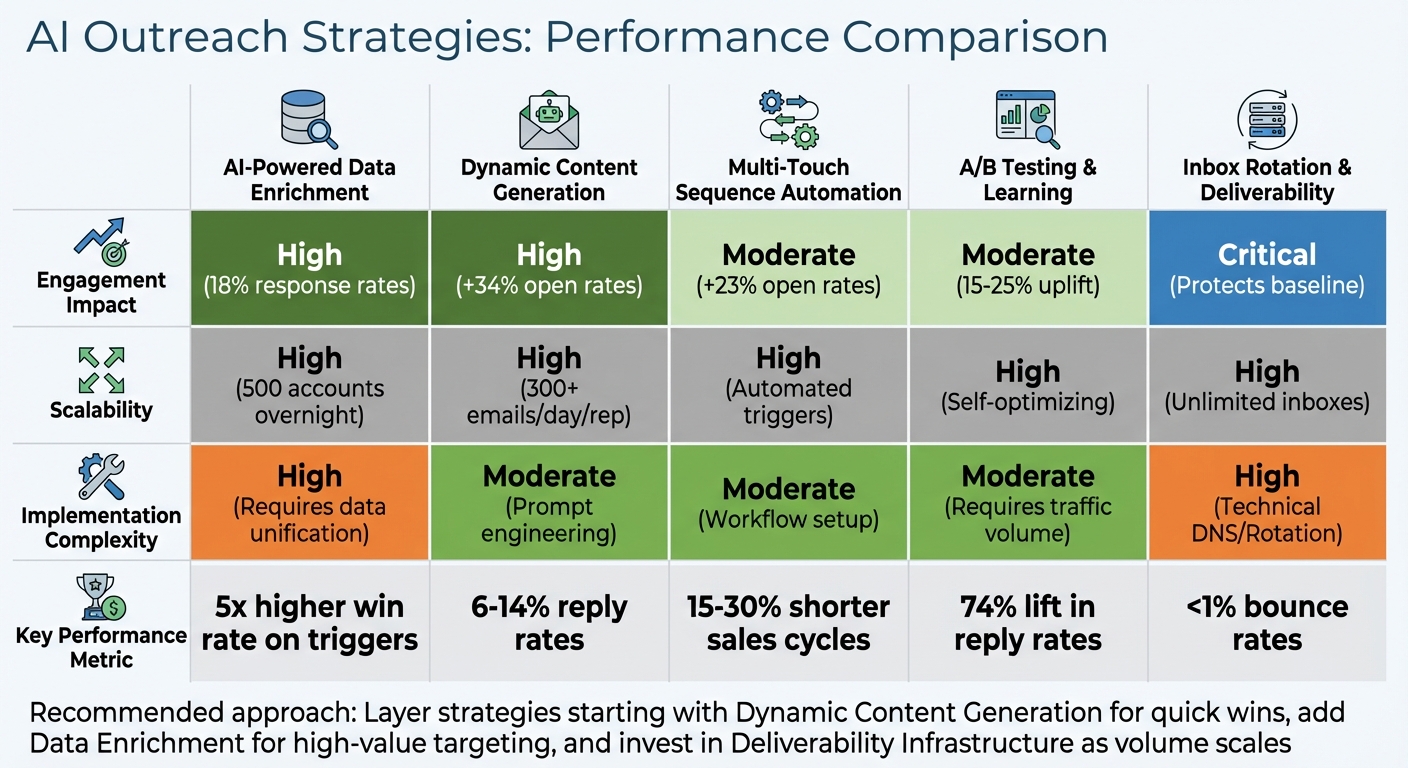
5 AI Outreach Strategies: Engagement Impact, Scalability & Implementation Comparison
The table below provides a quick overview of the five AI strategies discussed earlier, comparing their effects on engagement, scalability, and implementation complexity. Each strategy plays a unique role in supporting personalized, scalable outreach campaigns. This comparison can help agencies managing high-volume outreach identify which approaches best align with their goals and resources.
| Strategy | Engagement Impact | Scalability | Implementation Complexity | Key Performance Metric |
|---|---|---|---|---|
| 1. AI-Powered Data Enrichment | High (18% response rates) | High (500 accounts overnight) | High (Requires data unification) | 5x higher win rate on triggers |
| 2. Dynamic Content Generation | High (+34% open rates) | High (300+ emails/day/rep) | Moderate (Prompt engineering) | 6–14% reply rates |
| 3. Multi-Touch Sequence Automation | Moderate (+23% open rates) | High (Automated triggers) | Moderate (Workflow setup) | 15–30% shorter sales cycles |
| 4. A/B Testing & Learning | Moderate (15–25% uplift) | High (Self-optimizing) | Moderate (Requires traffic volume) | 74% lift in reply rates |
| 5. Inbox Rotation & Deliverability | Critical (Protects baseline) | High (Unlimited inboxes) | High (Technical DNS/Rotation) | <1% bounce rates |
AI-powered data enrichment stands out for its ability to drive response rates by leveraging real-time signals, although it demands a robust infrastructure to unify data from various sources. Dynamic content generation strikes a balance between ease of implementation and impact, with AI-driven subject lines boosting open rates by 34% on average. Multi-touch sequence automation is effective for shortening sales cycles, while A/B testing delivers consistent, incremental improvements through optimization. Lastly, inbox rotation and deliverability ensure your outreach avoids spam filters, maintaining the integrity of your campaigns.
For many agencies, a layered approach works best: start with dynamic content generation for quick wins, add data enrichment for targeting high-value accounts, and invest in deliverability infrastructure as your outreach scales. This combination not only boosts reply rates but also safeguards your sender reputation over time.
Conclusion
The five AI-driven strategies discussed – data enrichment, dynamic content generation, multi-touch automation, A/B testing, and deliverability infrastructure – can transform high-volume outreach into a precise and effective process. By combining these techniques, agencies can scale from sending 100 to over 1,000 personalized emails weekly without increasing their team size. Even better, they meet the “Show Me You Know Me” standard that modern B2B buyers expect.
The shift from generic templates to signal-based personalization isn’t just a trend – it’s a necessity. Cold email reply rates have plummeted from 8.5% in 2019 to about 4% in 2026. Meanwhile, signal-personalized emails now see an impressive 18% response rate, with 73% of B2B buyers actively disregarding generic outreach. These numbers prove that relevance beats volume every time.
To succeed, agencies should layer their efforts: start with dynamic content generation for quick wins, leverage data enrichment to focus on high-value accounts with real-time triggers, and invest in a strong deliverability infrastructure as outreach volume grows. A Human-in-the-Loop (HITL) approach ensures personalization stays authentic and effective.
For agencies operating on platforms like Upwork, tools like Convertix.io offer a competitive edge. By automating job matching and proposal generation with a portfolio-focused strategy, agencies with up to 50 employees can send up to 600 tailored proposals monthly – maintaining both quality and relevance to turn leads into clients.
As the market evolves, agencies that embrace these AI strategies will thrive. In a world where relevance matters more than sheer numbers, these approaches provide the foundation for long-term success.
FAQs
How do I keep AI personalization from sounding fake?
To make AI-driven personalization feel genuine, blend automation with a touch of human insight. Reference specific details about the recipient – such as recent accomplishments, events, or unique characteristics – to make your outreach feel personal. While AI can generate the core content, adding manual tweaks ensures the message feels credible and relevant. This balance keeps your communication from coming across as overly generic or templated, helping it feel more authentic.
What should I automate first to reach 1,000 emails a week?
To hit the goal of sending 1,000 emails a week, focus on automating your outreach while keeping personalization front and center. Leverage AI-powered tools to segment your email list and craft messages tailored to each recipient. Once your content is ready, set up automated workflows to manage the high volume. This approach helps you scale your efforts, ensuring your emails remain engaging and maintain strong deliverability rates – all without sacrificing quality.
How do I scale inbox rotation without hurting deliverability?
Think of your inboxes as a diversified portfolio – each one playing a role in maintaining balance and performance. To scale effectively while protecting deliverability, segment inboxes based on factors like domain age, email provider, and health score.
Here’s how to keep things running smoothly:
- Adjust sending rates dynamically: Keep an eye on bounce rates and spam complaints. If trends shift, tweak your sending volumes accordingly.
- Monitor key metrics: Regularly track placement, bounces, and complaint rates. These indicators will guide you in managing inbox health.
- Reassign inboxes smartly: Use data to shuffle inboxes between pools such as Primed, Ramping, and Resting. This ensures that no inbox is overused or underperforming.
By reacting to real-time data, you can scale your efforts while safeguarding your sender reputation.
